
Microsoft's VibeVoice-ASR Transcribes 60-Minute Meetings in One Pass, Beating Gemini
Microsoft Research released a 9B-parameter unified speech model that transcribes a full hour of audio in one pass, tagging who spoke, when, and what.
Takeaways
- Microsoft Research released VibeVoice-ASR, a 9B unified speech model transcribing 60 minutes of audio in one pass. Weights
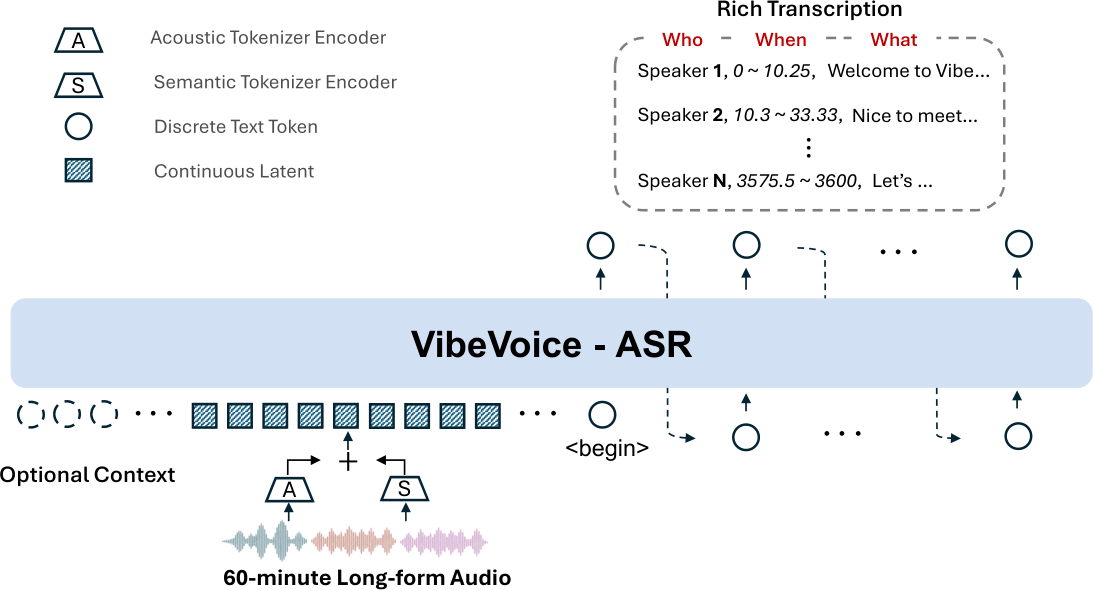
- Jointly produces transcription, speaker diarization, and timestamps as a single interleaved Rich Transcription stream.
- 7.5 Hz continuous speech tokenizer compresses one hour of audio into 27,000 tokens, fitting a 64K LLM context.
- Prompt-based hotword injection improves domain terminology accuracy without any fine-tuning or retraining.
- Beats Gemini-2.5-Pro and Gemini-3-Pro on DER and tcpWER across AMI, AliMeeting, AISHELL-4, and MLC benchmarks.
- Open-sourced under MIT with vLLM inference, fine-tuning code, and Foundry Model Catalog availability. GitHub
Speech recognition has gotten remarkably good at short clips, but hand it a two-hour meeting or a rambling podcast and most systems still fall apart. The industry workaround has been to chop audio into 30-second slices, transcribe them independently, then stitch results back together with a separate diarization model. Microsoft Research just released a system that treats that entire pipeline as a single generation task.
VibeVoice-ASR is a 9B parameter unified speech recognition model capable of processing up to 60 minutes of audio in a single pass, jointly completing recognition, speaker diarization, and timestamping in one inference process. It sits in a single repository that hosts Text-to-Speech, real time TTS, and Automatic Speech Recognition models under an MIT license.
Why chunking breaks long audio
The dominant approach to long recordings is a cascaded pipeline: voice activity detection cuts speech into sub-30-second segments, an ASR model transcribes each one, and a separate diarization stack clusters speaker embeddings across segments. This divide-and-conquer strategy has two structural failures.
- Context fragmentation. Independently processing segments severs global semantic dependencies. Homophones, coreferences, and named entities that only make sense across sentence boundaries get mangled.
- Pipeline complexity. ASR, diarization, and timestamping are handled by disjoint models, and a failure in segmentation or diarization propagates into the final transcript. Instead of slicing audio into short segments and reconciling results afterward, the model processes long recordings holistically, preserving global context across the entire conversation.
The compression trick that makes it fit
The core insight is that if you can compress audio aggressively enough, an entire hour fits inside a single LLM context window. VibeVoice uses continuous speech tokenizers that run at 7.5 Hz and a next-token diffusion framework where a Large Language Model reasons over text and dialogue and a diffusion head generates acoustic detail. At 7.5 tokens per second, sixty minutes of 24 kHz audio becomes just 27,000 tokens, which slots comfortably into a 64K context.