
MobileLLM-Flash Runs 1.8x Faster Than LFM2 on Real Phones
Researchers introduce a hardware-in-the-loop architecture search that produces mobile-ready language models running up to 1.8x faster on phone CPUs.
Takeaways
- Researchers publish MobileLLM-Flash, a family of 350M, 650M, and 1.4B mobile-optimized LLMs.
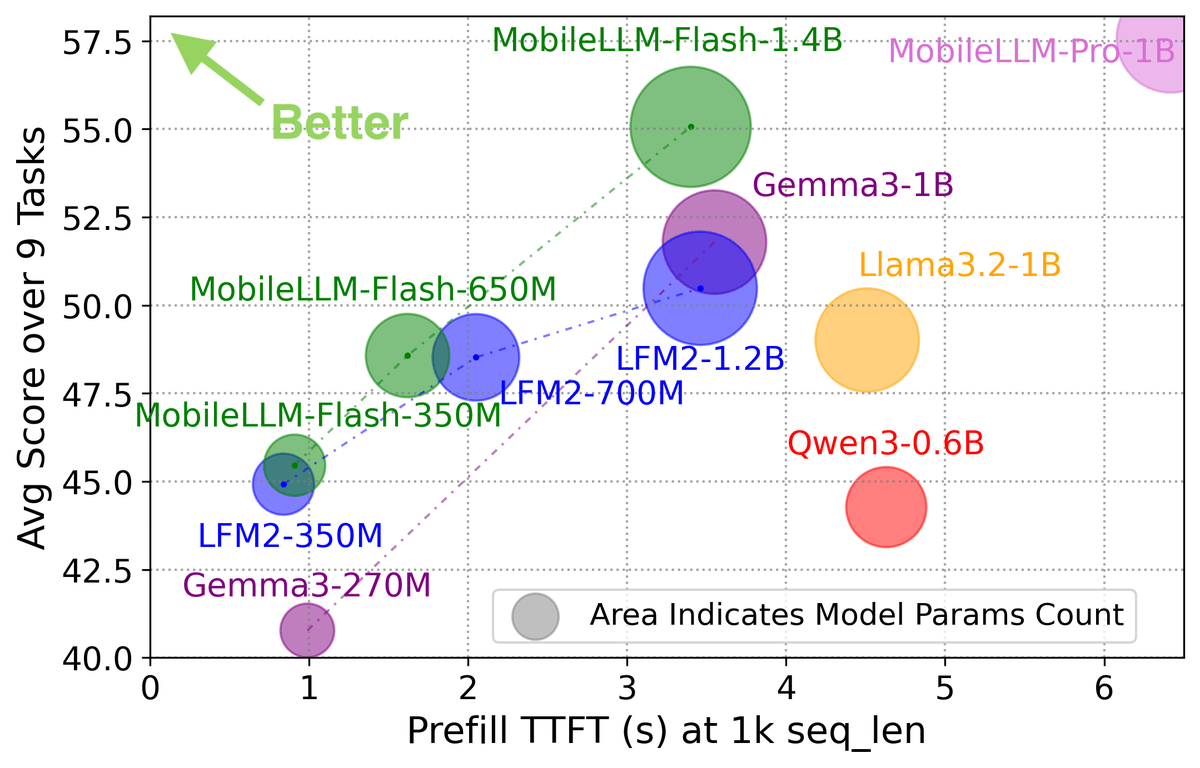
- Up to 1.8x faster prefill and 1.6x faster decode than LFM2 on mobile CPUs.
- Two-stage Bayesian optimization search uses real phone latency, not FLOPs, as the objective.
- Parameter count vs measured latency correlation is only 0.40 Kendall tau - FLOPs are not enough.
- Skip attention beat sliding-window attention on ExecuTorch; shallow-and-wide beat deep-and-thin at low latency.
- Accepted to ACL 2026 Industry Track; runs on ExecuTorch without custom kernels.
A team of researchers has published a paper describing MobileLLM-Flash, a family of small language models designed by treating on-device latency itself as an optimization target rather than a downstream concern. The work, accepted to the ACL 2026 Industry Track, argues that the usual proxies developers rely on when shrinking models for phones, namely parameter count and FLOPs, are surprisingly poor predictors of what a Snapdragon or Apple CPU actually does with the graph.
The three released sizes (350M, 650M, and 1.4B) are pruned out of a shared 1.8B backbone and, according to the paper, deliver up to 1.8x/1.6x faster prefill and decode speeds than LFM2 on mobile CPUs while matching or beating it on accuracy. The authors constrain themselves to operators that ExecuTorch already supports, so the models drop into standard mobile runtimes without custom kernels.
When FLOPs stop predicting wall-clock time
The paper's opening argument is that most efficient LLM work optimizes the wrong thing. When the authors benchmarked 100 candidate architectures on a Samsung Galaxy S25 exported via ExecuTorch, they found the Kendall tau correlation between parameter count and measured prefill latency was only 0.40, and FLOPs against prefill latency landed at 0.46. Decode showed a similar pattern. Two models with the same parameter budget can differ substantially in wall-clock time depending on shape, attention pattern, and how the graph maps to the CPU.
That mismatch motivates the core methodology: put a real phone in the loop and let a Bayesian optimizer search the design space using measured time-to-first-token rather than a theoretical proxy.