
NVIDIA's Hydra-0 Teaches Any Robot by Watching Human Hands Move
A research team proposes representing robot actions as pixel-space motion, letting one world model learn from human, single-arm, and bimanual data alike.
Takeaways
- Researchers introduce Hydra-0, a world model that represents robot actions as pixel-space motion flow across the image.
- The approach unifies human, single-arm, bimanual, and handheld-gripper data in one shared training signal.
- Reports 90.4% lower robot-motion error and 60.2% lower object-motion error versus an action-conditioned baseline.
- Trained on 7 datasets, 178K episodes, 1.56M video windows, over 2,200 hours of interaction video.
- Emergent inverse mode converts human demonstration object flow into executable robot actions without expert demos.
- Paper and project page available online.
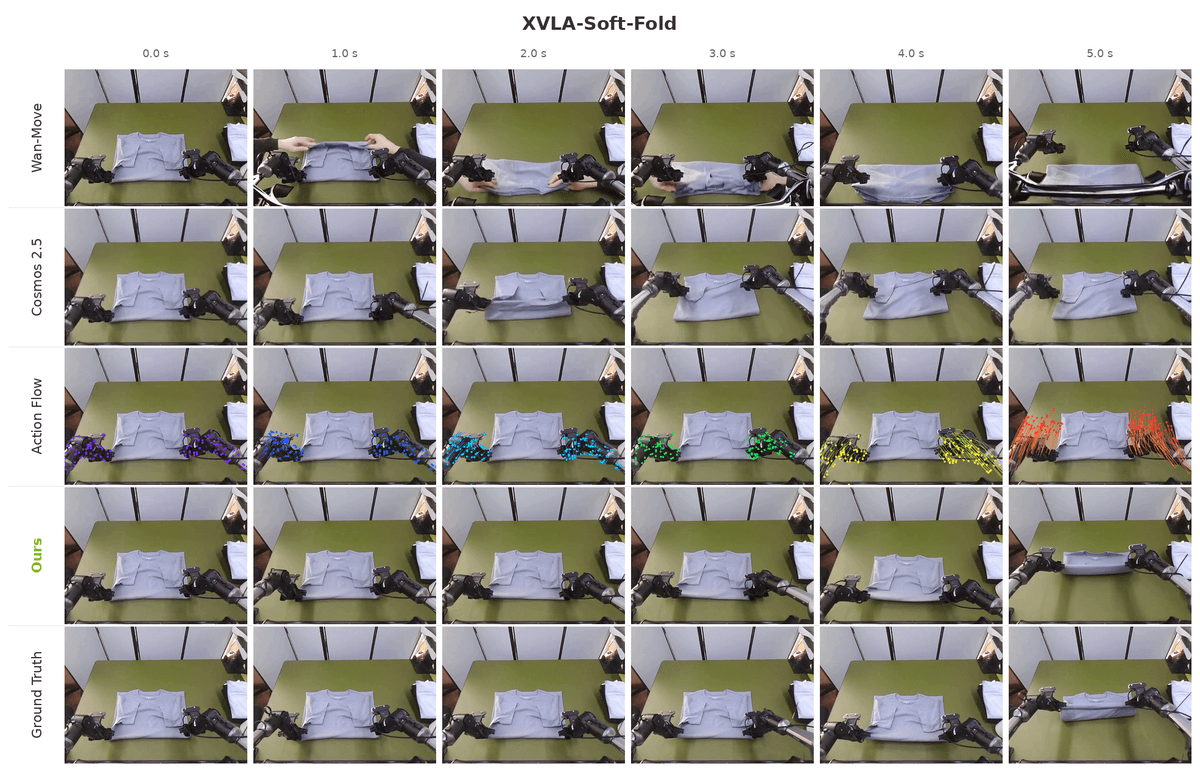
A team of researchers from Brown, MIT, Columbia, and NVIDIA has published a paper introducing Hydra-0, a world model that sidesteps one of robotics' most stubborn problems: the fact that every robot speaks its own language. Their proposal is to stop describing actions with joint angles or end-effector coordinates and start describing them as pixel motion in the camera image, a representation they call action flow.
The payoff is a single model that trains across human hands, handheld grippers, single-arm robots, and bimanual robots without adapters or per-robot heads, delivering 90.4% lower robot-motion error and 60.2% lower object-motion error than an action-conditioned baseline. It also displays a strange emergent trick: run the interface backward, and it can propose robot motions that imitate a human demonstration.
Why joint angles are a dead end for generalist robots
A world model in robotics is a learned simulator that predicts what the next video frame will look like given the current frame and a proposed action. It is the engine behind planning, policy evaluation, and increasingly real control. The catch: most robot world models are conditioned on joint positions or end-effector commands, representations tied to a specific embodiment. A gripper command on a Franka arm and a UR5 arm can look identical in the action space but produce completely different pixels on screen.
That mismatch has forced the field to train a separate model per robot or bolt on embodiment-specific projection heads, throwing away the ability to learn from the enormous pool of human video and cross-robot data sitting on the internet.
Actions as pixels
Hydra-0's core idea is to move the action into the same coordinate system as the observation. Instead of feeding the model six joint angles, the team projects the commanded motion of visible robot points into the image plane and hands the model a dense pixel-space trajectory: where each visible part of the robot should be a moment from now. The next-frame prediction task then becomes purely visual.