
ReDSR Beats GAN Rivals at 4x Image Restoration With 7.4M Parameters
ReDSR trains a Mamba-based super-resolution network that learns degradation by reproducing the low-res input, beating prior blind SR baselines across benchmarks.
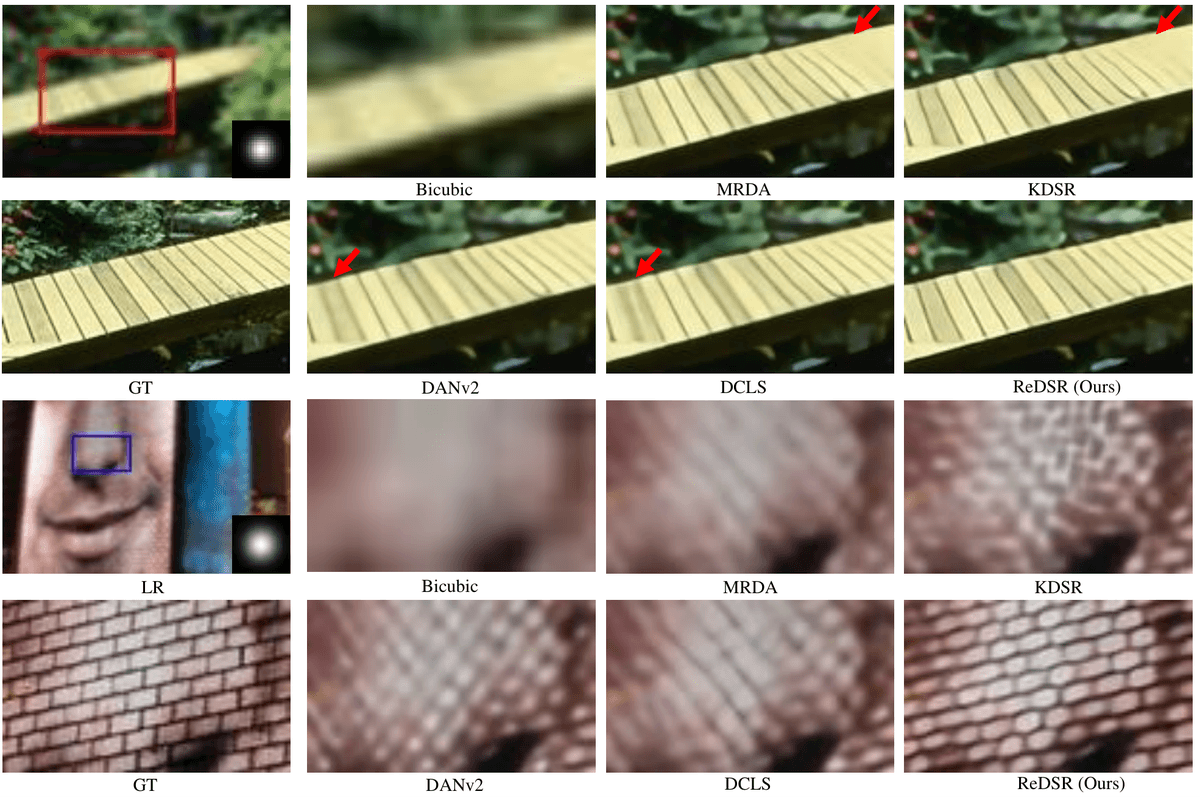
Takeaways
- ReDSR learns degradation representations by reproducing LR images instead of contrastive discrimination.
- Energy-distance loss aligns the representation with a Gaussian prior for better generalization to unseen degradations.
- Degradation-aware Mamba block predicts SSM parameters from the degradation vector and uses zigzag scan for spatial continuity.
- Achieves state-of-the-art PSNR on Set5, Set14, B100, Urban100, Manga109 for 4x blind SR at 43ms per image.
- Beats Real-ESRGAN and BSRGAN on AIM2019 and NTIRE2020 with roughly half the parameters and a quarter of the latency.
- Code and pretrained weights are not yet publicly released alongside the arXiv paper.
Blind image super-resolution is the messy version of a well-studied problem: you get a low-resolution photo, you have no idea what blur kernel, noise, or compression pipeline mangled it, and you still need to reconstruct a clean high-resolution output. A new paper from Hongda Liu and colleagues, Preserving Full Degradation Details for Blind Image Super-Resolution, proposes ReDSR, a framework that learns degradation by trying to reproduce the corrupted input rather than merely tell corruptions apart, and pairs that with a Mamba-style backbone tuned for image restoration.
Why contrastive degradation learning hits a wall
Classical blind SR pipelines first estimate the degradation kernel, then condition an SR network on that estimate. That works when the estimator is accurate, but small errors get amplified into artifacts. A newer line of work, kicked off by DASR, dropped explicit estimation in favor of learning distinct representations by distinguishing different degradations in a batch, which risks the most significant degradation differences providing shortcuts so subtle differences get discarded.
In practice this shows up as representation collapse: the learned degradation representations exhibit strong bias towards significant difference and cannot well capture the subtle degradation difference, resulting in limited generalization performance. If two blurs are close in kernel space, contrastive training has no incentive to separate them.