
Stanford Researchers Argue VLAs Alone Won't Build Truly Capable Robots
A new position paper from researchers at Stanford, ETH Zurich, and UCL argues that scaling VLA models alone won't get us to generalist robots — and maps out the four missing pieces.
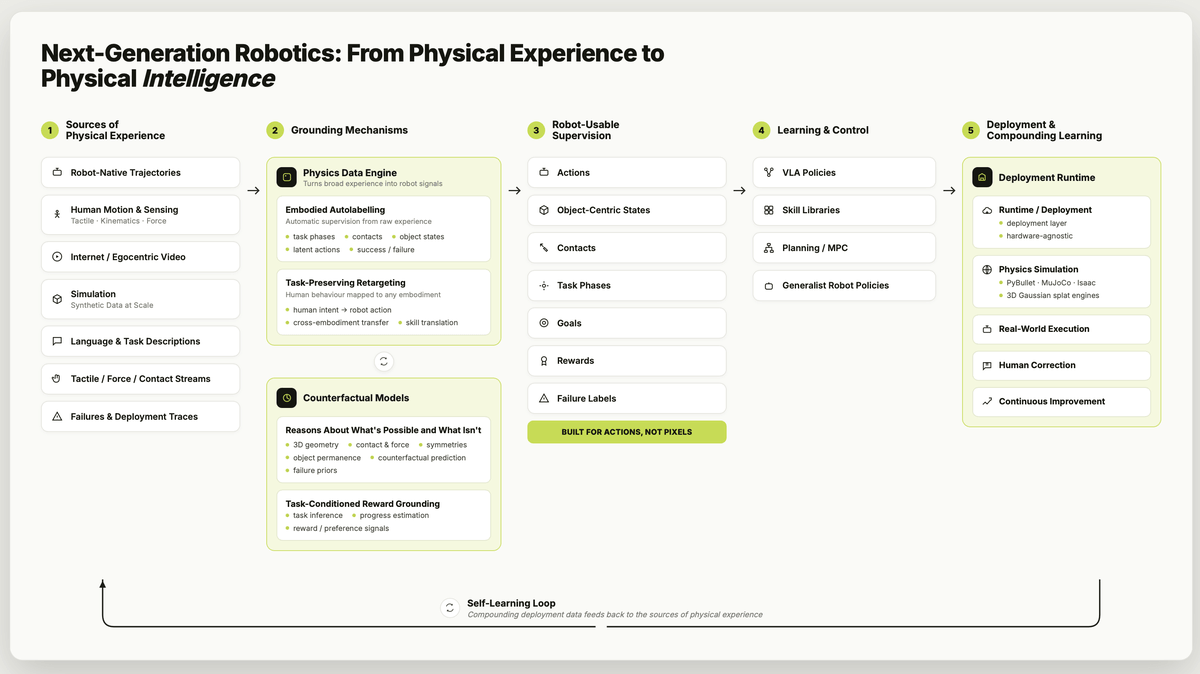
The dominant playbook for generalist robotics right now is simple: collect more robot demonstrations, train a bigger Vision-Language-Action (VLA) model, and hope for broader generalization. A new position paper from researchers at Stanford, ETH Zurich, the Italian Institute of Technology, and UCL argues that this framing is fundamentally incomplete , and that the field is missing something more structural than model scale.
The central bottleneck is not only policy learning, but the absence of mechanisms that convert the world's abundant unstructured behavioural data into grounded robot supervision. The paper, titled Robots Need More Than VLAs & World Models, is a survey and research agenda rolled into one. It comes from researchers affiliated with Motoniq.ai alongside academics from some of the top robotics labs in the world.
The data problem hiding in plain sight
To understand the argument, you need to understand what VLA models actually are. VLA models integrate visual perception, natural language understanding, and robotic action into a unified framework, enabling machines to perform complex tasks in dynamic, unstructured environments. Models like