
Tencent Proves Three AI Judges Agreeing on Quality Means Almost Nothing
A 105,600-instance study finds that LLM judges agree by defaulting to shared surface heuristics, and a knowledge-grounded rubric method breaks the illusion.
Takeaways
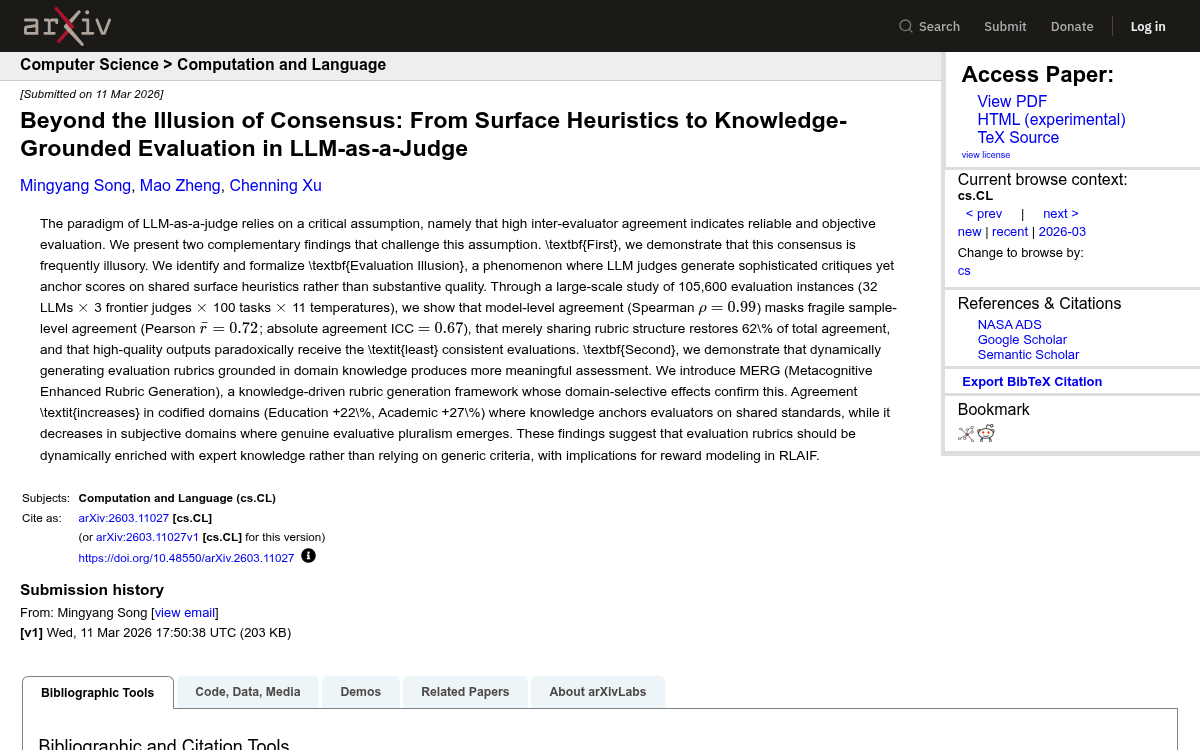
- Tencent study of 105,600 evaluations shows LLM judge agreement often reflects shared surface heuristics, not real quality assessment.
- Model-level Spearman hits 0.99 but sample-level Pearson averages 0.72 and ICC drops to 0.67, the Resolution Paradox.
- Sharing only rubric dimension names accounts for 62% of inter-judge agreement, exposing the Rubric Commensurability Problem.
- Higher-quality outputs paradoxically receive less consistent evaluations (quality vs agreement rho = -0.513).
- MERG framework forces judges through knowledge activation and bias reflection before scoring, changing agreement by -22% to +27% depending on domain.
- Reward models trained on MERG preferences resisted overoptimization roughly three times longer than baseline in early RLAIF tests.
The industry has been running on a comforting assumption: if three frontier models independently give a text similar scores, they must be picking up on something real about quality. A new study from Tencent's Large Language Model Department argues that assumption is largely wrong, and it has the numbers to back it up.
In Beyond the Illusion of Consensus, the authors run 32 LLMs spanning Base, Instruct, and Thinking tiers, 3 frontier judges (Claude 4.5 Opus, Gemini 2.5 Pro, GPT-5.1), 100 diverse writing tasks, and 11 temperature settings, yielding 105,600 evaluation instances. The finding: agreement between LLM judges is often what they call an Evaluation Illusion, where the critiques sound sophisticated but the scores are anchored on formatting, fluency, and confident tone.
The consensus is thinner than it looks
The paper cracks the notion of "evaluator agreement" into three levels and shows they tell very different stories. Model-level Spearman rank correlation is near-perfect (0.989 at temperature 0.0), but sample-level Pearson agreement averages only 0.72, and absolute agreement measured by ICC drops to 0.67. In other words, judges reliably agree on which model is better overall, but disagree substantially on individual outputs, which is exactly the granularity RLAIF reward models operate at.
The authors call this the Resolution Paradox. Leaderboards validate evaluators at the macro-resolution where the system reliably distinguishes coarse quality tiers (Base vs. Thinking, Cohen's d = 2.58), but RLAIF deploys them at per-sample micro-resolution, the very granularity where the illusion is strongest and fine-grained signals are unreliable.
Even more troubling: output quality and evaluator agreement are negatively correlated (Spearman rho = -0.513, p = 0.003). Base models elicit r = 0.81 while Thinking models elicit only r = 0.76. Surface features are enough to identify obviously bad text, but once you're comparing genuinely capable models, judges fall back on heuristics and start disagreeing.