
0xSteph's Open-Source Toolkit Turns Claude Into 50 Hacking Specialists
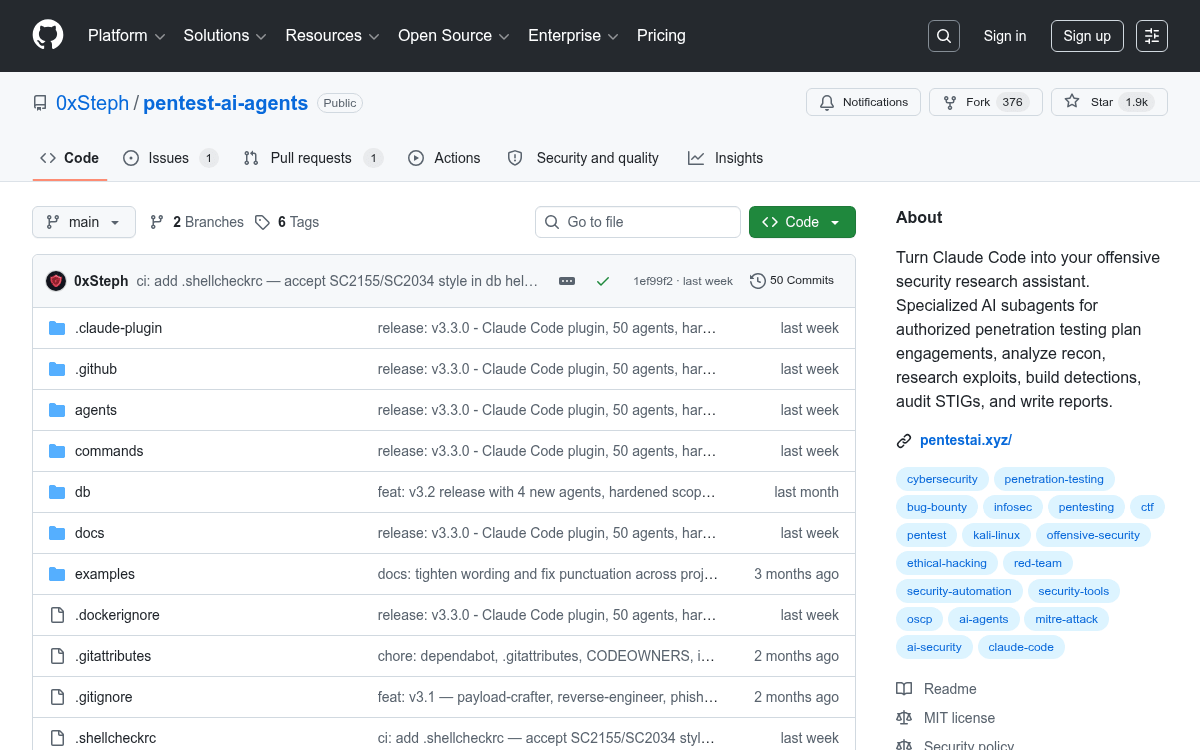
pentest-ai-agents turns Claude Code into a 28-agent red team swarm -- covering every phase from OSINT to reporting, with zero infrastructure and per-command human approval gates
Takeaways
- 28-to-50 agent growth: pentest-ai-agents now ships 50 Claude Code subagents covering every phase of a pentest, from OSINT to reporting. GitHub
- Two-tier execution model: Tier 1 agents advise; Tier 2 agents (recon, vuln scanner, AD attacker, exploit chainer) can run tools directly with per-command human approval.
- Zero infrastructure: Install is a single shell command or two Claude Code plugin lines -- no Python env, no Docker, no API keys beyond a Claude subscription.
- Dual offensive/defensive perspective: Every offensive technique ships with detection rules, log artifacts, and Sigma queries baked into the agent response.
- Companion MCP server: A separate pentest-ai MCP server exposes 150+ security tools for Claude Desktop, Cursor, and VS Code Copilot with autonomous exploit chaining.
- Local model support: Agent files are plain markdown; an adapter script converts them for Ollama or LM Studio for fully air-gapped deployments.
pentest-ai-agents is an open-source collection of Claude Code subagents built by security researcher 0xSteph that turns Claude into a structured offensive security assistant. The idea is simple: instead of asking a single general-purpose model to context-switch between writing Nmap commands, analyzing Active Directory paths, and drafting executive summaries, you get a swarm of specialists -- each one deeply tuned to a specific phase of a penetration test.
A swarm, not a chatbot
The toolkit transforms Claude Code into a fully specialized offensive security research assistant, automatically routing each query to the most appropriate specialist agent based on what you describe in plain English. Each subagent runs in its own context window with a custom system prompt, specific tool access, and independent permissions -- Claude delegates matching tasks to those subagents, which work independently and return results to the main conversation.
The repo has grown fast since launch. It started at 28 agents, expanded to 35, and now sits at 50 Claude Code subagents covering recon, web, Active Directory, cloud, mobile, wireless, social engineering, payload crafting, reverse engineering, exploit chaining, detection engineering, forensics, and more.
What the agents actually cover
The roster splits into three categories. On the offensive side:
- Engagement Planner -- builds phased pentest plans with MITRE ATT&CK technique mappings and time estimates
- Recon Advisor -- parses output from Nmap, Nessus, BloodHound, and 20+ other tools, then prioritizes targets and recommends exact follow-up commands
- AD Attacker -- runs BloodHound, Impacket, CrackMapExec, and Certipy for Kerberoasting, DCSync, delegation abuse, and certificate attacks (ESC1-ESC8)
- Exploit Chainer -- takes isolated low-severity findings and autonomously chains them into a full compromise path, scoring each chain by reach, reliability, stealth, and speed
- PoC Validator -- generates and safely executes non-destructive proof-of-concept scripts to kill false positives before they waste time