
ACE Studio's ACE-Step 1.5 Beats Commercial Music AI Running on Your Own GPU
ACE-Step 1.5 is a free, MIT-licensed music generation model that beats most commercial tools on benchmarks and runs on consumer GPUs with under 4GB VRAM.
Takeaways
- Benchmark leader: ACE-Step 1.5 scores 8.09 on SongEval and ranks between Suno v4.5 and v5 in blind human evaluations.
- Extreme speed: Generates a full song in under 2 seconds on an A100 and under 10 seconds on an RTX 3090, using only 4GB VRAM.
- Hybrid LM + DiT architecture: A Qwen3-based language model acts as a composer planner; a 2B DiT handles acoustic rendering — each specialized for its role.
- Full editing toolkit: Supports cover generation, repainting, vocal-to-BGM, stem separation, LoRA fine-tuning, and a VST3 DAW plugin.
- Free and MIT-licensed: Runs locally with no API costs; weights on Hugging Face; commercial use permitted.
- Known weaknesses: Vocal tracks can exhibit metallic artifacts and pitch glitches; style/lyric alignment still trails Suno v5.
ACE-Step 1.5 is the open-source music generation model that the community has been waiting for. Built by ACE Studio and StepFun, it crosses a threshold that previous open models couldn't reach: commercial-grade audio quality running entirely on your own hardware, no subscription required. With over 11,000 GitHub stars and 1,400 forks, it's become the fastest-growing open music model in the space.
Speed that changes the workflow
ACE-Step v1.5 achieves quality beyond most commercial music models while remaining extremely fast , under 2 seconds per full song on an A100 and under 10 seconds on an RTX 3090. That's not a cherry-picked demo clip , that's a full song. The model runs locally with less than 4GB of VRAM, and supports lightweight personalization: users can train a LoRA from just a few songs to capture their own style.
For context, the turbo variant achieves this by compressing the diffusion process from 50 denoising steps down to just 8, using a technique called Adversarial Dynamic-Shift Distillation. The result is a 200x speedup over the base model, without the quality loss you'd normally expect from that kind of compression.
A hybrid brain: planner + renderer
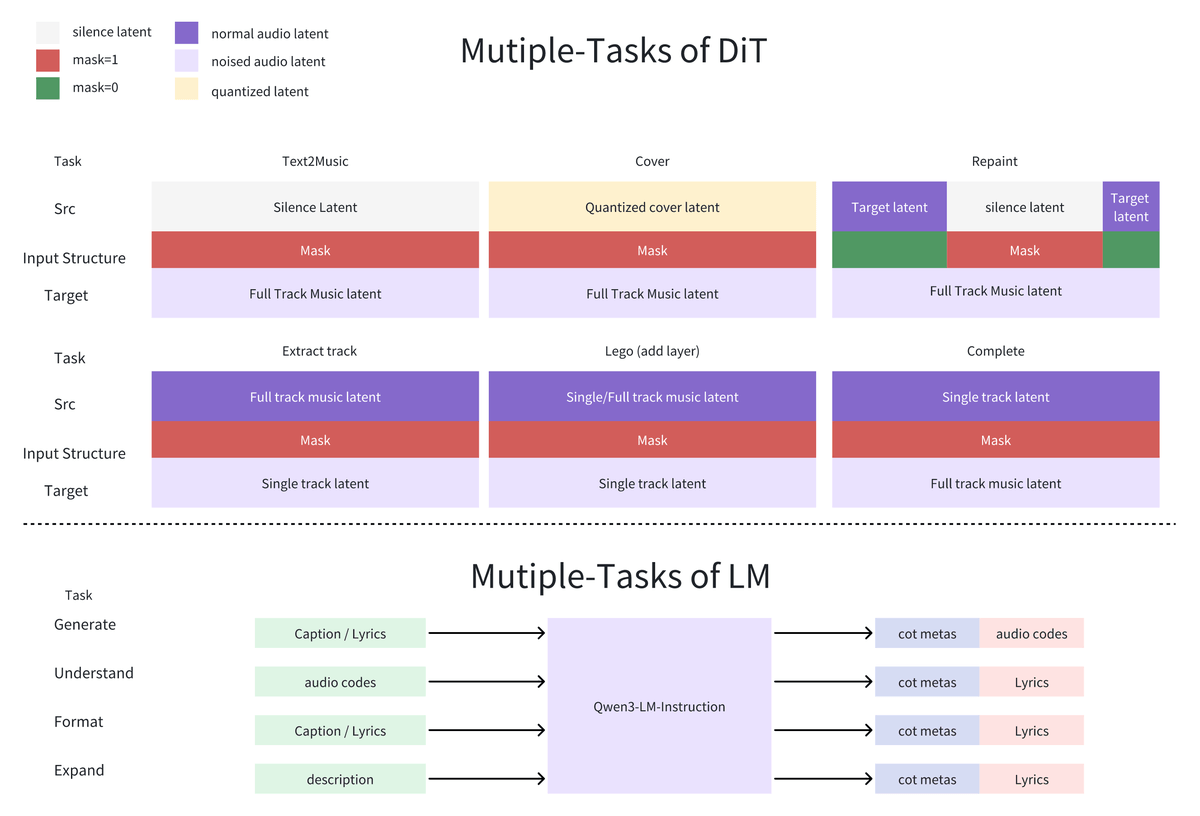
The architecture is the real story here. Most music generation models are end-to-end black boxes , you put text in, audio comes out, and the model handles everything in one shot. ACE-Step 1.5 takes a different approach by splitting the job into two specialized components.
- Language Model (LM) as Composer Agent: A Qwen3-based LM acts as a high-level planner. It takes your vague prompt and expands it into a structured song blueprint , BPM, key, duration, lyrics, structure , all in a Chain-of-Thought YAML format before the audio is ever generated.
- Diffusion Transformer (DiT) as Acoustic Renderer: A ~2B parameter DiT receives the structured blueprint and focuses exclusively on generating high-fidelity audio. Because it gets clean, unambiguous instructions, it can specialize on acoustic quality rather than semantic interpretation.
- 1D Waveform VAE: Instead of the mel-spectrogram representations that plagued earlier models (including ACE-Step v1.0), v1.5 uses a pure waveform-domain 1D VAE that compresses 48kHz stereo audio into a compact latent space, preserving transients, bass clarity, and vocal separation that mel-spectrograms routinely destroy.