
AEON-7's Ornith-1.0 Runs 3x Faster With Zero Refusals and No Capability Loss
AEON-7 abliterates Ornith-1.0-35B with zero capability loss, then squeezes 3x faster decode on a DGX Spark via NVFP4 + DFlash speculative decoding.
Takeaways
- Zero refusals, zero capability loss: AEON-7 abliterated Ornith-1.0-35B to 0/80 refusals while keeping agentic coding pass@1 at 0.833 (identical to base) and KL ≈ 0.0014.
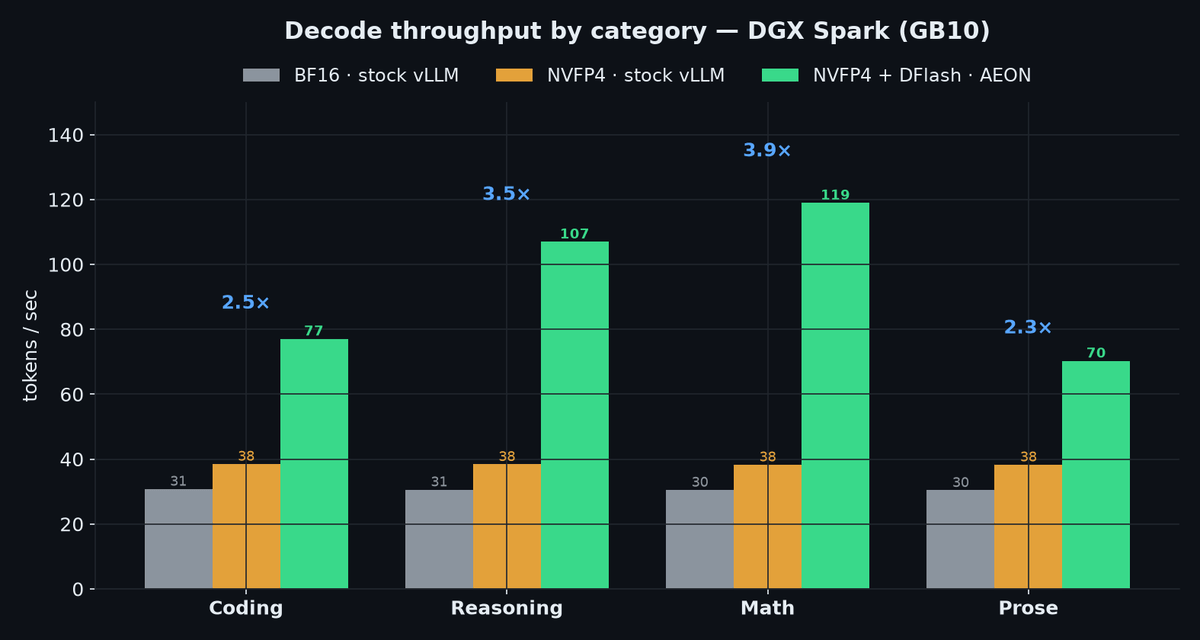
- 3x faster on DGX Spark: NVFP4 + DFlash speculative decoding delivers 93 tok/s avg decode vs. 30 tok/s on stock BF16 vLLM — a 3.05x speedup.
- Two weight variants: BF16 (~66 GB) for any vLLM GPU, NVFP4 (~23.7 GB) for Blackwell only (B200, GB10).
- Novel abliteration pipeline: Expert-Granular Abliteration across all 256 MoE experts + SSM conv1d outlier repair before editing — first known abliteration of a hybrid GatedDeltaNet MoE.
- Base model is SOTA: Ornith-1.0-35B scores 64.2 on Terminal-Bench 2.1, beating Qwen 3.5-397B (53.5) at a fraction of the parameters, with 256K context and vision.
- MIT licensed, fully open: Weights, recipe config, and DGX Spark QuickStart are all public on GitHub.
Ornith-1.0-35B AEON Ultimate Uncensored is a community release that takes DeepReinforce's brand-new state-of-the-art agentic coding model, surgically removes every refusal behavior, and then squeezes out 3x the decode speed on NVIDIA's DGX Spark , all without touching coding capability. It is the most technically detailed uncensored model release in recent memory, and it doubles as a practical performance guide for Blackwell hardware.
The base model is already a big deal
Ornith-1.0 is a self-improving family of open-source models for agentic coding, available in 9B Dense, 31B Dense, 35B MoE, and 397B MoE sizes, post-trained on Gemma 4 and Qwen 3.5, achieving state-of-the-art performance among open-source models of comparable size on benchmarks like Terminal-Bench 2.1 and SWE-Bench Verified. The key architectural trick is that the 35B variant is a Mixture-of-Experts model with 35B total parameters, but only ~3B are active per token , your model has a brain the size of 35B, but for any given thought, it only fires up the 3B neurons that matter, saving compute.
The key innovation behind Ornith-1.0 is a self-improving training framework: instead of relying on human-designed harnesses to drive solution generation in RL, Ornith-1.0 learns to generate both solution rollouts and the task-specific harnesses that guide those rollouts, jointly optimizing the scaffold and the resulting solution so the model can discover better search trajectories. The results are strong: Ornith-1.0-35B significantly outperforms similarly sized models including Qwen 3.5-35B and Gemma 31B, and despite having only 35B parameters, it even surpasses Qwen 3.5-397B on Terminal-Bench 2.1 (64.4 vs. 53.5).
What abliteration actually does
Abliteration is a model-editing technique, not a jailbreak prompt. It is used to create uncensored LLMs by removing a refusal-related signal from a model's internal representations, and because it changes internal behavior rather than prompt phrasing, it is often more stable than jailbreaks across sessions and prompts. Concretely, by identifying and removing a specific "refusal direction" in the model's activation space, you can make the model respond to harmful requests that it would normally refuse , without the need for retraining.