
AI4Finance's FinGPT Beats GPT-4 on Sentiment for $300 Instead of $3M
FinGPT brings open-source, LoRA-powered financial LLMs to anyone with a GPU — beating GPT-4 on sentiment at under $300 per fine-tune
Takeaways
- FinGPT is a free, MIT-licensed framework for fine-tuning LLMs on financial tasks, built by the AI4Finance Foundation.
- Uses LoRA fine-tuning to adapt models like Llama 3.1 for under $300 — vs. ~$3M for BloombergGPT.
- Introduces RLSP (Reinforcement Learning on Stock Prices), using actual market reactions as training signal instead of human feedback.
- Achieves 82.1% accuracy on financial sentiment, outperforming ChatGPT, FinBERT, and zero-shot Llama 3.1.
- Weak on complex numerical reasoning, multi-step financial QA, and long-form summarization.
- Pretrained adapters and demos available on GitHub and HuggingFace.
FinGPT is the open-source answer to a question the finance world has been quietly asking: why should cutting-edge financial AI be locked behind a $3 million training run? Built by the AI4Finance Foundation , a nonprofit backed by researchers from Columbia University and NYU Shanghai , FinGPT is a full-stack framework for building, fine-tuning, and deploying financial large language models. It now has over 20,000 GitHub stars and an active community pushing it into new territory, from stock forecasting to robo-advisory agents.
The Problem It Was Built to Solve
While proprietary models like BloombergGPT have taken advantage of their unique data accumulation, such privileged access calls for an open-source alternative to democratize internet-scale financial data. The issue is not just cost , it is also freshness. The finance domain presents unique challenges, including high temporal sensitivity, constant dynamism, and a low signal-to-noise ratio. A model trained once and left static quickly becomes stale in a market that moves by the minute.
BloombergGPT trained an LLM using a mixture of finance data and general-purpose data, which took about 53 days, at a cost of around $3M. It is costly to retrain an LLM model like BloombergGPT every month or every week, thus lightweight adaptation is highly favorable. FinGPT was designed from the ground up to flip that equation.
How It Actually Works
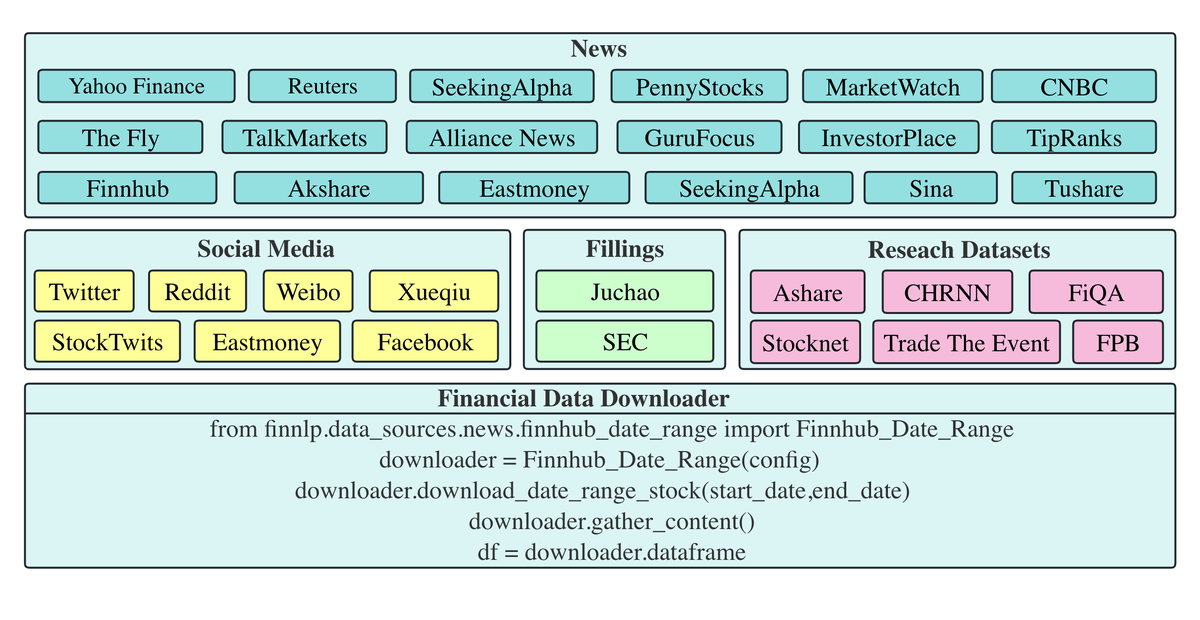
Unlike proprietary models, FinGPT takes a data-centric approach, providing researchers and practitioners with accessible and transparent resources to customize their financial LLMs. The framework is organized into five layers:
- Data source layer , pulls from financial news (Reuters, CNBC, Yahoo Finance), SEC filings, social media (Twitter, Reddit, Weibo), and academic datasets
- Data engineering layer , real-time NLP pipeline for cleaning, tokenizing, embedding, and filtering noisy financial text
- LLMs layer , fine-tuning via LoRA, QLoRA, RLSP, and RAG on top of open base models like Llama 3.1 and ChatGLM
- Tasks layer , standardized benchmarks for sentiment analysis, NER, summarization, numerical reasoning, and more