
Alibaba's Qwen3-ASR Beats GPT-4o Transcribe at a Fraction of the Size
Alibaba's Qwen3-ASR brings open-source speech recognition across 52 languages, beating GPT-4o Transcribe on key benchmarks at 1.7B parameters
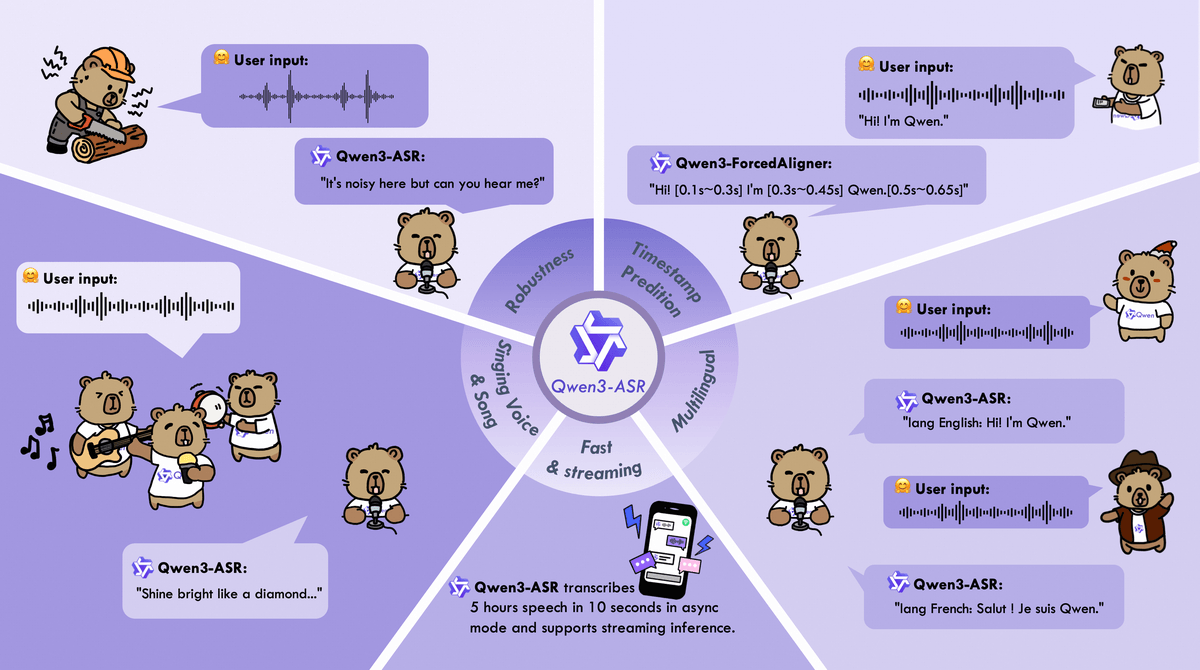
Takeaways
- Three models released: Qwen3-ASR-1.7B (flagship), Qwen3-ASR-0.6B (high-throughput), and Qwen3-ForcedAligner-0.6B (timestamp alignment).
- 52 languages and dialects supported, including 22 Chinese dialects and multi-accent English, in a single all-in-one model.
- Beats GPT-4o Transcribe and Whisper-large-v3 on most English, Chinese, and multilingual benchmarks (WER metric).
- Forced aligner is 3x more precise than WhisperX (42.9ms vs 133ms average error), and holds accuracy on 5-minute audio where others fail.
- Full inference toolkit ships with vLLM backend, OpenAI-compatible API, streaming support, Gradio demo, and fine-tuning scripts.
- Apache 2.0 license, free for commercial use; available on Hugging Face and via GitHub.
Qwen3-ASR is Alibaba Cloud's latest open-source speech recognition release, and it's a serious one. The Qwen team dropped a full family of ASR models , two transcription models (0.6B and 1.7B parameters) plus a novel forced-alignment model , all under the Apache 2.0 license. The 1.7B flagship beats Whisper-large-v3 across the board and trades blows with GPT-4o Transcribe and Gemini 2.5 Pro on multilingual benchmarks, despite being a fraction of the size.
No need to juggle multiple specialized models or build complex pipelines: a single Qwen3-ASR model handles language identification, multilingual transcription, and non-speech segment detection. That alone is a significant shift from how most production ASR pipelines are built today.
Three models, one toolkit
The release includes two production-ready ASR models (0.6B and 1.7B parameters) and a novel forced alignment model, all designed to work seamlessly across dozens of languages and acoustic environments. Here's what each one does:
- Qwen3-ASR-1.7B: The flagship. State-of-the-art accuracy, best for offline batch processing and high-quality transcription.
- Qwen3-ASR-0.6B: The efficient variant. Reaches 2000x throughput at a concurrency of 128 , making it suitable for real-time, high-volume workloads.
- Qwen3-ForcedAligner-0.6B: A non-autoregressive (NAR) model , meaning it generates all output tokens in parallel rather than one at a time , that aligns existing text transcripts to their audio timestamps. Supports up to 5 minutes of audio in 11 languages.
Both ASR models support language identification and speech recognition for 30 languages and 22 Chinese dialects, as well as English accents from multiple countries and regions. The full language list spans Arabic, German, French, Spanish, Japanese, Korean, Hindi, Vietnamese, and many more.
How it's built
The project emerges from Alibaba's broader Qwen3-Omni foundation model, leveraging massive-scale speech training data to achieve remarkable robustness. The architecture chains three components: an audio transformer (AuT) encoder that compresses raw audio into acoustic features, a cross-attention decoder that projects those features into the language model's embedding space, and the Qwen3 LM backbone that generates the final text output.