
Ant Group's LingBot-Video Opens a 30B Robot Physics Model to All
Ant Group's Robbyant open-sources a 30B MoE video model trained on 70,000+ hours of robot data to teach AI real physics
Takeaways
- First open-source MoE video model for robotics: LingBot-Video is a 30B-parameter MoE model that activates only 3B per step, giving ~3x faster inference than a dense 30B model.
- Trained on 70,000+ hours of robot data: Includes real manipulation, quadruped locomotion, and egocentric views to teach physical plausibility, not just visual quality.
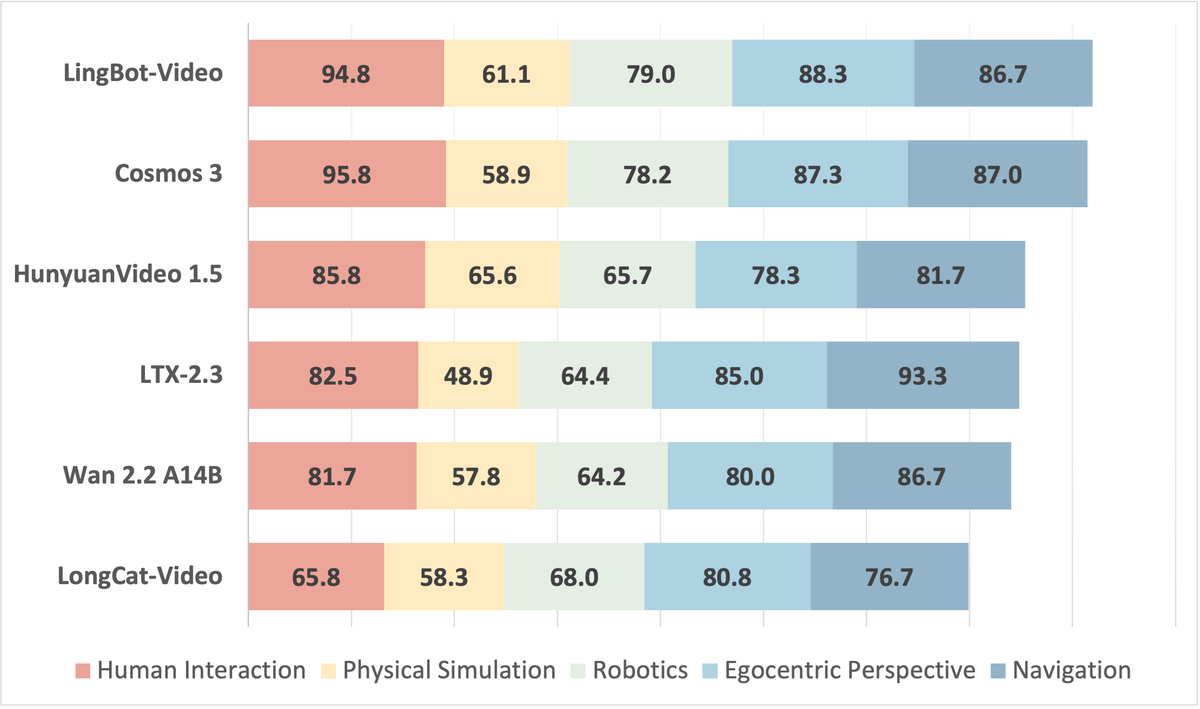
- Top of RBench leaderboard: Scores 0.620 average, leading all open-source models in manipulation, long-horizon, and quadruped tasks.
- Six-signal reward system: Uses GRPO with rewards for motion coherence, physical plausibility, and task completion — not just aesthetics.
- Fully open-source under Apache 2.0: Code, weights, and paper available on GitHub and Hugging Face.
- Part of Ant Group's embodied AI stack: Released alongside LingBot-World 2.0, with use cases spanning synthetic data generation, policy evaluation, and action planning.
LingBot-Video is the first open-source video generation model built on a Mixture-of-Experts (MoE) architecture specifically designed for embodied intelligence. Released by Robbyant, an embodied intelligence company within Ant Group, it takes direct aim at one of the hardest unsolved problems in robotics: teaching a video model what physics actually feels like, not just what it looks like.
LingBot-Video is the world's first open-source MoE video generation foundation model built specifically for embodied intelligence, delivering significant improvements in inference efficiency, physical plausibility, action comprehension, and task completion. The code, weights, and technical report are all available now under an Apache 2.0 license, free to use.
The problem with video models and robots
Standard video generation models are trained on internet video. They learn how the world looks, but not how it behaves. A robot policy trained on or evaluated against such a model will see convincing-looking outputs that violate basic physical constraints: objects that pass through each other, arms that teleport, or grasps that produce no reaction force. This is a fundamental gap between digital content creation and embodied AI.
LingBot-Video was redesigned for robotics use cases and is aimed at improving inference efficiency, physical plausibility, action comprehension, and task completion. The model is not meant to generate movie clips. It is meant to serve as a data engine, policy evaluator, and action-conditioned simulator for robot training pipelines.
30B parameters, 3B active: the MoE trick
MoE, or Mixture-of-Experts, is an architecture where the model is divided into many specialized sub-networks called "experts". For any given input, only a small subset of those experts are activated. This means you get the representational capacity of a large model at the compute cost of a much smaller one.
LingBot-Video's flagship model has 30 billion total parameters but only activates 3 billion per inference step. The architecture is scaled from scratch, balanced between capacity and cost, with approximately 3x faster inference. On long video sequences of 1 million tokens, this translates to a 3.18x speedup over a dense 30B model running the same workload. The team also trained a 120B version to validate that the scaling behavior stays consistent as the model grows.