
Ant Group's LingBot-World Turns a Single Image Into a Playable Open-Source World
Robbyant's LingBot-World is a fully open-source interactive world simulator that generates controllable video environments in real time, with sub-second latency and up to 10 minutes of coherent generation.
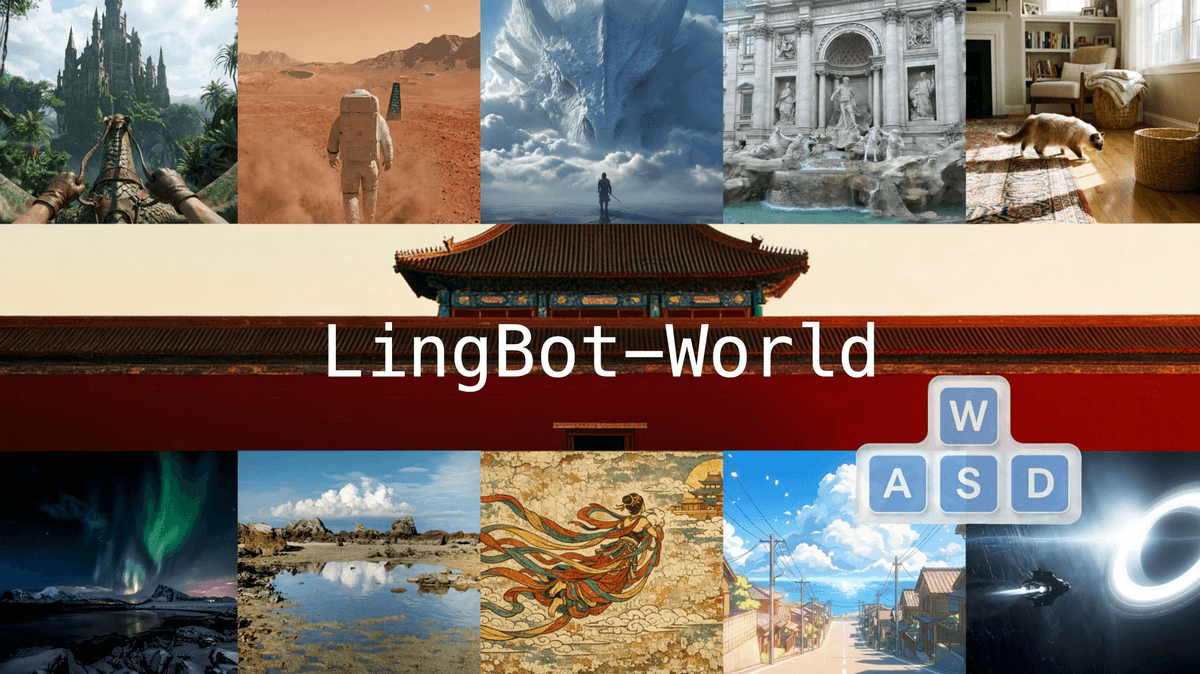
Takeaways
- Robbyant (Ant Group) open-sourced LingBot-World, a real-time interactive world simulator built on video generation with sub-1-second latency at 16 FPS.
- The model generates navigable environments from a single image, controlled by keyboard inputs (W/A/S/D) and camera poses, without pre-built 3D assets.
- A three-stage training pipeline evolves a 14B Wan2.2 base into a 28B MoE world model, then distills it into a fast causal autoregressive variant for streaming generation.
- LingBot-World outperforms Yume-1.5 and HY-World 1.5 on VBench benchmarks, scoring 0.8857 on dynamic degree versus 0.7612 and 0.7217 for competitors.
- Three model variants are available on HuggingFace: Base (Cam), Base (Act), and Fast; a 4-bit quantized version exists for limited GPU setups.
- Key limitations include high GPU requirements (8 GPUs recommended), scene drift over very long runs, and no support for fine-grained object interaction or multi-agent simulation.
LingBot-World, released by Robbyant, the embodied AI unit inside Ant Group, is an open-source world simulator that turns a single image into a navigable, interactive video environment. You press W to move forward, A to strafe left, and the model generates what comes next in real time. It is not a video player. It is closer to a game engine that runs entirely inside a neural network.
From passive video to interactive world
Most video generation models produce a fixed clip and stop. Most text-to-video models generate short clips that look realistic but behave like passive movies. They do not model how actions change the environment over time. LingBot-World is built differently. It is built as an action-conditioned world model that learns the transition dynamics of a virtual world, so that keyboard and mouse inputs, together with camera motion, drive the evolution of future frames.
The practical result: it supports real-time interactivity, achieving a latency of under 1 second when producing 16 frames per second. At that speed, it is fast enough to feel responsive. LingBot-World leads the industry in applicable scenarios, generation duration, dynamic content, and resolution.
The three things that make it different
LingBot-World maintains high fidelity and robust dynamics in a broad spectrum of environments, including realism, scientific contexts, cartoon styles, and beyond. It enables a minute-level horizon while preserving contextual consistency over time, which is also known as long-term memory. It supports real-time interactivity, achieving a latency of under 1 second when producing 16 frames per second.
The long-term memory property is the most technically interesting. One of the most interesting properties of LingBot-World is emergent memory. The model maintains global consistency without explicit 3D representations such as Gaussian splatting. When the camera moves away from a landmark such as Stonehenge and returns after about 60 seconds, the structure reappears with consistent geometry. When a car leaves the frame and later reenters, it appears at a physically plausible location, not frozen or reset. The world keeps running even when you are not looking at it.
The model also handles diverse visual styles without breaking. LingBot-World maintains quality across visual styles because of its training approach. The model learned from three data sources simultaneously: real-world video teaches physical world appearance and behavior, game recordings teach how humans interact with virtual environments, and Unreal Engine synthetic data covers extreme camera angles and movement patterns that are difficult to capture naturally.