
Baidu's PaddleClas Packs 98 Vision Models Into One Python API
PaddleClas v2.6 brings 98 production-ready vision models, sub-3ms CPU inference, and a low-code pipeline via PaddleX
Takeaways
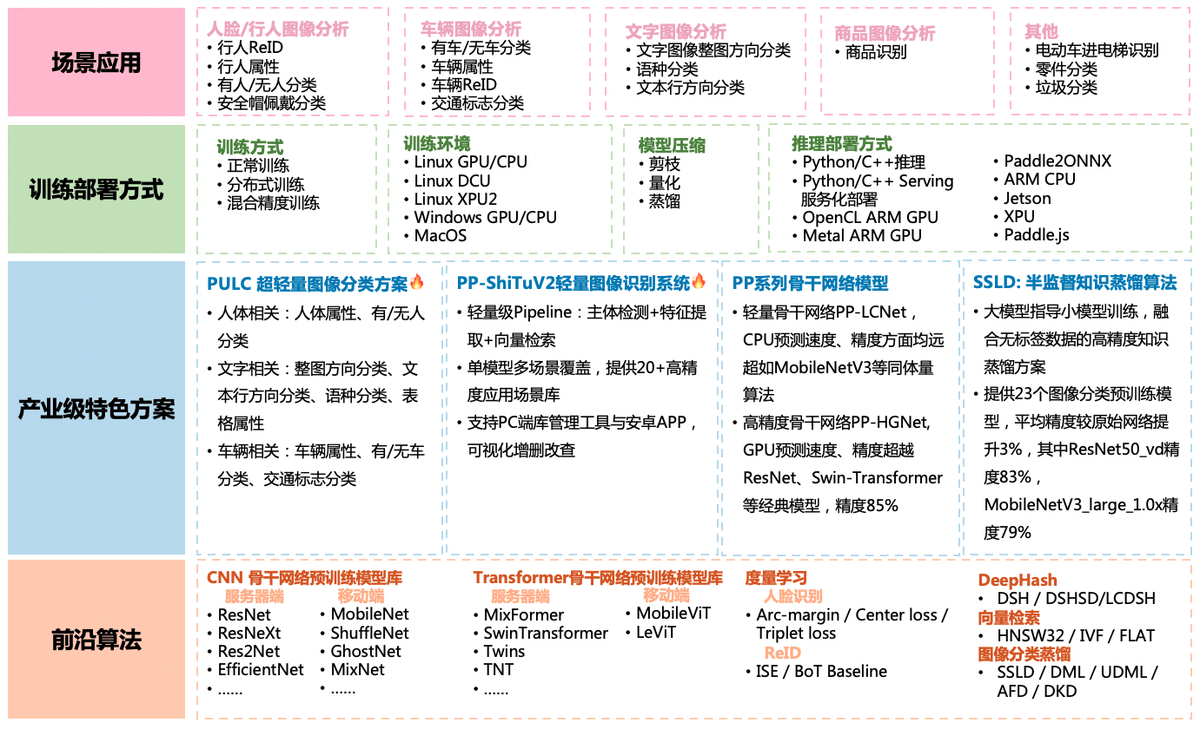
- v2.6 ships 98 models in 6 pipelines accessible via a single Python API through PaddleX integration, covering classification, multi-label, retrieval, and face recognition.
- PULC achieves sub-3ms CPU inference with accuracy on par with SwinTransformer, using SSLD distillation and PP-LCNet backbone.
- PP-ShiTuV2 open-set recognition adds new categories without retraining — just add images to a retrieval database; Recall@1 improved by 8 points over V1.
- New models added: MobileNetV4, StarNet, FasterNet, CLIP-based retrieval models, and multi-label PP-HGNetV2 variants.
- SSLD distillation boosts top-1 accuracy by 3%+ using unlabeled data, no ground-truth labels needed during distillation training.
- Deployment targets include Python/C++ inference, REST serving, Paddle Lite for mobile, and ONNX export for TensorRT/OpenVINO/NCNN. GitHub repo
PaddleClas is Baidu's open-source visual classification and recognition toolkit built on the PaddlePaddle framework. With nearly 5,900 GitHub stars and over 1,200 forks, it has quietly become one of the most comprehensive industrial-grade computer vision toolkits in the open-source ecosystem, covering everything from lightweight mobile inference to GPU-optimized backbone networks.
The library's latest major release, v2.6, added a significant quality-of-life upgrade: low-code full-pipeline development via PaddleX integration. PaddleClas is an image classification and image recognition toolset for industry and academia, helping users train better computer vision models and apply them in real scenarios. The v2.6 update consolidates 98 core models into 6 callable pipelines, accessible through a single Python API.
One API, 98 Models
The headline feature of v2.6 is the PaddleX integration. Rather than hunting through config files and training scripts, you can now invoke any of the 98 PaddleClas models with a minimal Python call. The six pipelines cover general image classification, multi-label classification, general image recognition, and face recognition. Beyond that, the same API surface also reaches 200+ models across detection, segmentation, OCR, and time-series tasks.
Getting started looks like this:
import paddlex as pdx
# Load a pre-trained general image classification pipeline
pipeline = pdx.create_pipeline(pipeline="image_classification")
# Run inference on a local image
result = pipeline.predict("./my_image.jpg")
print(result)
The v2.6 release also added new model families to the zoo, including MobileNetV4, StarNet, and FasterNet for image classification, plus CLIP-based feature models (PP-ShiTuV2_rec_CLIP_vit_base