
BentoML's OpenLLM Serves Open-Source Models 8x Faster Than Ollama
OpenLLM by BentoML lets you self-host any open-source LLM as an OpenAI-compatible API endpoint, from local GPU to production cloud, with a single command.
Takeaways
- OpenLLM by BentoML serves any open-source LLM as an OpenAI-compatible API with a single command, locally or in the cloud.
- Uses vLLM as the inference backend, enabling continuous batching and PagedAttention for high-concurrency GPU serving.
- Benchmarks show up to 8x higher throughput and 8x more tokens/second than Ollama under concurrent load on a single A100.
- Supports 15+ model families including Llama 4, DeepSeek R1, Qwen 2.5, Mistral, Gemma 3, and Phi-4 out of the box.
- One-command deploy to BentoCloud for autoscaling, managed infrastructure, and observability; also exports to Docker/Kubernetes.
- Free and open-source (Apache 2.0); custom model repositories supported, though only public repos are currently allowed.
If your team is running open-source models in production, you've probably hit the same wall: getting from "model weights on disk" to "scalable API your app can actually call" is more work than it should be. OpenLLM, the open-source project from BentoML, is built around collapsing that gap into a single command.
The problem it actually solves
At its core, OpenLLM packages any open-source large language model into a production-ready API server that speaks the OpenAI protocol. That means existing code written against the OpenAI SDK works instantly with self-hosted Llama, DeepSeek, Qwen, or any custom model you choose. No adapter layer, no rewrite.
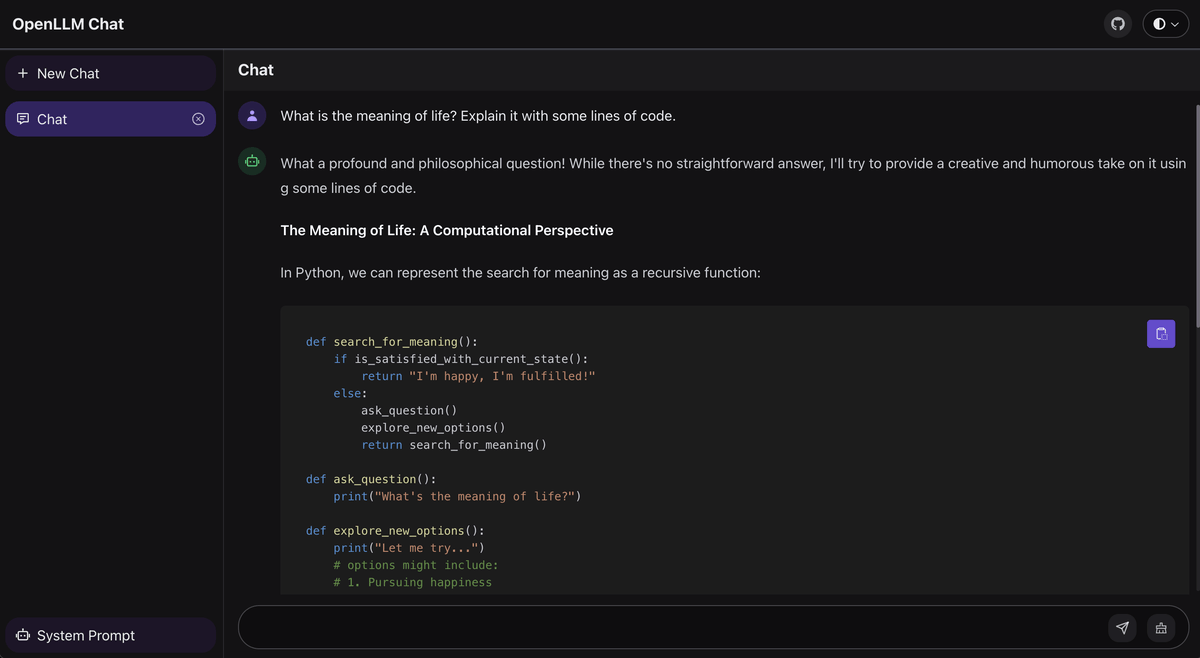
This matters because the dominant self-hosting alternative, Ollama, is optimized for single-user local use. OpenLLM allows developers to run any open-source LLMs or custom models as OpenAI-compatible APIs with a single command, and it features a built-in chat UI, state-of-the-art inference backends, and a simplified workflow for enterprise-grade cloud deployment with Docker, Kubernetes, and BentoCloud.
Under the hood: vLLM does the heavy lifting
OpenLLM is built on top of BentoML, a unified model serving framework, and integrates various components to provide a seamless experience for working with LLMs. The inference backend is