
Brush Brings 3D Gaussian Splatting to Every GPU Without CUDA
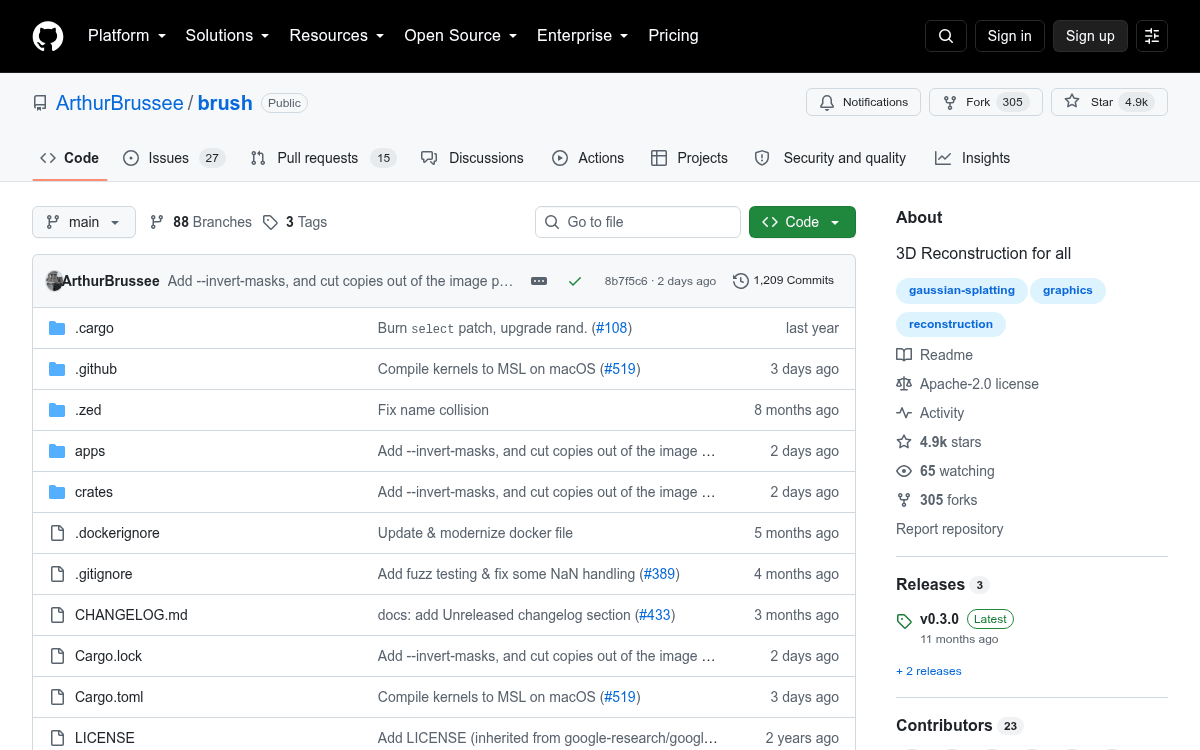
Brush is an open-source Gaussian splatting engine that trains and renders 3D scenes on any GPU, any OS, and even in a browser without CUDA.
Takeaways
- Brush is a Rust Gaussian splatting engine that trains and renders on any GPU without CUDA.
- Runs natively on Windows, macOS, Linux, Android, and in Chrome via WebGPU and the Burn ML framework.
- Version 0.3 adds MCMC-style training with an optional cap on total splat count.
- Supports datasets larger than RAM by streaming files from disk during training.
- Reported to train as fast as gsplat while reaching slightly higher PSNR/SSIM on MipNeRF360.
- Apache-2.0 licensed, ships prebuilt binaries, and includes a CLI plus a web demo.
Gaussian splatting has become the go-to technique for turning a handful of photos into a photoreal 3D scene, but the reference implementations have been locked to NVIDIA hardware and Python toolchains full of CUDA extensions. Brush, an open-source project by Arthur Brussee that just crossed 4,900 GitHub stars, takes a different route: it is a 3D reconstruction engine using Gaussian splatting that works on macOS, Windows, Linux, AMD/Nvidia/Intel cards, Android, and in a browser, using WebGPU compatible tech and the Burn machine learning framework.
One binary, every GPU
The core pitch is portability. Unlike traditional Gaussian splatting implementations that require CUDA, Brush runs on Windows, macOS, Linux, Android, and in web browsers through WebGPU and the Burn machine learning framework, and produces simple dependency free binaries, runs on nearly all devices, without any setup. Under the hood, all GPU operations funnel through the burn-cubecl backend, which compiles to WGSL and dispatches via wgpu, with custom kernels in brush-render and brush-kernel integrating with Burn's execution model.
That design choice is the real breakthrough. Most Gaussian splatting stacks assume a beefy NVIDIA workstation. Brush treats a MacBook, an Android phone, and a Chrome tab as first-class training targets. There is a live