
ContextGem Collapses Complex Document Extraction Into a Few Lines of Python
A new open-source Python framework turns document extraction into a declarative task, handling prompts, references, and validation with minimal code.
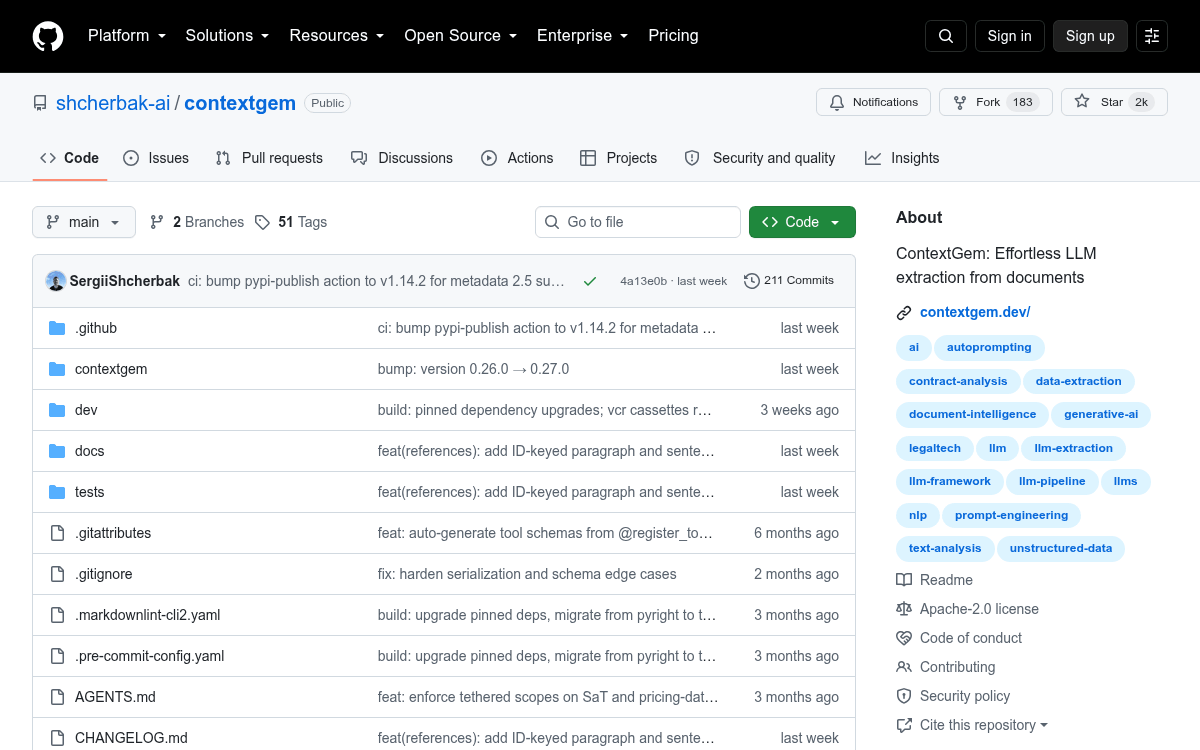
Takeaways
- ContextGem is an open-source Python framework for LLM-based structured extraction from documents, released under Apache 2.0.
- Two primitives: Aspects for text segments and Concepts for typed data points like strings, dates, JSON, ratings.
- Auto-generates prompts, validates outputs, and maps every extraction back to paragraph or sentence references.
- Uses LiteLLM under the hood, supporting OpenAI, Anthropic, Google, xAI, Ollama, LM Studio.
- Optimized for single-document accuracy, not cross-document retrieval, so RAG frameworks remain better for corpus search.
- Recommended minimum model is gpt-4o-mini class; 8B local models often struggle with the detailed prompts.
Pulling structured data out of contracts, invoices, and reports usually means gluing together prompt templates, Pydantic schemas, chunkers, retrievers, and a validation loop that catches hallucinated fields. ContextGem is an open-source Python framework that collapses that stack into a few declarative objects, letting you describe what you want in natural language while the library handles the extraction machinery.
The project is Apache 2.0 licensed and available on PyPI. Per the documentation, ContextGem aims to make structured extraction from documents possible with minimal code.
What the framework actually does
Building a reliable extraction pipeline typically involves writing prompts, designing validation models, mapping outputs back to source references, orchestrating multi-step workflows, and tracking usage across LLMs. ContextGem wraps those steps behind two primitives: Aspects and Concepts.
- Aspects pull out text segments like clauses, chapters, or thematic sections, and can be nested hierarchically.
- Concepts extract structured data points using intelligent inference: entities, insights, structured objects, classifications, numerical calculations, dates, ratings, and assessments.