
Datalab's Lift Pulls Structured JSON From PDFs 3x Faster Than Gemini
Datalab open-sources a 9B vision model that extracts structured JSON from documents at near-frontier accuracy, running 3x faster than Gemini Flash 3.5.
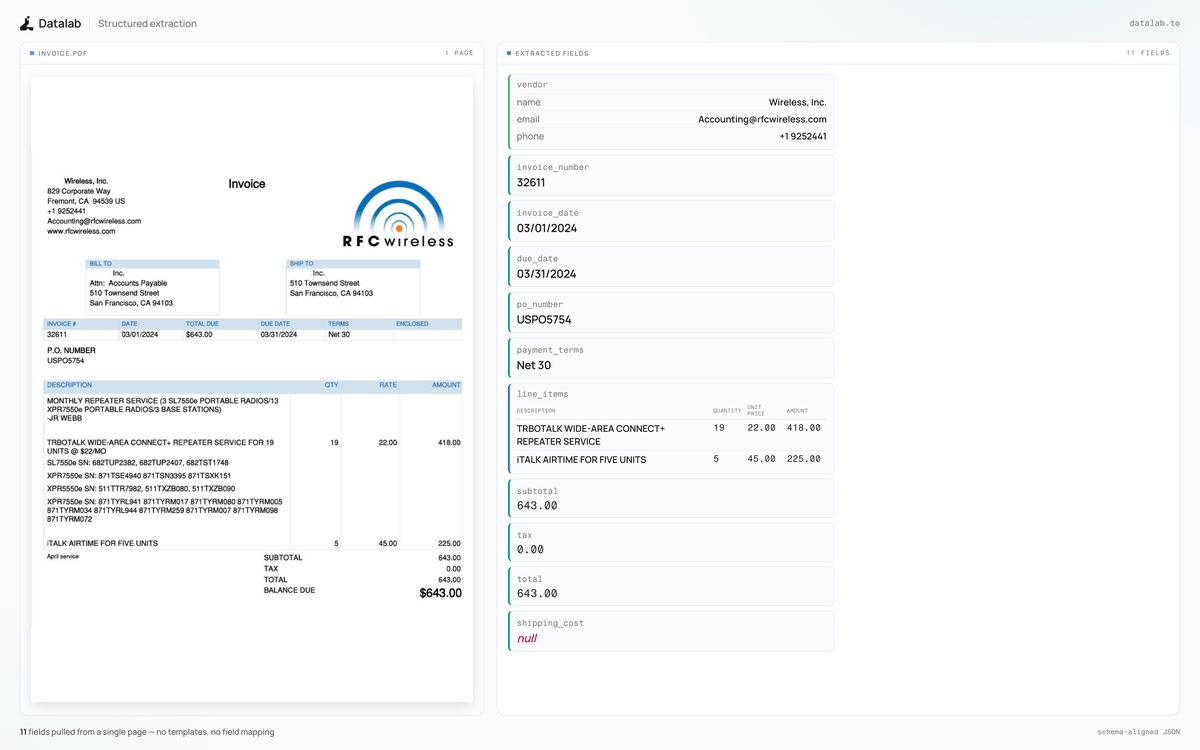
Takeaways
- Datalab open-sources lift, a 9B vision model that extracts structured JSON from PDFs and images via a JSON schema.
- 90.2% field accuracy on a 225-document benchmark, just behind Gemini Flash 3.5 (91.3%) and well ahead of NuExtract3 (81.5%).
- 3x faster than Gemini Flash 3.5: 9.5s median latency per document vs. 28.1s, running on a single GPU via vLLM.
- Schema-constrained decoding guarantees valid, well-typed JSON output -- no malformed responses possible.
- Install with
pip install lift-pdf; supports CLI, Python API, and a Streamlit Schema Studio app. GitHub repo - Apache 2.0 code, OpenRAIL-M weights: free for research and startups under $5M; commercial self-hosting requires a license.
Datalab has open-sourced lift, a 9-billion-parameter vision model purpose-built for one thing: pulling structured JSON out of PDFs and images. You pass it a JSON schema, it hands back a JSON object that matches it exactly. No prompt engineering, no post-processing, no hoping the output parses correctly.
The release comes from Vik Paruchuri, Datalab's CEO and the creator of the popular Marker and Surya open-source document tools. Datalab has been quietly building a stack of specialized document intelligence models, and lift is their first open-weight model aimed squarely at the structured extraction problem.
Why frontier models aren't the right tool here
The standard approach to document extraction today is to throw a frontier model at the problem: send your PDF pages to GPT or Gemini, write a prompt asking for JSON, and hope the output is valid and complete. It works, but it's slow, expensive, and the output format is never truly guaranteed. As Datalab's COO put it, "much of humanity's collective knowledge is still trapped in complex documents like PDFs" and if AI can't accurately extract that data, it can't be trusted to act on it.
Lift takes a different approach. It's a structured extraction model that pulls structured JSON out of PDFs and images -- pass any JSON schema and lift returns a JSON object matching it, using schema-constrained decoding to guarantee valid, well-typed output. Schema-constrained decoding means the model's token generation is hard-constrained to only produce tokens that keep the output valid according to your schema -- so you literally cannot get malformed JSON back.