
Datawhale's Every-Embodied Lets Python Beginners Build and Train Real Robot AI
Every-Embodied is a free, open-source course that takes you from basic Python to training and deploying state-of-the-art robot AI models like SmolVLA and Pi0.
Takeaways
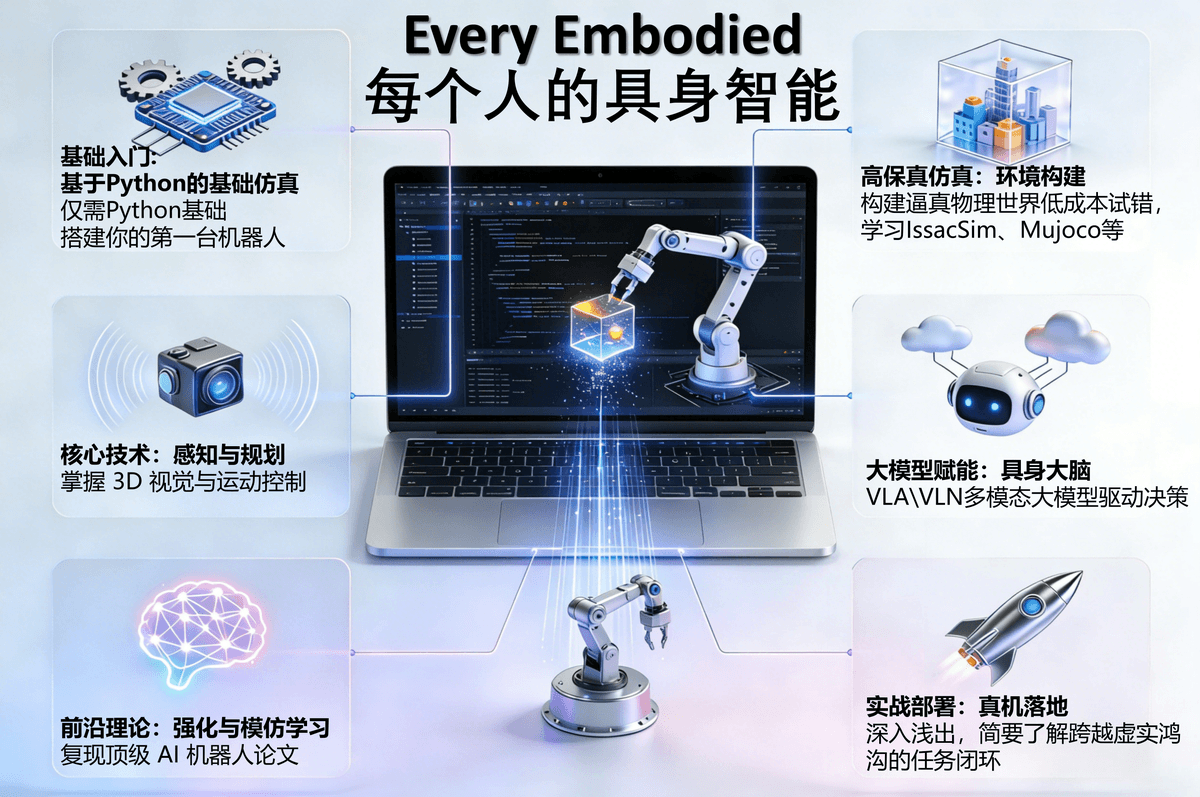
- Every-Embodied is a free, open-source course by Datawhale that teaches embodied AI from scratch using only Python as a prerequisite.
- It covers building VLA models (Vision-Language-Action) including OpenVLA, SmolVLA, and Pi0, which let robots see, understand language, and act physically.
- The curriculum has three stages: robotics fundamentals, core AI (CV, RL, motion planning), and frontier model reproduction with real hardware deployment.
- A quick-start demo runs a MuJoCo robotic arm simulation in three commands; heavier tutorials need an RTX 3060+ GPU.
- Backed by Hugging Face, Shanghai AI Lab, and Alibaba DAMO Academy; 1,378 stars with 22% weekly growth.
- Licensed CC BY 4.0 and free; English translations of core tutorials are available alongside the original Chinese content.
Building a robot that can see, understand language, and physically act on the world used to require deep expertise in robotics, control theory, and large-scale ML. Every-Embodied, an open-source course from Datawhale, is trying to change that. With only Python as a prerequisite, it walks you through building embodied AI systems from scratch, all the way up to reproducing frontier models like OpenVLA, SmolVLA, and Pi0.
The repo has crossed 1,378 stars, with 307 new stars in a single week, a 22% week-over-week growth that signals real momentum. It is backed by Hugging Face, Shanghai AI Lab, and Alibaba DAMO Academy, and it keeps getting bigger, with new tutorials landing almost every week.
What is embodied AI, and why is it hard to learn?
Embodied AI refers to intelligent systems that can perceive, interact, and learn through a physical body, such as a robot or autonomous vehicle, in the real world. The core idea is that true intelligence emerges from continuous interaction with an environment, not from processing data in isolation. Think of it as giving an AI a body and letting it learn by doing, the way a child learns by touching, grabbing, and falling.
The central building block of modern embodied AI is the Vision-Language-Action (VLA) model. A VLA takes a camera image and a natural language command as input, and outputs robot joint movements as output. It is essentially a multimodal model that has been extended with an action head. OpenVLA is a 7B-parameter open-source VLA trained on roughly 970,000 robot episodes from the Open X-Embodiment dataset, covering 22 different robot embodiments. SmolVLA, from Hugging Face, is a compact ~450M parameter open-source VLA designed to run on consumer-grade hardware like a laptop or modest GPU, tightly integrated with the LeRobot library.