
Decoding AI's Free Open-Source Course Builds a Real Production RAG Brain
A free, open-source 6-module course teaching you to build a production-ready AI assistant on top of your personal knowledge base using agents, RAG, and fine-tuning.
Takeaways
- Free, open-source 6-module course teaching production-grade agentic RAG on your personal knowledge base — GitHub repo
- Ingests Notion data (or any source), crawls 700+ links, scores quality with LLMs, and stores everything in MongoDB
- Fine-tunes Llama 3.1 8B with Unsloth to handle cheap summarization for Contextual Retrieval at scale
- Agentic inference layer built with HuggingFace smolagents, giving the assistant a retriever tool and a summarization tool
- Full LLMOps stack: ZenML for orchestration, Opik for observability, Comet for experiment tracking, Hugging Face for deployment
- Costs ~$1-$5 to run end-to-end; no Notion account required thanks to a public S3 data snapshot
Most RAG tutorials stop at a Jupyter notebook with a PDF and a chatbot. This open-source course from Decoding AI goes several steps further: it walks you through building a full production system that turns your personal notes and research into a queryable AI assistant, complete with fine-tuned LLMs, agentic retrieval, observability, and LLMOps tooling. With nearly 2,800 GitHub stars and 477 forks, it has clearly struck a nerve.
The idea behind it
The "Second Brain" concept, popularized by productivity author Tiago Forte, refers to your personal knowledge base: notes, resources, and research you accumulate over time. The problem is that as it grows, it becomes harder to actually access. The course builds an AI assistant that sits on top of that knowledge base and lets you query it in natural language, with answers grounded exclusively in your own materials, not hallucinated from general training data.
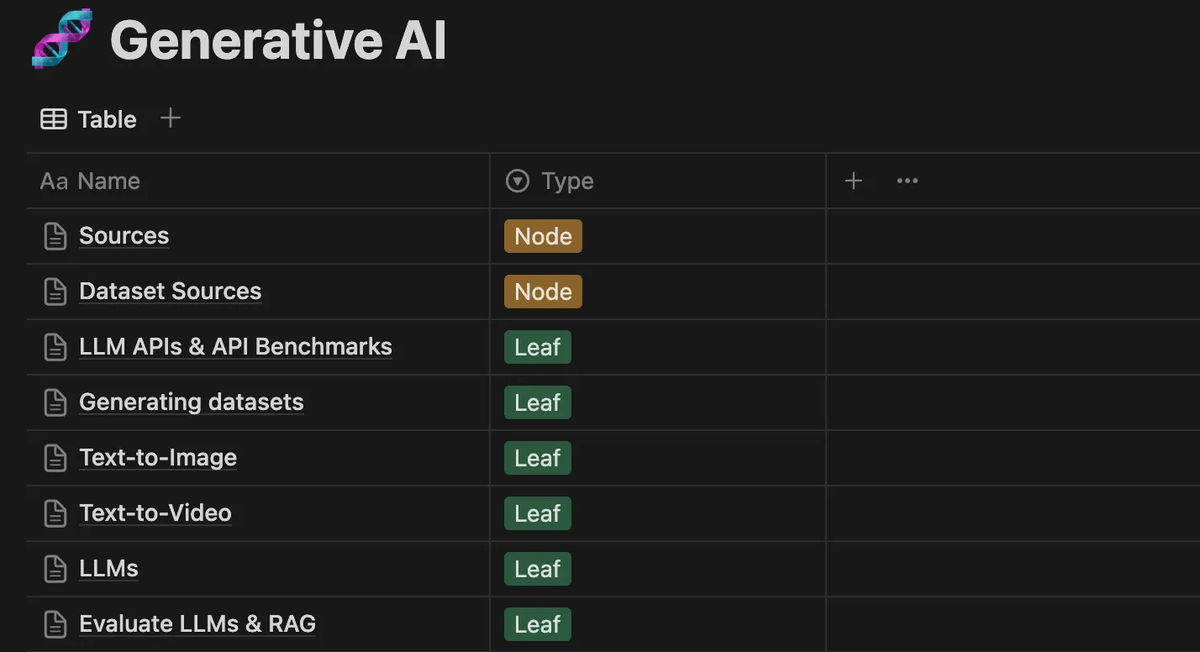
The course uses Notion as the data source, but the pipeline is designed to be swapped out for Google Drive, Obsidian, Apple Notes, or any other system. A curated snapshot of ~100 Notion pages and 500+ links covering GenAI, RAG, MLOps, and LLMs is provided in a public S3 bucket, so you don't need a Notion account to complete the course.
Six modules, one real system
The course contains 6 modules that teach you how to build an advanced RAG and LLM system using LLMOps and ML systems best practices. The modules are structured around actually building the system end-to-end, not just reading about it:
- Module 1 , Architecture: System design overview using the Feature/Training/Inference (FTI) pattern, a framework that organizes any ML system into three cleanly separated pipeline types.
- Module 2 , Data pipelines: ETL pipeline that pulls from Notion's API, crawls 700+ embedded links using Crawl4AI, normalizes everything to Markdown, and scores document quality using LLMs and heuristics.