
Deep-Live-Cam Hits 94K Stars Swapping Any Face in Real Time
Deep-Live-Cam hits 94k GitHub stars with real-time face swapping from a single photo, no training required, running live on consumer GPUs
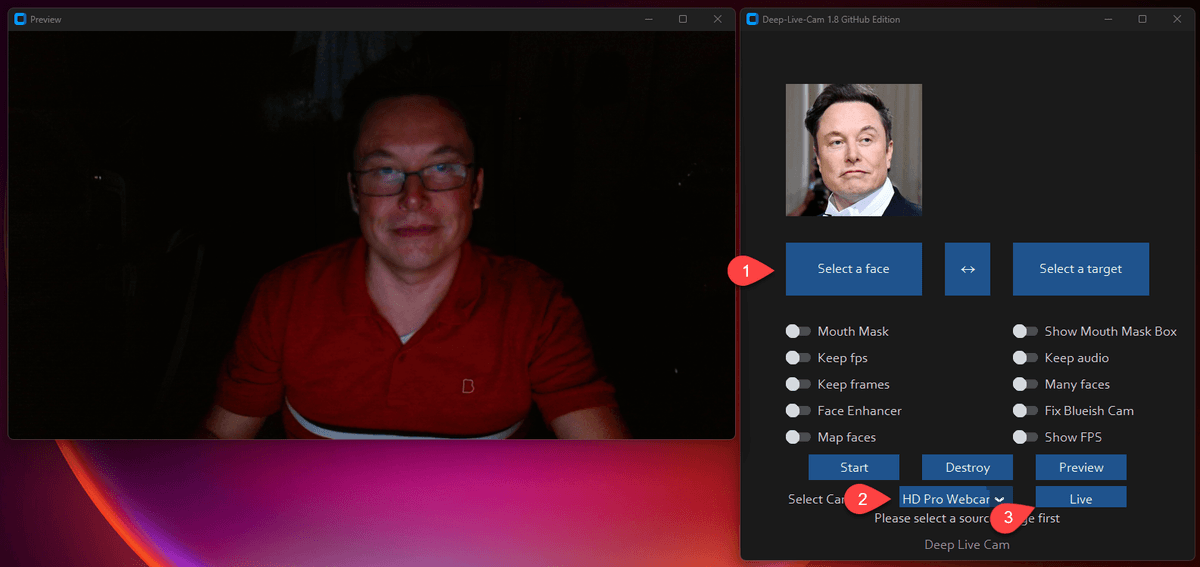
Takeaways
- 94k GitHub stars: Deep-Live-Cam enables real-time face swapping from a single photo with no model training required.
- How it works: Uses InsightFace landmarks + inswapper_128 model + GFPGAN restoration in a live per-frame pipeline.
- Key features: Webcam live mode, multi-face mapping, mouth masking, and built-in NSFW content filtering.
- v2.3 update: Adds HyperSwap (256x256 faces), 4x faster enhancer, ReSwapper engine, and RTX upscaling support.
- Hardware: 60+ FPS on RTX 4090; CPU-only mode works but drops below real-time at full resolution.
- Dual-use risk: Deepfake fraud losses exceeded $200M in Q1 2025 alone; tool ships with NSFW filters but no identity verification.
Deep-Live-Cam has quietly become one of the most-starred AI repositories on GitHub, crossing 94,000 stars and 13,700 forks. The pitch is simple and slightly unsettling: drop in one photo of any face, click a button, and your webcam feed is replaced with that person in real time. No dataset collection. No model training. No waiting overnight for convergence.
One photo, zero training
Deep-Live-Cam is an open-source real-time face-swapping tool that uses a single source image to swap faces in live video streams without any training. It enables instant deepfakes for streaming, content creation, and interactive experiences. That last part is the real unlock. Previous tools like DeepFaceLab required you to train a custom model on hours of footage of the target face. Deep-Live-Cam skips that entirely.
Deep-Live-Cam uses a fundamentally different approach: single-shot inference with pre-trained models. Instead of training a custom model for each face, it leverages the inswapper_128 model, a pre-trained face-swapping neural network that can generalize to any face from just one image. The tradeoff is quality ceiling vs. speed, but for live use cases, the speed wins.
How the pipeline actually works
The processing pipeline follows a multi-stage architecture. First, InsightFace's detection models locate all faces in each frame and extract 106 facial landmarks for alignment. Second, the inswapper model performs the actual face swap by embedding the source face into the target's facial geometry. Third, GFPGAN (Generative Facial Prior GAN -- a model that restores fine facial details) enhances the swapped face to reduce artifacts and improve realism. Finally, the enhanced face is blended back into the original frame using mask-based compositing.