
DeepTeam's Open-Source Framework Automatically Attacks Your AI Before Hackers Do
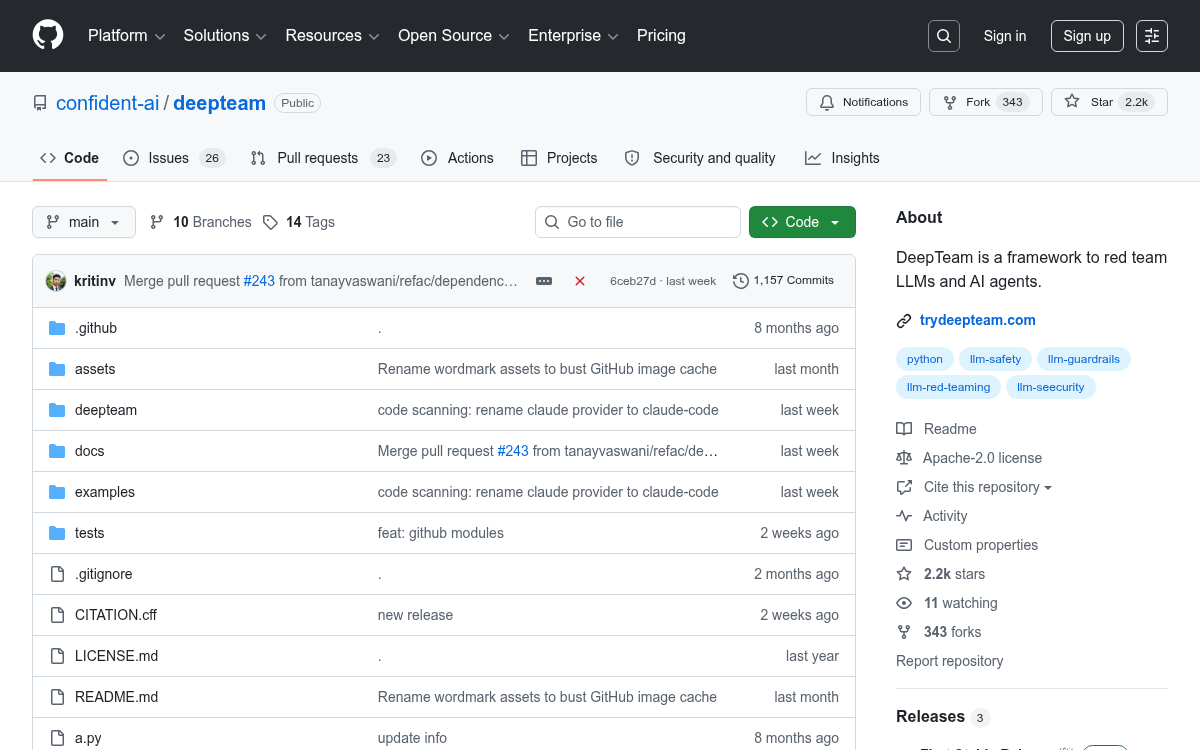
DeepTeam is an open-source Python framework that automates adversarial attacks on LLMs and AI agents, covering 50+ vulnerabilities and aligning with OWASP, NIST, and MITRE standards out of the box.
Takeaways
- What it is: DeepTeam is a free, open-source Python framework for automated adversarial red teaming of LLMs and AI agents.
- Coverage: 50+ vulnerabilities across 6 categories (bias, PII, SQL injection, agentic hijacking, etc.) and 20+ attack methods including multi-turn jailbreaks.
- Framework alignment: One-line integration with OWASP Top 10 for LLMs 2025, OWASP for Agents 2026, NIST AI RMF, MITRE ATLAS, and more.
- No dataset needed: Adversarial inputs are dynamically generated at test time; just wrap your app in a callback function.
- Guardrails included: 7 production-ready guards (toxicity, prompt injection, privacy, etc.) close the loop from finding to fixing vulnerabilities.
- Free & local: Apache 2.0 licensed, runs locally, needs an OpenAI (or compatible) API key for the attack simulation engine.
DeepTeam is an open-source red teaming framework for LLMs and AI agents, built by the team behind DeepEval (the popular LLM evaluation library). Red teaming, borrowed from traditional cybersecurity, means hiring a dedicated team to attack your own system before real adversaries do. DeepTeam brings that same idea to AI: instead of manual prompt crafting, it uses LLMs to automatically generate and fire adversarial attacks at your model, then scores the results.
The problem it's solving
The shift from deterministic software to probabilistic LLMs has fundamentally altered the cybersecurity landscape. Traditional static benchmarks and prompt testing often fail to capture the complex, emergent vulnerabilities of AI systems , which is exactly why DeepTeam was built to automate the simulation of adversarial attacks and rigorously validate model defenses.
Most AI safety practices still treat models as static artifacts: something you evaluate once, score, and ship. DeepTeam exists because that assumption is wrong. It's an LLM red-teaming tool built for a world where models behave like actors, not features , and where failure modes emerge only through interaction, pressure, and misuse.
A 2025 study analyzing 214,271 attack attempts found that automated red teaming achieved a 69.5% success rate, compared with 47.6% for manual testing. That gap is the core argument for a tool like this.
What it covers
DeepTeam simulates attacks , jailbreaking, prompt injection, multi-turn exploitation, and more , to uncover vulnerabilities like bias, PII leakage, and SQL injection in your AI agents, RAG pipelines, and chatbots. It also offers guardrails to prevent these issues in production.
The vulnerability library is organized into six categories:
- Data Privacy , PII leakage, prompt leakage (system prompt exposure)
- Responsible AI , bias, toxicity, fairness, child protection, ethics violations
- Security , SQL injection, shell injection, SSRF, BFLA/BOLA, RBAC bypass, tool metadata poisoning
- Safety , illegal activity facilitation, graphic content, self-harm advice, unexpected code execution
- Business , misinformation, IP violations, competitor endorsement