
Fudan's OpenOCR Beats 7B Document Parsers With a Tiny 0.1B Model
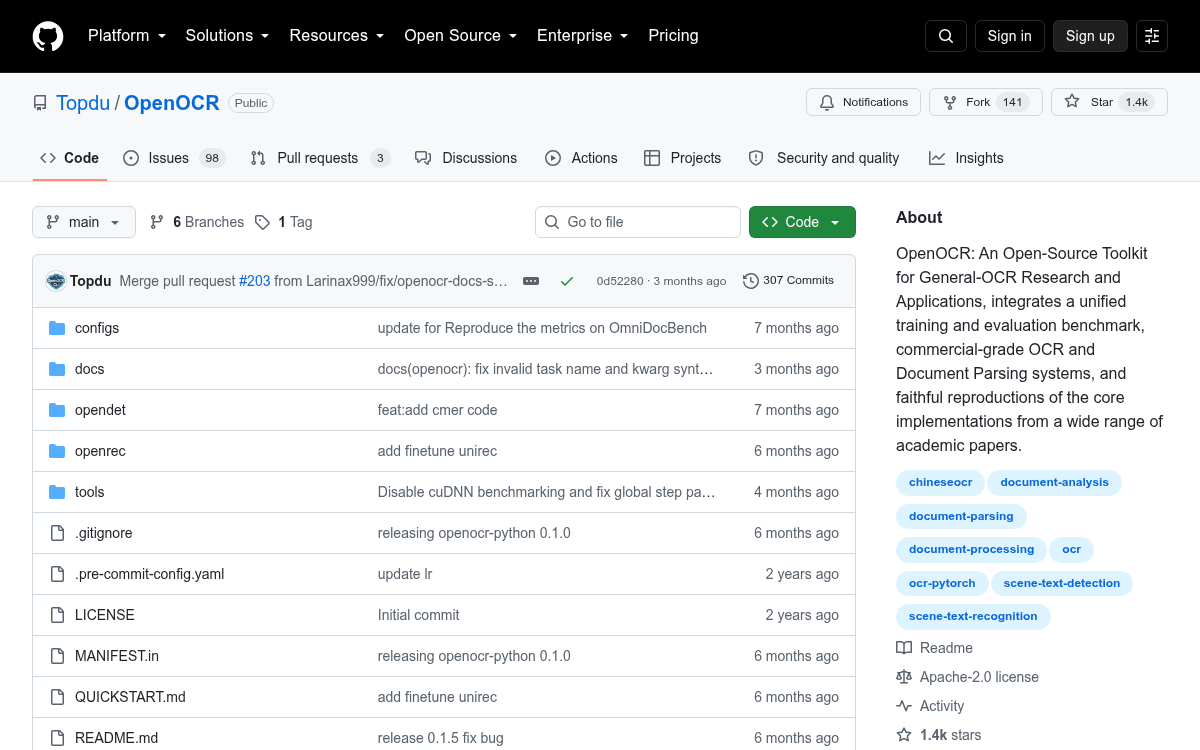
Fudan University's FVL Lab released OpenOCR, an Apache-licensed toolkit bundling a 0.1B document parser, unified text/formula recognizer, and 24 reproduced STR methods.
Takeaways
- Fudan FVL Lab released OpenOCR, an Apache 2.0 toolkit for text, formula, table, and document parsing.
- OpenDoc-0.1B hits 90.57% on OmniDocBench v1.5 with only 100M parameters, beating many MLLM-based parsers.
- UniRec-0.1B unifies text, formula, and table recognition in one model trained on the UniRec40M dataset.
- SVTRv2 (ICCV 2025) beats PP-OCRv4 by 4.5% while showing CTC can outperform encoder-decoder recognizers.
- Bundled harness reproduces 24 scene text recognition methods with identical training on Union14M-L-Filter real data.
- Latest openocr-python 0.1.5 adds PDF input, parallel document element recognition, ONNX export, and fine-tuning tutorials.
A research group at Fudan University just released an OCR toolkit that quietly consolidates a large chunk of the scene text and document parsing literature into a single installable Python package. OpenOCR comes out of the FVL Lab and bundles a general-purpose text detection and recognition system, an ultra-lightweight document parser, a unified text-and-formula recognizer, and faithful reimplementations of two dozen scene text recognition papers under one training and evaluation harness.
Rather than juggling PaddleOCR, MMOCR, and a graveyard of one-off paper repos, you get one codebase with a unified interface across detection, recognition, formulas, tables, and full document parsing.
What is actually in the box
The toolkit ships several distinct systems that share the same training and inference stack. SVTRv2 is the workhorse recognizer, published at ICCV 2025, and its headline claim is that a CTC-based single visual model can beat attention-based encoder-decoder recognizers on both accuracy and speed for arbitrarily shaped text. The general OCR system built on SVTRv2 outperforms the PP-OCRv4 baseline by 4.5% on the OCR competition leaderboard while preserving similar inference speed.
The two newer releases are more interesting for anyone doing document AI work: