
Google Bets Its Entire Cloud on MCP With One Official Open-Source Hub
Google's official MCP repo centralizes managed remote servers for BigQuery, GKE, Maps, and 10+ more services, with IAM auth and no local setup required.
Takeaways
- Official hub: google/mcp is Google's single repo for all official MCP servers, deployment guides, and examples.
- No local setup: Managed remote servers activate automatically when you enable the corresponding Google Cloud API, accessible via HTTP endpoint.
- Broad coverage: 14+ remote servers including BigQuery, Spanner, AlloyDB, Firestore, GKE, Compute Engine, Maps, Chronicle, and more.
- Enterprise security: IAM-based auth (no shared keys), Model Armor prompt-injection scanning, audit logging, and VPC Service Controls built in.
- Client-agnostic: Works with Gemini CLI, Claude, ChatGPT, Cursor, and any MCP-compatible client.
- Open-source track: Self-hostable servers for Workspace, Firebase, Analytics, Chrome DevTools, Flutter/Dart, and gcloud CLI also included.
If you've been stitching together community-built MCP servers to connect your AI agents to Google Cloud, that era is over. Google has published google/mcp, an official repository that serves as the single source of truth for all of Google's Model Context Protocol integrations: managed remote servers, open-source servers, deployment guides, and working examples. It's the clearest signal yet that Google is treating MCP as a first-class part of its infrastructure strategy.
What MCP actually is (and why the "remote" part matters)
MCP, often likened to a "USB-C for AI", has quickly become a common standard to connect AI models with data and tools. The protocol defines how an AI agent discovers and calls external tools, whether that's running a SQL query, provisioning a VM, or fetching geospatial data. The key distinction in Google's implementation is remote vs. local:
- Local MCP servers run as a subprocess on your machine, communicating over stdin/stdout. They're fragile, hard to scale, and require every developer to manage their own installation.
- Remote MCP servers run on Google's infrastructure and expose a stable HTTP endpoint. Your agent just points to a URL.
Implementing Google's existing community-built servers often required developers to identify, install, and manage individual, local MCP servers or deploy open-source solutions, placing the burden on developers and often leading to fragile implementations. The managed remote approach eliminates all of that.
What's in the repo
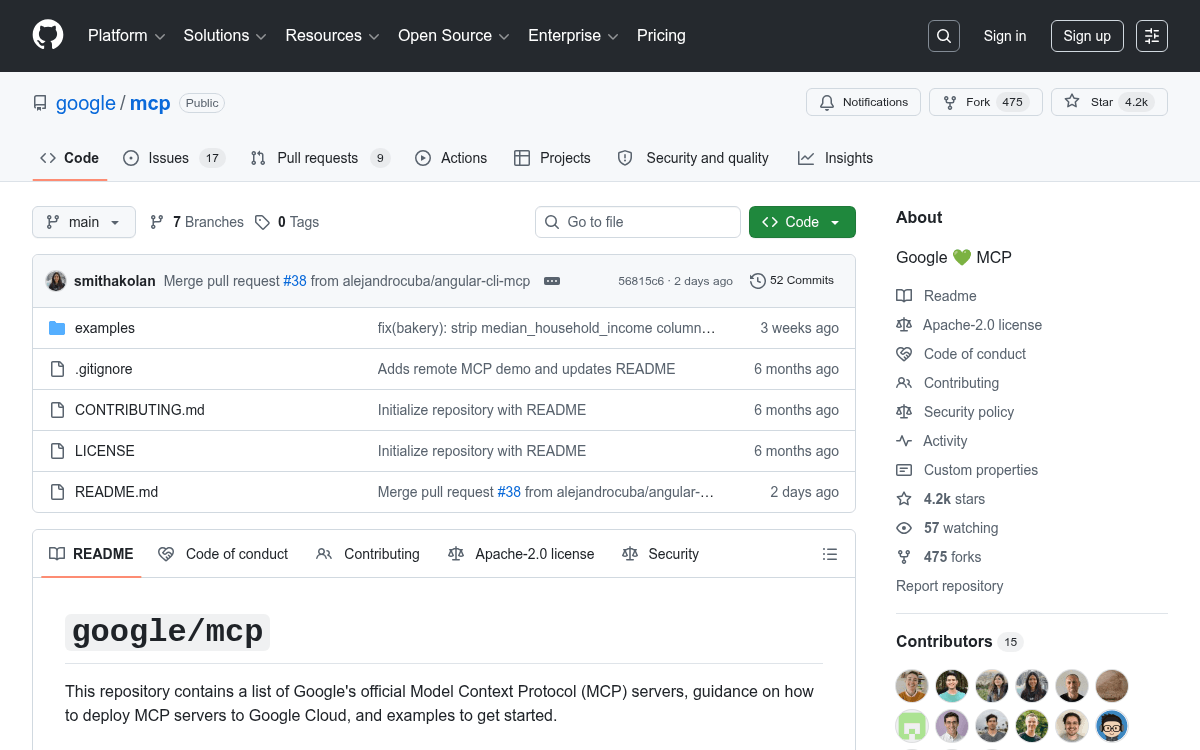
The repository contains a list of Google's official MCP servers, guidance on how to deploy MCP servers to Google Cloud, and examples to get started. It's split into two tracks:
Managed remote servers (zero infrastructure to run): Google's existing API infrastructure is now enhanced to support MCP, providing a unified layer across all Google and Google Cloud services. Developers can now simply point their AI agents or standard MCP clients like Gemini CLI to a globally-consistent and enterprise-ready endpoint for Google and Google Cloud services.