
H2O.ai's LLM Studio Lets Anyone Fine-Tune Open-Source AI Without Writing Code
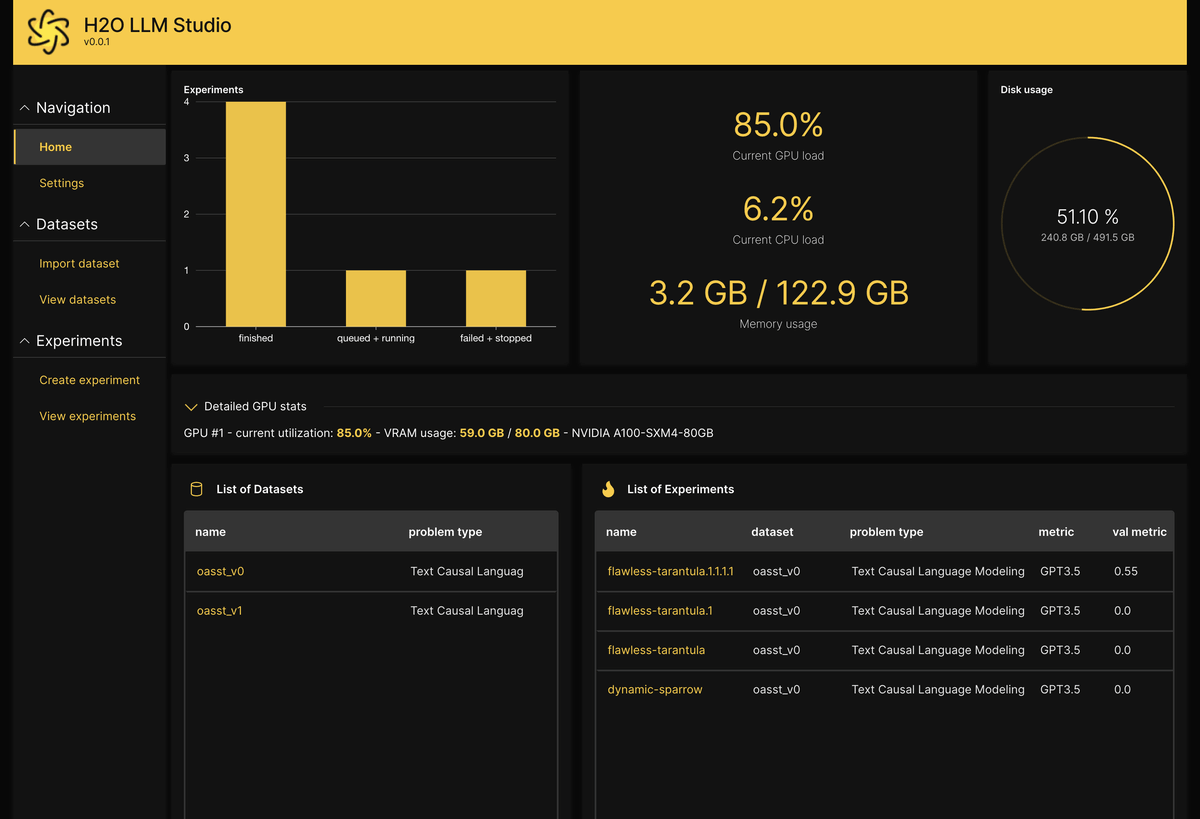
H2O LLM Studio is an open-source, no-code GUI that lets anyone fine-tune large language models without writing a single line of code.
Takeaways
- H2O LLM Studio is a free, open-source (Apache-2.0) no-code GUI for fine-tuning LLMs, now at v1.14.14 with 5k+ GitHub stars.
- Supports LoRA, 4-bit QLoRA, and 8-bit training to fine-tune 7B+ models on consumer GPUs with low memory overhead.
- RLHF fully replaced by DPO/IPO/KTO preference optimization for simpler, more stable alignment training.
- New problem types added: Causal Classification and Causal Regression, expanding use beyond text generation.
- Fine-tuned models have shown up to 70% cost reduction and 75% faster inference vs. large general-purpose models.
- Self-host on Ubuntu + NVIDIA GPU, deploy via Docker or uv, or launch instantly on RunPod; enterprise tier available from H2O.ai.
H2O LLM Studio is an open-source framework from H2O.ai that puts a full LLM fine-tuning pipeline behind a point-and-click interface. No training scripts, no custom CUDA kernels, no boilerplate. You upload a CSV, pick a backbone, configure a few hyperparameters, and hit run. The project has crossed 5,000 GitHub stars and 530+ forks, and it keeps shipping: the latest release, v1.14.14, landed at the end of June 2026.
The problem it solves
Pre-trained LLMs are not always tailored to specific domains, and fine-tuning them to fix that has historically required coding expertise and in-depth knowledge of model architecture and hyperparameters. H2O LLM Studio removes that barrier entirely. It eliminates the need for coding expertise, providing an intuitive GUI for uploading training data, selecting LLM architecture, and configuring hyperparameters.
What you actually get
The feature set covers the full lifecycle from raw data to a deployed model:
- No-code fine-tuning GUI built on H2O Wave, accessible at
localhost:10101 - LoRA and 8-bit training for low memory footprint fine-tuning
- DPO/IPO/KTO preference optimization as a replacement for RLHF, improving training stability and efficiency
- DeepSpeed sharded training for multi-GPU machines with NVLink, replacing FSDP with more flexibility