
Hardik Pandya's stop-slop Teaches AI to Catch Its Own Writing Patterns
Hardik Pandya open-sourced a prompt skill file that teaches LLMs to detect and strip their own writing clichés from prose
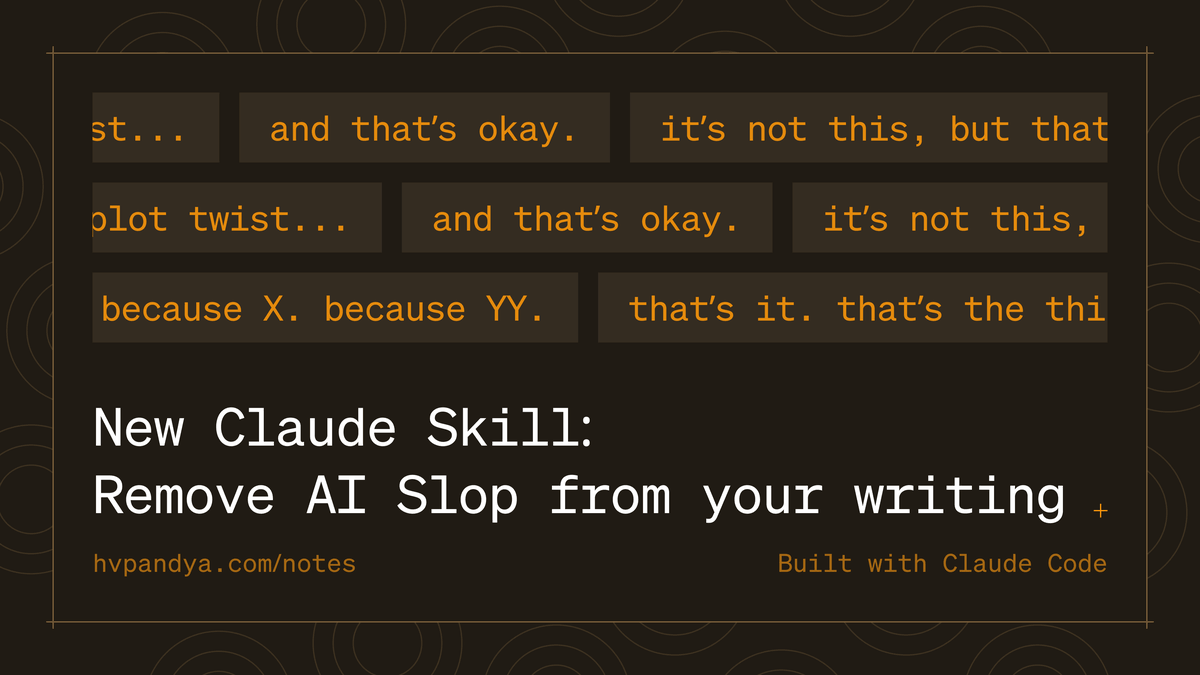
Takeaways
- stop-slop is an open-source skill file by Hardik Pandya for stripping AI writing tells from LLM-generated prose.
- It ships as structured Markdown files: a core
SKILL.mdwith rules plus reference files for banned phrases, structural clichés, and before/after examples. - Works with Claude Code, Claude Projects, custom instructions, or any LLM via API system prompt — model-agnostic by design.
- Targets three layers: banned phrases (adverbs, throat-clearing), structural clichés (em dashes, binary contrasts), and sentence-level rules (active voice, no Wh- starters).
- Includes a built-in 5-dimension scoring rubric (directness, rhythm, trust, authenticity, density) — scores below 35/50 trigger a revision pass.
- Free and MIT-licensed; embed it in pipelines, Claude Projects, or personal system prompts without restriction.
There is a specific texture to AI-generated writing that most people can feel before they can name it. Throat-clearing openers. Em dashes everywhere. Sentences that fragment for drama. Adverbs stacked on top of each other. Hardik Pandya decided to codify every one of these tells into a structured prompt file, and the result is stop-slop, an open-source skill for removing AI writing patterns from prose.
A skill file, not a model
The term "skill" here refers to a structured instruction set you load into an LLM context, similar to a system prompt but organized as a reusable module. stop-slop ships as a small folder of Markdown files: a core SKILL.md with rules and a scoring rubric, plus a references/ directory containing banned phrases, structural patterns to avoid, and before/after transformation examples.
The repo is model-agnostic by design. The README lists four integration paths:
- Claude Code: add the folder directly as a skill
- Claude Projects: upload
SKILL.mdand the reference files to project knowledge - Custom instructions: