
HKU's LightRAG Hits 30K Stars by Cutting RAG Indexing Costs 60%
The HKUDS graph-enhanced RAG framework accepted at EMNLP 2025 crosses 30K GitHub stars, with multimodal support and a growing ecosystem of extensions now in active development.
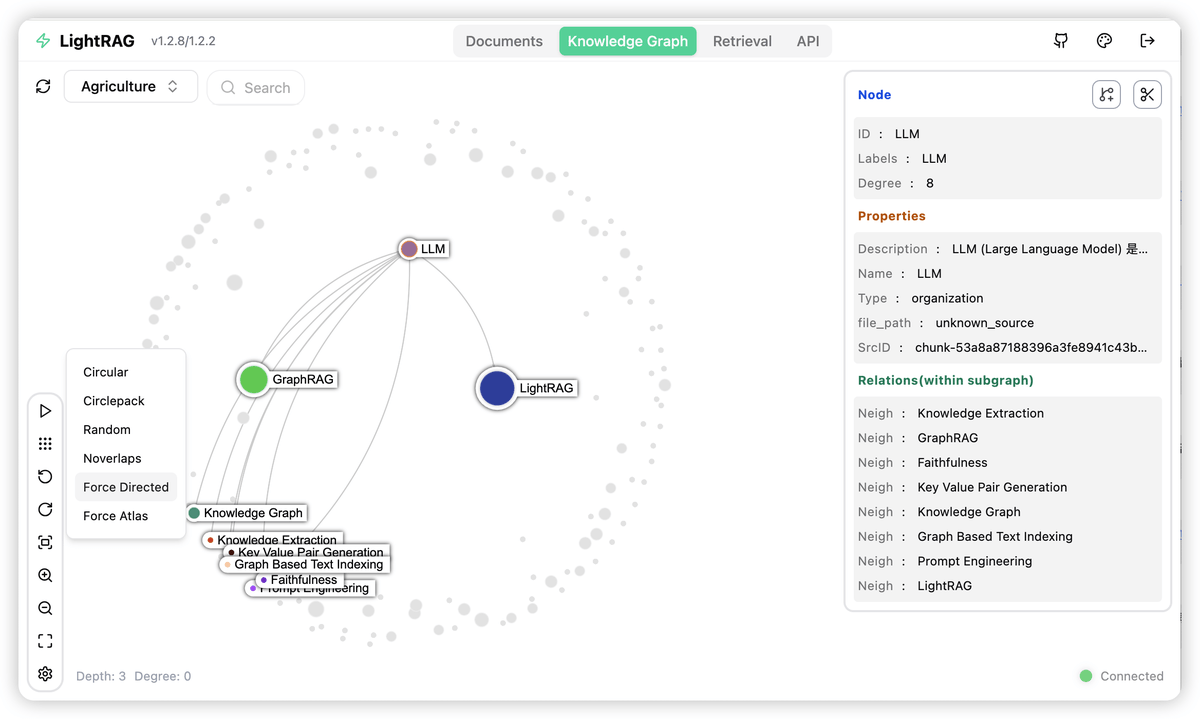
Takeaways
- 30K GitHub stars: LightRAG from HKU Data Science Lab crosses 30,000 stars, accepted at EMNLP 2025.
- Graph + vector hybrid: Automatically builds a knowledge graph from documents and combines it with vector search for multi-hop queries.
- ~60% lower indexing token cost vs GraphRAG, with roughly half the median query latency, per benchmark analysis.
- Five query modes: local, global, hybrid, naive, and mix (default); each trades off precision vs. coverage.
- Multimodal support added in v1.5: Processes PDFs, images, tables, and formulas via MinerU/Docling integration.
- Growing ecosystem: Companion projects include RAG-Anything, VideoRAG, and MiniRAG from the same lab.
LightRAG, the graph-enhanced retrieval-augmented generation framework from the HKU Data Science Lab, has crossed 30,000 GitHub stars. The milestone reflects sustained community momentum around a system that was first released in late 2024, accepted at EMNLP 2025, and has since grown into a full-featured RAG platform with multimodal support, multiple storage backends, and an active ecosystem of companion projects.
The problem it was built to solve
Existing RAG systems have significant limitations, including reliance on flat data representations and inadequate contextual awareness, which can lead to fragmented answers that fail to capture complex inter-dependencies. The classic example: ask a vector-only RAG system a question that requires connecting facts across multiple documents, and it retrieves disconnected chunks that each answer part of the question but miss the relationship between them.
LightRAG extracts entities and relationships from your documents to build a knowledge graph, then combines graph-based retrieval with vector search to deliver more accurate, context-aware answers than traditional chunk-based RAG systems. The knowledge graph is built automatically during indexing -- no manual annotation required.

The dual-level retrieval engine
The core technical idea is a two-tier retrieval system that operates at different levels of abstraction simultaneously. The low-level component targets specific entities and relationships for fine-grained queries, while the high-level component enables broader knowledge discovery. This is what lets LightRAG handle both pinpoint factual lookups and open-ended summarization questions with the same index.
LightRAG tackles GraphRAG's limitations by folding relational signals into a standard dense index and introducing a dual-level, coarse-to-fine retriever that first selects cluster representatives and then expands to their ego networks; this removes explicit graph traversal, supports incremental index patches, and reduces indexing token cost by approximately 60% while roughly halving median query latency, all without hurting answer quality on multi-hop QA benchmarks.