
HumanSignal's Adala Teaches Itself to Label Data Using a Few Gold Examples
HumanSignal open-sourced Adala, a Python framework where agents iteratively learn data labeling skills from ground truth datasets using LLM runtimes.
Takeaways
- Adala is an open-source autonomous data labeling agent framework from HumanSignal, Apache 2.0 licensed.
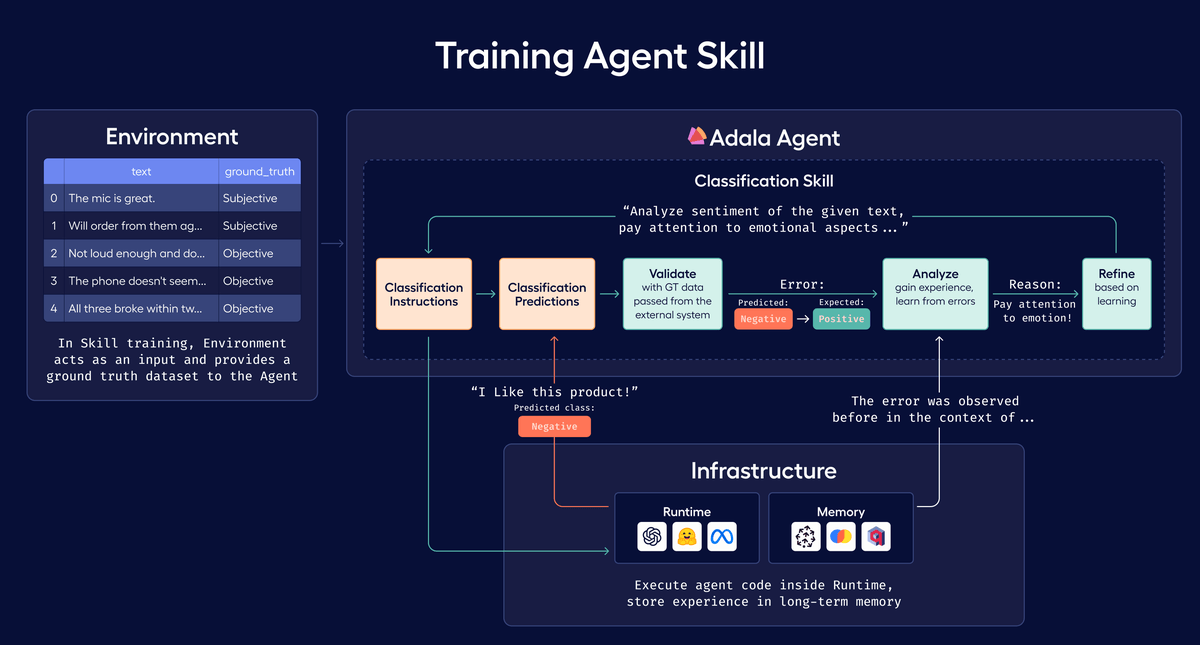
- Agents learn skills iteratively from a ground truth DataFrame via a student/teacher LLM runtime setup.
- Ships classification, summarization, translation, QA, text generation, and ontology creation skills with Colab examples.
- Works with OpenAI directly or with Claude and Gemini through OpenRouter as the runtime.
- Install with
pip install adala; requires anOPENAI_API_KEYor equivalent. - Roadmap includes NER, multi-task learning, REST API, and multimodal skills; see the docs.
Data labeling is the least glamorous part of building ML systems, and also the most expensive. Adala, an open source framework from HumanSignal (the team behind Label Studio), takes a swing at that problem by turning labeling into an agent task where the agent teaches itself using a small seed of ground truth.
The name stands for Autonomous DAta (Labeling) Agent. The framework is built for agents specialized in data processing with an emphasis on diverse labeling tasks, and those agents can independently acquire one or more skills through iterative learning influenced by their operating environment, observations, and reflections. The repo sits at around 1.6k stars and is Apache 2.0 licensed.
Skills, environments, runtimes: the core loop
Adala breaks an agent into three primitives that map cleanly onto how a data scientist thinks about a labeling job:
- Skills: the actual capability, like classification, summarization, translation, or QA. Each skill has instructions, an input template, and an output template.
- Environment: where ground truth lives. You hand it a pandas DataFrame of labeled examples and it becomes the signal the agent learns against.