
Kreuzberg Collapses the Entire RAG Ingest Stack Into One Rust Engine
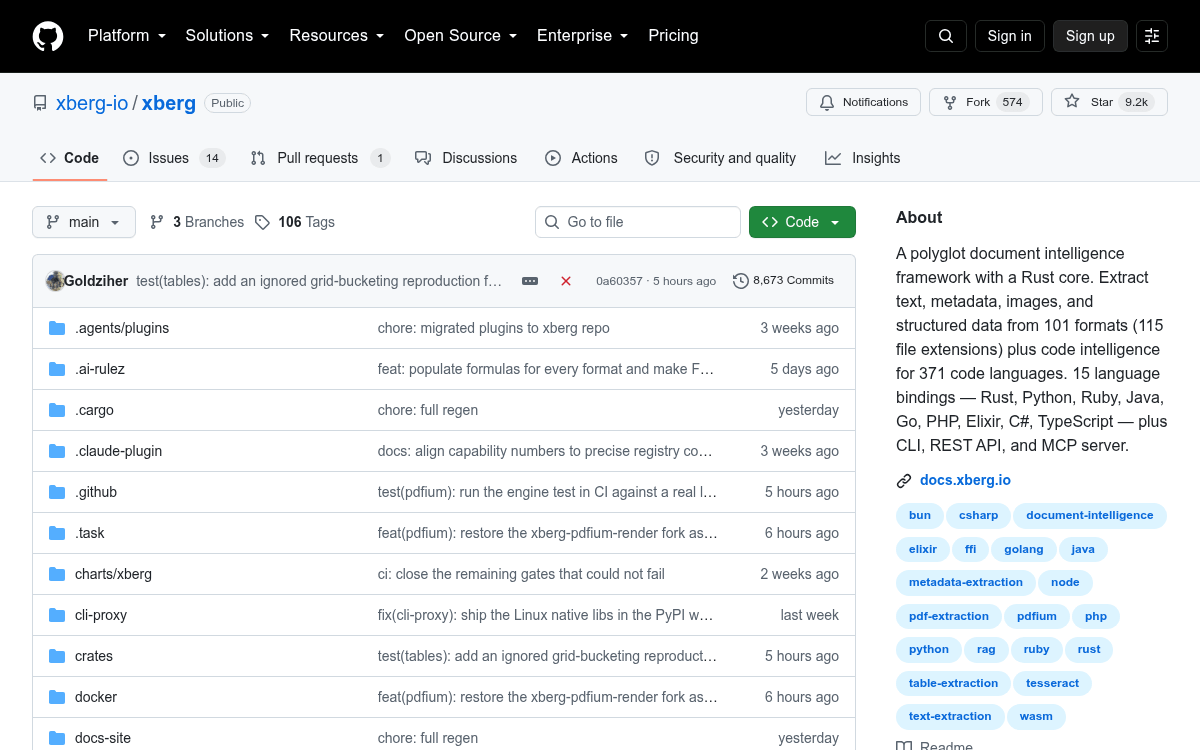
Kreuzberg is an open-source document intelligence framework with a Rust core and native bindings for 16 languages, aimed at RAG pipelines that need CPU-only extraction.
Takeaways
- Kreuzberg is an open-source document intelligence framework with a Rust core and 16 language bindings.
- Handles 96 file formats and code intelligence across 306 programming languages via tree-sitter.
- Runs on CPU with SIMD-accelerated parsing, pure-Rust PDF, and streaming for multi-GB files.
- Ships as library, CLI, REST API, or MCP server for direct agent integration.
- Built-in OCR, Whisper transcription, chunking, embeddings, and structured LLM extraction for RAG pipelines.
- Licensed under Elastic License 2.0; self-hostable alternative to Textract, Document AI, and Azure DI.
If you have ever tried to plug a folder of PDFs, scanned invoices, PowerPoints, and email archives into a retrieval pipeline, you know the ingest layer is where most projects quietly die. Kreuzberg is an open-source attempt to make that layer boring: a single Rust-based extraction engine with native bindings for 16 languages, packaged as a library, CLI, REST API, and MCP server.
The project has grown into one of the more ambitious document intelligence stacks on GitHub. It advertises extraction of text, metadata, transcripts, and code intelligence from 96 file formats and 306 programming languages, running at native speed without a GPU. The pitch is aimed squarely at RAG builders who do not want to ship documents to a proprietary cloud OCR service just to fill a vector database.
What Kreuzberg actually is
At its center sits a Rust core that the maintainers wrap into per-language SDKs. Kreuzberg turns documents, images, audio, and source code into clean structured text, pulling tables, metadata, transcripts, and code intelligence across 96 formats and 306 programming languages. Everything else, the Python package, the Node module, the Java jar, the WASM build, is a binding around the same engine, which is how the project avoids the usual drift between language ecosystems.
The design bet is explicit. Modern AI and RAG pipelines need fast, reliable extraction without a GPU or a stack of heavyweight dependencies. Kreuzberg delivers that from a single Rust core with SIMD-accelerated parsing, pure-Rust PDF handling, streaming for multi-GB files, and consistent output across every binding. In practice that means you can index a large corpus on the same boxes you already run your app on, instead of provisioning GPU workers just to read PDFs.