
LangChain's Local Deep Researcher Runs Autonomous AI Research on Your Own Hardware
LangChain's local-deep-researcher brings iterative AI web research entirely to your machine, with no API keys or data leaving your hardware
Takeaways
- Fully local deep research: Local Deep Researcher runs iterative web research using any Ollama or LMStudio model, with no data leaving your machine.
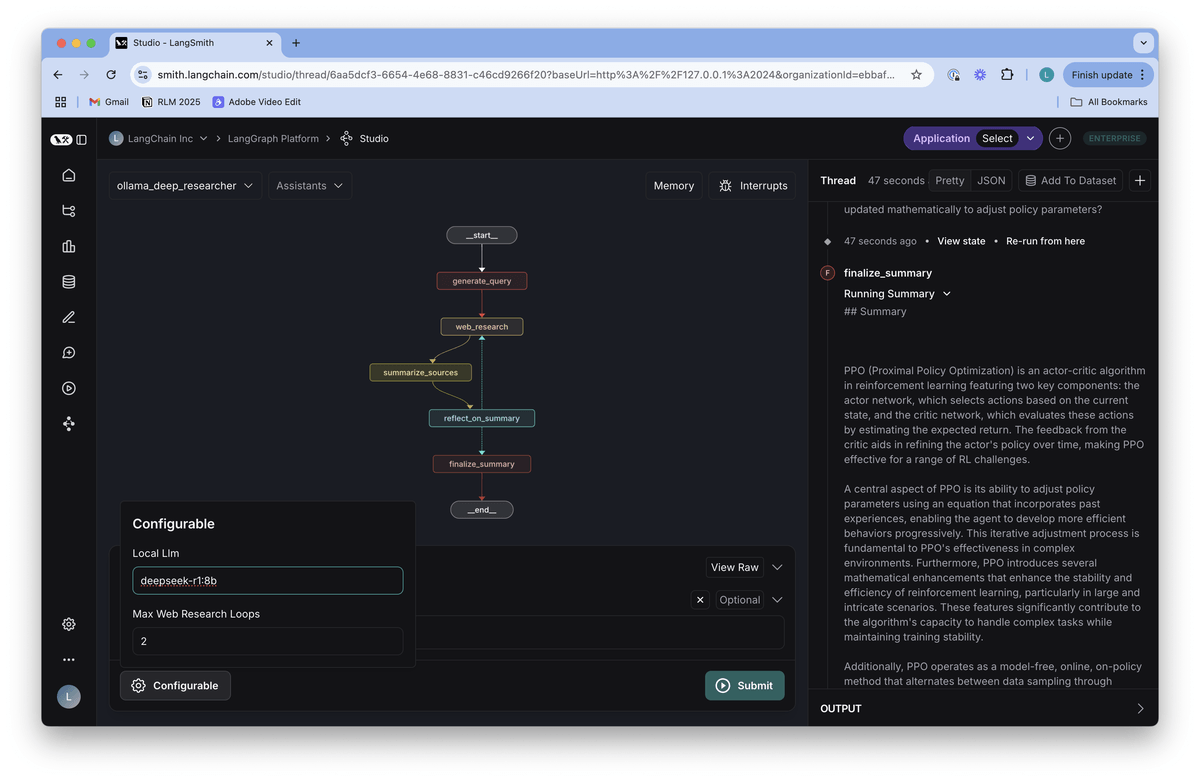
- Iterative gap-filling loop: The agent searches, summarizes, identifies knowledge gaps, and searches again for a configurable number of cycles, producing a cited markdown report.
- Zero-cost, no API keys required: DuckDuckGo is the default search backend; SearXNG support enables a fully air-gapped setup.
- Broad model support: Works with any Ollama or LMStudio model; a recent update added tool-calling mode for models that struggle with JSON output (including gpt-oss).
- Privacy-first use case: Designed for teams in compliance-sensitive environments where sending queries to cloud APIs is not an option.
- 9,200+ GitHub stars, MIT licensed: Actively maintained with Docker support, a TypeScript port, and LangGraph Studio UI for real-time graph visualization.
Local Deep Researcher is an open-source project from LangChain that turns any locally-hosted LLM into a fully autonomous research agent. Give it a topic, and it will iteratively search the web, summarize findings, identify what it still doesn't know, search again, and repeat until it produces a cited markdown report. No cloud API calls. No data leaving your machine. Just your GPU and a browser.
The project has quietly accumulated over 9,200 GitHub stars and nearly 1,000 forks, which is a strong signal that it's filling a real gap: the ability to run deep research workflows with complete data sovereignty.
Why this matters right now
The concept of AI-driven research automation gained traction in early 2025, as large language models began transcending simple question-answering. OpenAI's release of Deep Research marked a watershed moment, introducing iterative, self-correcting research workflows that mimic human exploration. But those tools come with a catch: most depend on cloud-hosted APIs or external embedding services, making them unfit for organizations that need to operate in compliance-sensitive or air-gapped environments.
Local Deep Researcher is the open-source answer to that problem. It replicates the same iterative research loop, but runs entirely on hardware you control.
The loop under the hood
Local Deep Researcher is inspired by IterDRAG, an approach that decomposes a query into sub-queries, retrieves documents for each one, answers the sub-query, and then builds on the answer by retrieving docs for the next sub-query. In plain terms: instead of doing one big search and summarizing it, the model keeps asking follow-up questions about what it doesn't yet know.