
Lightpanda Replaces Chrome for AI Agents, Running 9x Faster at 16x Less Memory
Lightpanda is a from-scratch browser written in Zig that runs 9x faster and uses 16x less memory than Chrome, now with a built-in LLM agent that compiles tasks into replayable scripts
Takeaways
- New browser from scratch: Lightpanda is a headless browser written in Zig, not a Chromium fork, with no rendering engine.
- Massive performance gains: 9x faster and 16x less memory than Chrome headless on real-world benchmarks across 933 web pages on AWS EC2.
- Built-in LLM agent:
lightpanda agentlets you describe tasks in plain English, then saves them as replayable PandaScripts that run token-free. - Drop-in compatible: Exposes a CDP server so existing Puppeteer and Playwright scripts work with a one-line change.
- Native MCP server: Plug directly into Claude Code or any MCP-aware agent framework without extra infrastructure.
- Still in beta: No screenshots, no native Windows binary, incomplete Web API coverage, and some sites with anti-bot detection may not work.
Every AI agent that touches the web today is quietly running a full desktop browser under the hood. Chrome, even in headless mode, carries its entire rendering stack: CSS layout, image decoding, GPU compositing, font rasterization. Your agent never looks at the screen, but it's paying for all of it. Lightpanda is a bet that this is the wrong foundation, and that the only real fix is to start over.
A browser built for machines, not people
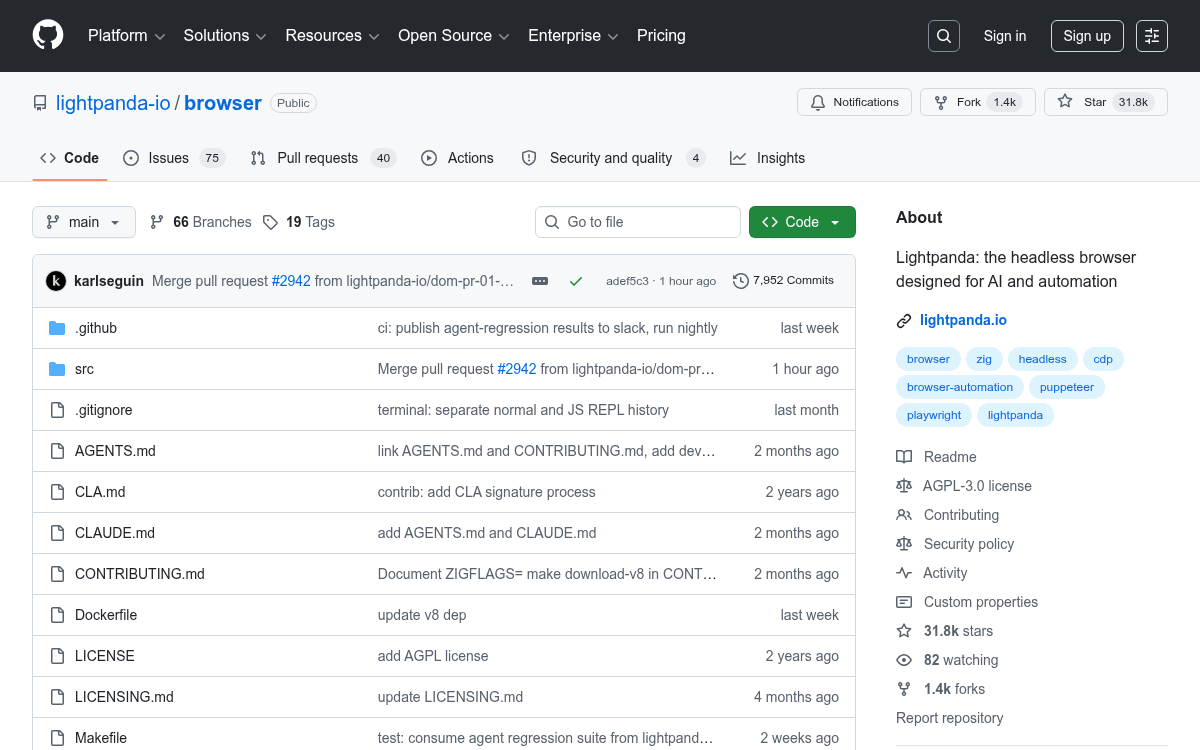
Lightpanda is the headless browser built from scratch for AI agents and automation. Not a Chromium fork. Not a WebKit patch. A new browser, written in Zig. The key architectural insight is surgical omission: throw out everything a human needs, keep only what a machine needs. The stack is: HTTP via libcurl, HTML parsing via html5ever (Mozilla's Rust parser), a custom Zig DOM engine, and V8 for JavaScript. No CSS layout engine. No image decoder. No GPU compositor. No font rasterizer. No accessibility tree.
Lightpanda was founded by Francis Bouvier, a Paris-based developer. Rather than patch Chromium, the team made a contrarian choice: write a new browser from scratch in Zig, a low-level systems language that competes with C and Rust on performance while being notably simpler to compile and cross-target. Zig gives them manual memory control without the footgun of C and without Rust's borrow checker slowing down iteration speed. For a browser engine where you need to manage thousands of DOM nodes, layout objects, and JS contexts simultaneously, that matters. The binary is small, startup is fast, and there's no garbage collector pause eating into your test execution time.
The numbers are hard to ignore
In the 25-process crawler benchmark, the project reports a peak memory footprint of 123 MB for Lightpanda versus 2.0 GB for Chrome, along with a crawl time of 4.81 seconds versus 46.70 seconds. The benchmark crawls 933 URLs from the Amiibo demo site on an AWS m5.xlarge instance, and the full methodology is documented in the project's benchmark details.
| Metric | Lightpanda | Headless Chrome |
|---|---|---|
| Peak memory (100 pages) | 123 MB | 2 GB |
| Execution time (100 pages) |