
Microsoft's Presidio Shields LLM Pipelines From Leaking Private Data
Microsoft's open-source Presidio framework strips PII from text, images, and structured data before it ever reaches an LLM or leaves your infrastructure
Takeaways
- What it is: Microsoft Presidio is a free, MIT-licensed open-source SDK for detecting and anonymizing PII in text, images, and structured data.
- LLM use case: Acts as a pre-processing firewall that strips sensitive data from prompts and RAG pipelines before they reach external model APIs like OpenAI or Anthropic.
- Coverage: Detects 50+ entity types globally -- SSNs, credit cards, IBANs, medical IDs, and country-specific IDs for the US, UK, India, Australia, Korea, Nigeria, and more.
- Architecture: Four modular components (analyzer, anonymizer, image-redactor, structured) run as stateless microservices; deployable via pip, Docker, Kubernetes, or PySpark.
- Limitations: Probabilistic detection means false positives and missed entities are possible; reversible anonymization breaks when LLMs rephrase output.
- Compliance: Supports GDPR, HIPAA, and PCI patterns including pseudonymization, encryption-based redaction, and full decision tracing for auditability.
Every time a developer pastes a customer email into a prompt or a RAG pipeline pulls from internal support tickets, sensitive data is one API call away from a third-party server. Microsoft Presidio is an open-source framework that spots personal information in text and replaces it before the model ever sees it. With nearly 9,000 GitHub stars and active commits as recently as this week, it has quietly become one of the most practical privacy tools in the AI stack.
What it actually does
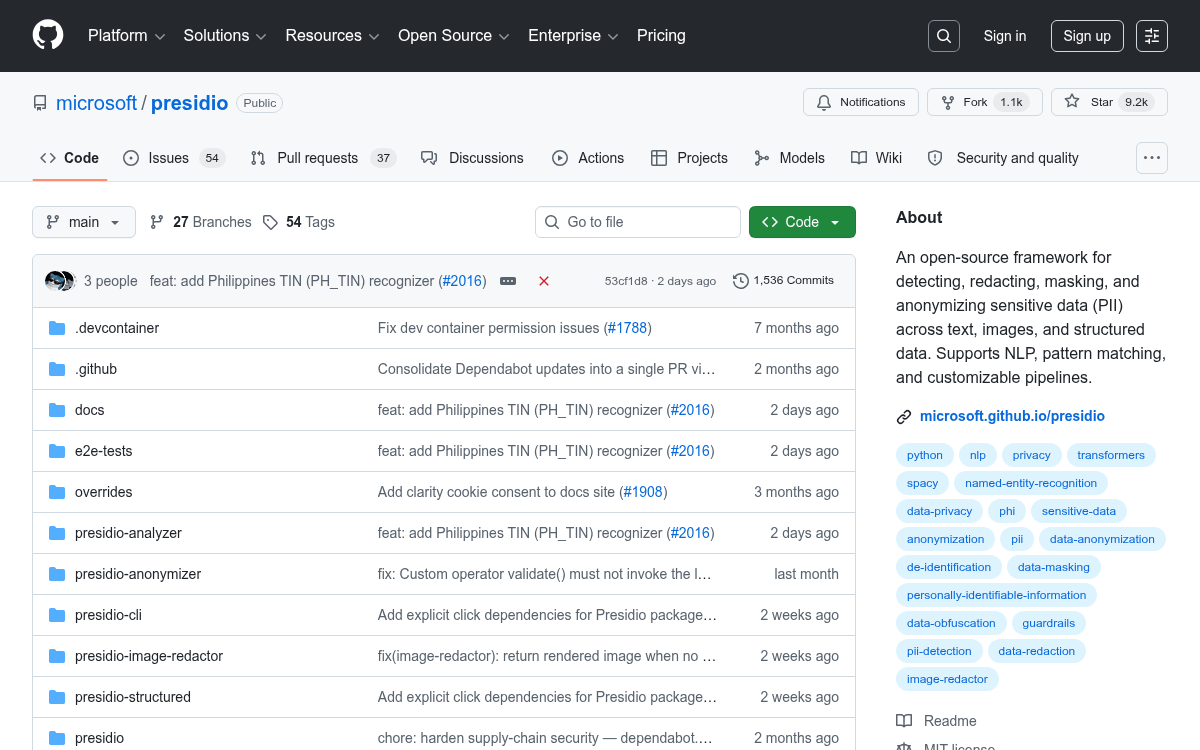
Presidio is an open-source framework that provides context-aware PII detection and anonymization for text, images, and other modalities. The framework is split into four independent modules you can mix and match:
- presidio-analyzer: detects PII entities in text using NLP, regex, and rule-based logic
- presidio-anonymizer: replaces detected entities using operators like redaction, masking, encryption, or fake-value substitution
- presidio-image-redactor: runs OCR on images (including DICOM medical scans) and blacks out any PII it finds
- presidio-structured: handles PII detection across DataFrames, JSON, and CSV files in batch
The analyzer and anonymizer run as separate microservices, keeping workloads compartmentalized and limiting the blast radius of potential vulnerabilities. By keeping processing stateless, Presidio avoids storing sensitive data at rest, further lowering the attack surface.
A detection engine with real depth
Presidio's detection is not just regex. Each recognizer combines multiple signals: pattern matching, checksums (Luhn algorithm for credit cards, for example), Named Entity Recognition (NER) via spaCy or HuggingFace transformers, and surrounding-word context to boost or suppress confidence scores. This multi-layer approach reduces false positives and improves detection accuracy in real-world data streams.
Out of the box, it covers a wide range of entity types globally and by country:
- Global: credit cards, crypto wallets, email addresses, IBAN codes, IP addresses, phone numbers, names, locations, URLs, medical licenses