
MiniMax H3 Director Mode Now Runs Locally on Your GPU
A community repo bundles five ready-to-run ComfyUI workflows for MiniMax H3, unlocking Director-style camera control for local video generation, editing, and character swaps.
Takeaways
- Repo packages five ready-to-run ComfyUI workflows for MiniMax H3 with Director-style camera control
- Covers T2V, FL2V/I2V, R2V, V2V, and RV2V modes across the fl2va and ref2va checkpoints
- RV2V workflow enables per-segment video editing and character replacement with reference images or audio
- Verified on RTX 4090 48GB with ComfyUI 0.30.0 using pruned INT8 quantized weights
- Built on MiniMax's open-weights H3 release, an omni-modal model generating joint video and audio
- Apache 2.0 licensed, uses upstream AIMixer node pack and Qwen3-VL-32B text encoder
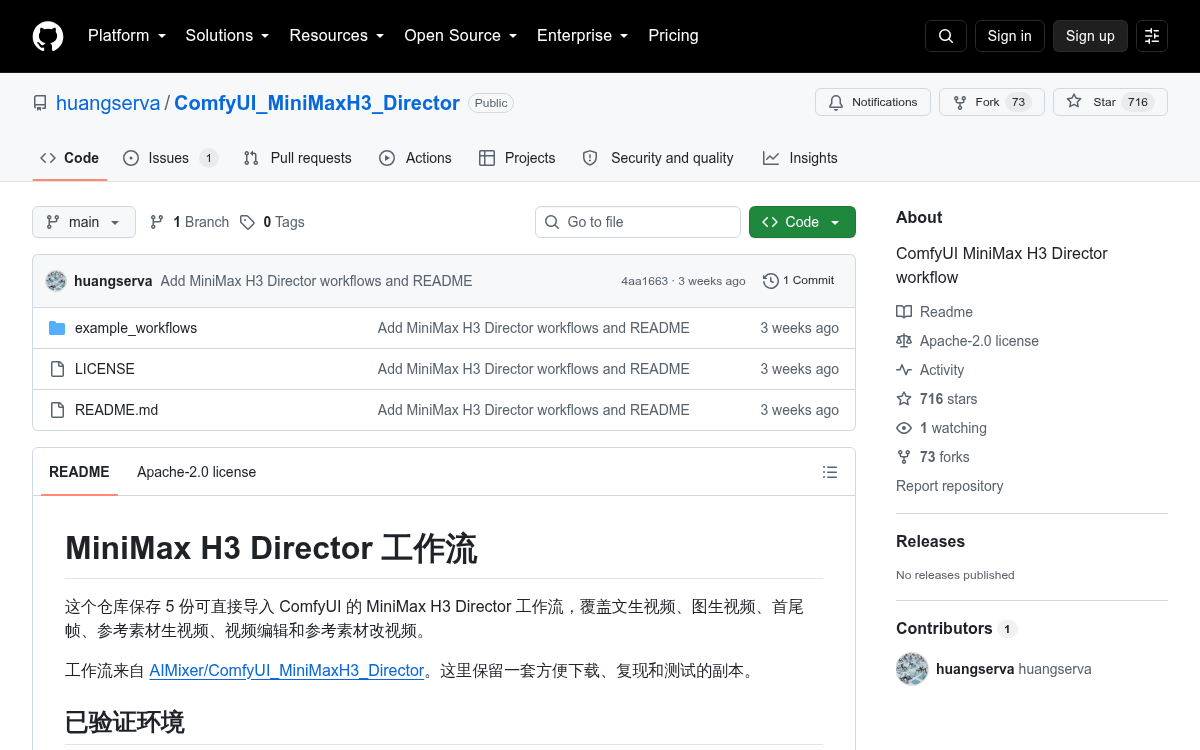
A new community repository makes it dramatically easier to run MiniMax H3 locally with fine-grained camera and scene control. The ComfyUI_MiniMaxH3_Director project ships five importable ComfyUI workflows covering the full spectrum of what H3 can do, from text-to-video through reference-driven editing and character replacement.
MiniMax open-sourced H3, the omni-modal model behind the Hailuo line, with weights published on Hugging Face and native ComfyUI support landing the same day, adding joint audio-video generation through four new nodes and six official workflow templates. This repo is a curated superset of those templates, pre-wired for the Director style of prompting that made Hailuo popular.
What Director mode actually buys you
Director mode is the differentiator against generic text-to-video models. You explicitly direct the camera using bracketed commands like [Pan left] or [Dolly in] to trigger the model's trained cinematic movements. Hailuo exposes multiple preset and trained camera moves, such as "from left to right" or "Debut," which infuse momentum and make shots feel cinematic. The workflows in this repo surface that control inside ComfyUI instead of behind MiniMax's hosted API.
Five workflows, two checkpoints
Each JSON file is a drop-in graph. The split runs between the FL2VA checkpoint (first/last frame plus audio) and the Ref2VA checkpoint (reference-driven):