
Momentum's Open Wearables Replaces 10 Fitness APIs With One Self-Hosted Layer
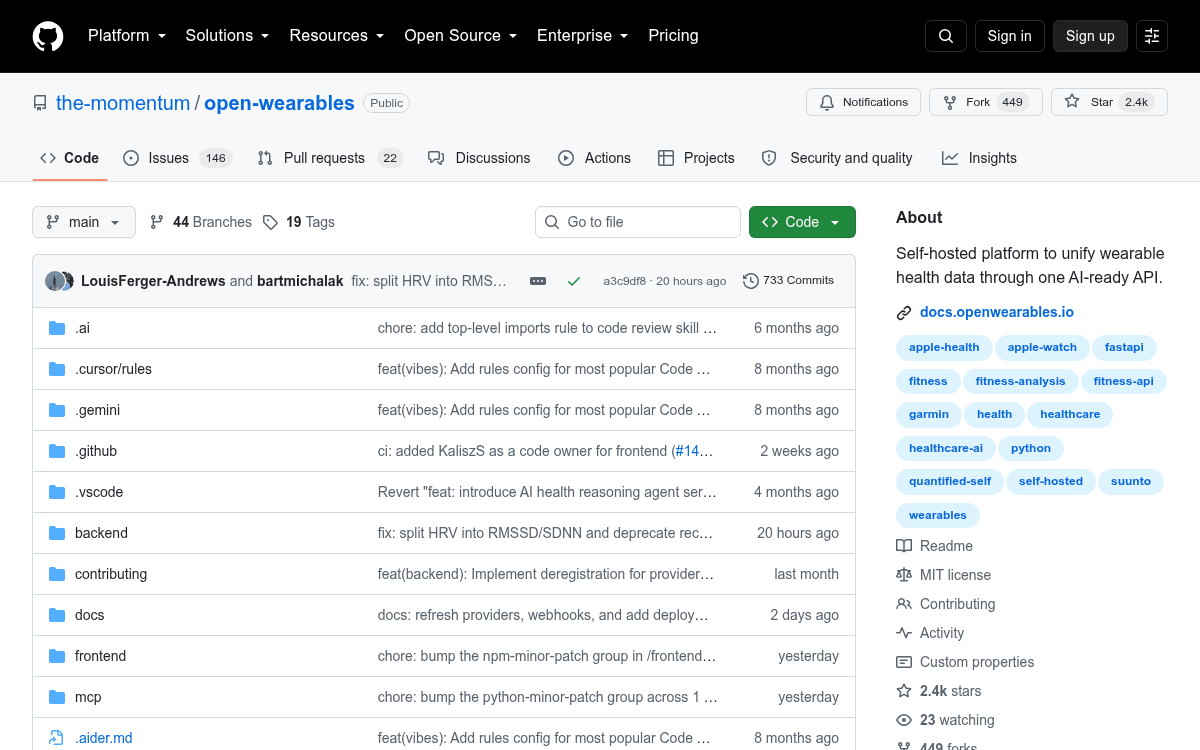
A self-hosted open-source platform that normalizes health data from Garmin, Whoop, Apple Health, Oura, and more behind a single REST API.
Takeaways
- Open Wearables is a self-hosted MIT-licensed platform unifying wearable health data behind one REST API. Repo
- Built on FastAPI, React, PostgreSQL, Redis, and Celery, deployable via a single
docker compose up. - Supports Garmin, Oura, Whoop, Suunto, Polar, Ultrahuman, Strava, Fitbit through cloud OAuth flows.
- Native SDKs push Apple HealthKit, Samsung Health, and Google Health Connect data from devices.
- Currently shipping: developer portal, user management, and full sync for Garmin, Polar, Suunto.
- Coming soon: natural-language Health Insights automations and embeddable AI Health Assistant. Docs
Anyone who has tried building a fitness or health app knows the pain: every wearable vendor ships its own OAuth quirks, rate limits, unit conventions, and SDK release schedules. Open Wearables, a new MIT-licensed project from the team at Momentum, tries to collapse that mess into a single self-hosted service, exposing normalized health data through one REST API that is ready to plug into LLM pipelines.
The repo has already crossed 1.8k stars and ships as a FastAPI backend, a React and TanStack Router frontend, PostgreSQL plus Redis for storage, and Celery for background sync jobs. You can bring the whole stack up locally with a single docker compose up -d, which is the point: no third-party auth service, no SaaS account, and no per-user billing between you and the raw data.
One API instead of ten integrations
The core value proposition is boring in the best possible way. Rather than wiring up Garmin, Whoop, Oura, Strava, and Apple Health separately, you point the platform at your users and it handles the OAuth dance, the sync loop, and the schema translation. The documentation lists coverage across two tiers: