
Neuphonic's NeuTTS Clones Voices On-Device in 3 Seconds Without Cloud GPUs
Neuphonic released a family of open-source TTS speech language models that clone voices from three seconds of audio and run entirely on phones, laptops, and Raspberry Pis.
Takeaways
- Neuphonic open-sourced NeuTTS, a family of on-device TTS speech language models with instant voice cloning.
- Three variants: NeuTTS-Air (~552M), NeuTTS-Nano (multilingual, ~229M), and NeuTTS-2E with 7 emotion controls.
- Clones a voice from 3 to 15 seconds of reference audio plus a transcript.
- Uses NeuCodec, a 0.8 kbps single-codebook neural codec with finite scalar quantization at 24 kHz.
- GGUF Q4/Q8 builds run real-time on phones, laptops, Raspberry Pi via llama.cpp.
- Every clip carries a Perth perceptual watermark for provenance; Apache 2.0 on Air.
Text-to-speech has spent the last few years locked inside expensive web APIs, with the best quality living behind subscription plans and cloud GPUs. Neuphonic wants to break that pattern with NeuTTS, a family of small, open-source speech language models designed to run locally on everyday hardware. The release targets natural-sounding synthesis, real-time performance, built-in watermarking, and speaker cloning on-device, opening the door to embedded voice agents, assistants, toys, and compliance-safe apps.
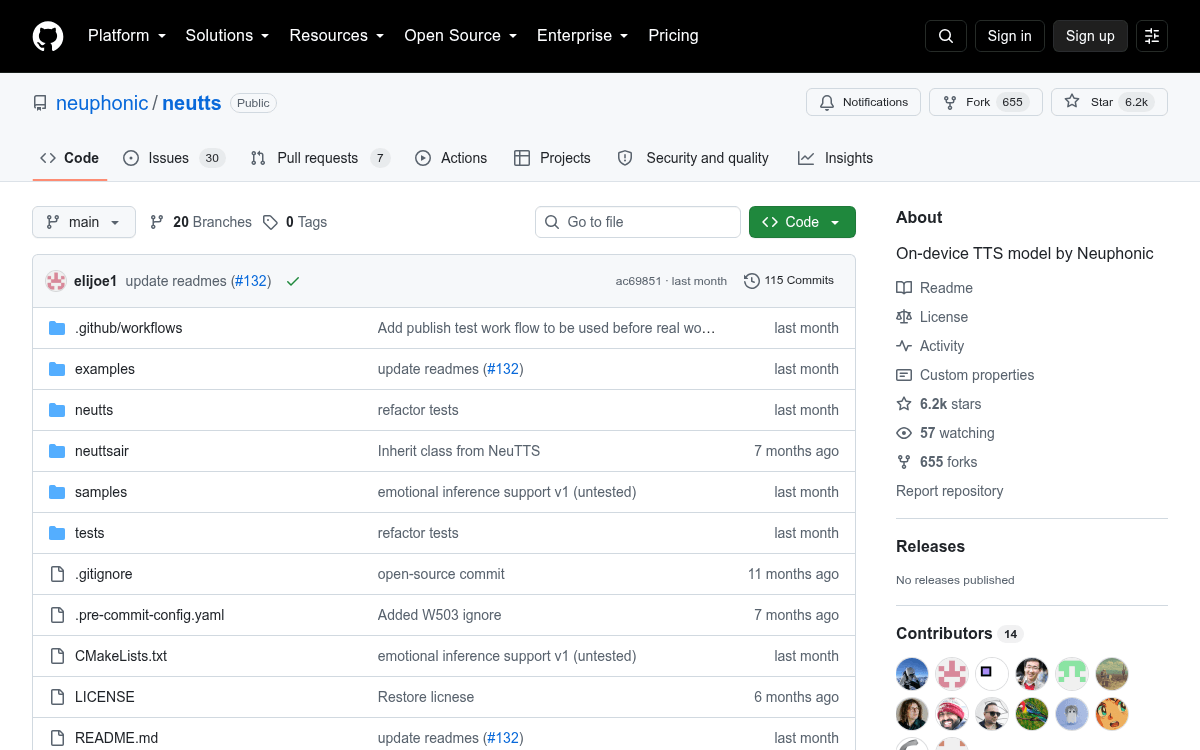
The repo has picked up over 6,000 stars and now spans three model lines: a mid-sized English flagship, a lightweight multilingual family, and an emotion-controllable variant. All of them ship with GGUF quantizations so you can wire them into llama.cpp-style runtimes without a GPU.
Three flavors, one architecture
The family shares a simple design: a small language model backbone emits acoustic tokens, and a neural codec turns those tokens into waveforms. The variants trade off size, language coverage, and controllability.
- NeuTTS-Air: the flagship English model with roughly 360M active parameters (~552M including embeddings), phoneme input, instant cloning, and Apache 2.0 licensing.
- NeuTTS-Nano: a lighter ~120M active parameter model available in English, French, German, and Spanish, also with cloning.
- NeuTTS-2E: ~125M active parameters with four fixed speakers (emily, paul, sophie, steven) and seven emotions covering angry, disgusted, fearful, happy, neutral, sad, and surprised.
Any backbone can be paired with any of the codec variants Neuphonic ships, including a PyTorch NeuCodec, a distilled version, and ONNX decoders (including an int8 build) for edge deployment.