
Nixtla's NeuralForecast Packs 30 AI Forecasting Models Into One Open-Source Library
Nixtla's NeuralForecast bundles 30+ deep learning models for time series behind a single sklearn-style API, from NBEATS to iTransformer and TimeLLM.
Takeaways
- Nixtla's NeuralForecast packages 30+ neural forecasting models behind one sklearn-style PyTorch API.
- Includes NBEATS, NHITS, TFT, PatchTST, iTransformer, TSMixer, TimesNet, DeepAR, TimeLLM and more.
- Ships official NHITS (AAAI 2023) and NBEATSx (IJF) reference implementations from the authors.
- Supports exogenous variables, probabilistic forecasts, interpretability, and Auto tuning via Ray or Optuna.
- Apache 2.0 licensed, installable with
pip install neuralforecastor conda-forge. - For zero-shot forecasting Nixtla points users at their separate hosted TimeGPT API.
Time series forecasting has been quietly overrun by deep learning research over the past few years, but most of the interesting papers ship with brittle reference code, mismatched interfaces, and benchmarks that never quite reproduce. NeuralForecast from Nixtla takes a run at fixing that: a single PyTorch library that packages more than 30 neural forecasting architectures behind a consistent .fit() / .predict() API.
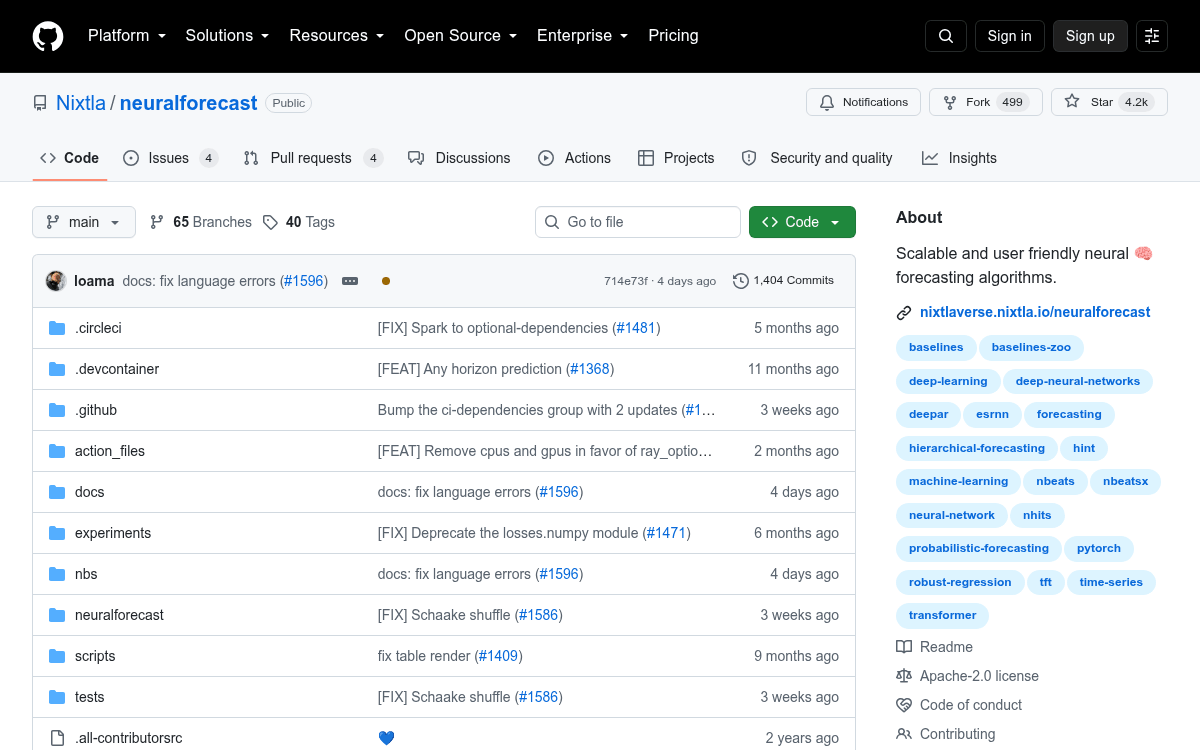
The project has crossed 4,000 stars on GitHub and sits alongside StatsForecast, MLForecast, and HierarchicalForecast as part of the broader Nixtlaverse. The maintainers argue that available implementations and published research have not realized neural networks' potential, being hard to use and continuously failing to improve over statistical methods while remaining computationally prohibitive. NeuralForecast is their opinionated answer.
One import, thirty architectures
The headline feature is breadth. Models range from classic networks like RNNs to recent transformers: MLP, LSTM, GRU, RNN, TCN, TimesNet, BiTCN, DeepAR, NBEATS, NBEATSx, NHITS, TiDE, DeepNPTS, TSMixer, TSMixerx, MLPMultivariate, DLinear, NLinear, TFT, Informer, AutoFormer, FedFormer, PatchTST, iTransformer, StemGNN, and TimeLLM. That is essentially the last five years of forecasting papers, all wired to the same data loader and training loop.