
Nous Research's Hermes Agent Cuts Cold-Start Time 80% and Never Forgets
Nous Research's open-source Hermes Agent pairs a persistent learning loop with 20+ messaging surfaces, turning a chatbot into a self-hosted teammate that grows.
Takeaways
- Hermes Agent is Nous Research's MIT-licensed self-improving agent with persistent memory and skill creation.
- Runs headless on a $5 VPS, GPU cluster, or serverless (Modal, Daytona) with seven terminal backends.
- One gateway process connects Telegram, Discord, Slack, WhatsApp, Signal, Email, and CLI to one shared memory.
- Herald v0.20.0 adds voice, A2A v1.0, signed webhooks, and ~80% faster cold start.
- Provider-pluggable: Nous Portal, OpenAI, Anthropic, Bedrock, OpenRouter, or your own endpoint.
- Includes GEPA-based self-evolution for evolving skills and prompts from execution traces.
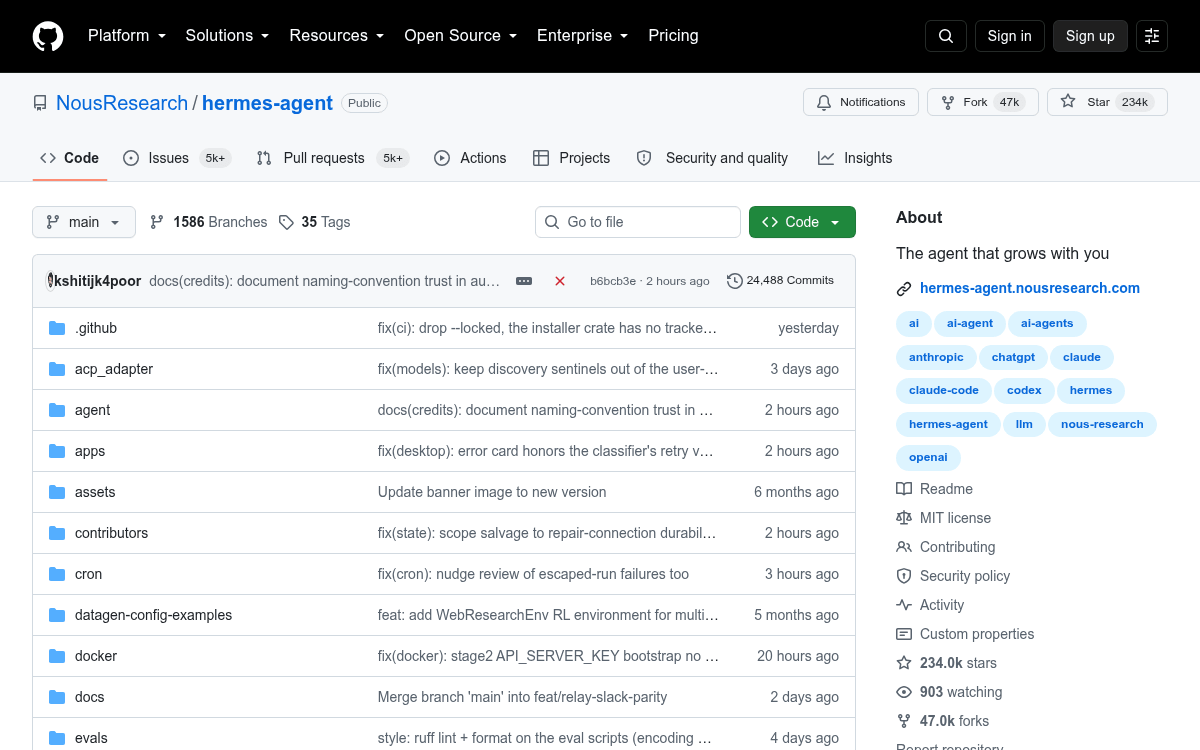
Nous Research has been quietly building something that looks less like a coding copilot and more like a personal operating system for LLMs. Hermes Agent is an MIT-licensed autonomous agent that installs on a laptop, a $5 VPS, or a GPU cluster, remembers what it learns across sessions, and lets you talk to it from Telegram while it works on a cloud VM. The repository has become one of the most-starred agent projects on GitHub, and the recent Herald release pushes it deeper into voice, agent-to-agent messaging, and grounded research.
An agent whose memory compounds
Hermes is billed as the only agent with a built-in learning loop. It creates skills from experience, improves them during use, nudges itself to persist knowledge, searches its own past conversations, and builds a deepening model of who you are across sessions. That framing matters because most agent frameworks treat each session as a blank slate, or offload recall to a vector DB that never really learns. Hermes tries to close the loop end to end.
Under the hood, the learning system combines several ideas the ML community has been circling for a while:
- Agent-curated memory with periodic self-nudges to write things down
- Autonomous skill creation after complex tasks, so procedures become reusable
- Skills that self-improve during use rather than sitting as static prompts
- FTS5 full-text search over past sessions with LLM summarization for cross-session recall
- Dialectic user modeling via Honcho to track who you are, not just what you asked
A separate research repo, hermes-agent-self-evolution, treats skill improvement as an optimization problem. GEPA reads execution traces to understand why things fail, not just that they failed, then proposes targeted improvements using DSPy plus a genetic prompt-evolution loop that ships candidate variants as PRs against the main agent.