
NousResearch's Hermes Agent Evolves Its Own Behavior Without Retraining Any Weights
NousResearch's hermes-agent-self-evolution uses GEPA and DSPy to let agents rewrite their own skills, prompts, and tool code — no GPU needed, ~$2–10 per run
Takeaways
- What it is: NousResearch released hermes-agent-self-evolution, a pipeline that uses GEPA + DSPy to automatically evolve Hermes Agent's skills, prompts, and code.
- No GPU needed: Everything runs via API calls only — no weight updates, no fine-tuning — at ~$2–10 per optimization run.
- GEPA is peer-reviewed: The core optimizer is an ICLR 2026 Oral paper that outperforms GRPO by up to 20% using up to 35x fewer rollouts.
- 5-phase roadmap: Phase 1 (skill files) is implemented; Phases 2–5 covering tool descriptions, system prompts, code, and continuous loops are planned.
- Hard guardrails: Every evolved variant must pass the full test suite, size limits, semantic checks, and benchmark gates — all changes go through human PR review, never auto-merged.
- Community traction: The repo has 3,300+ stars and 355 forks; users report up to 30% token reduction on repetitive tasks after weeks of use.
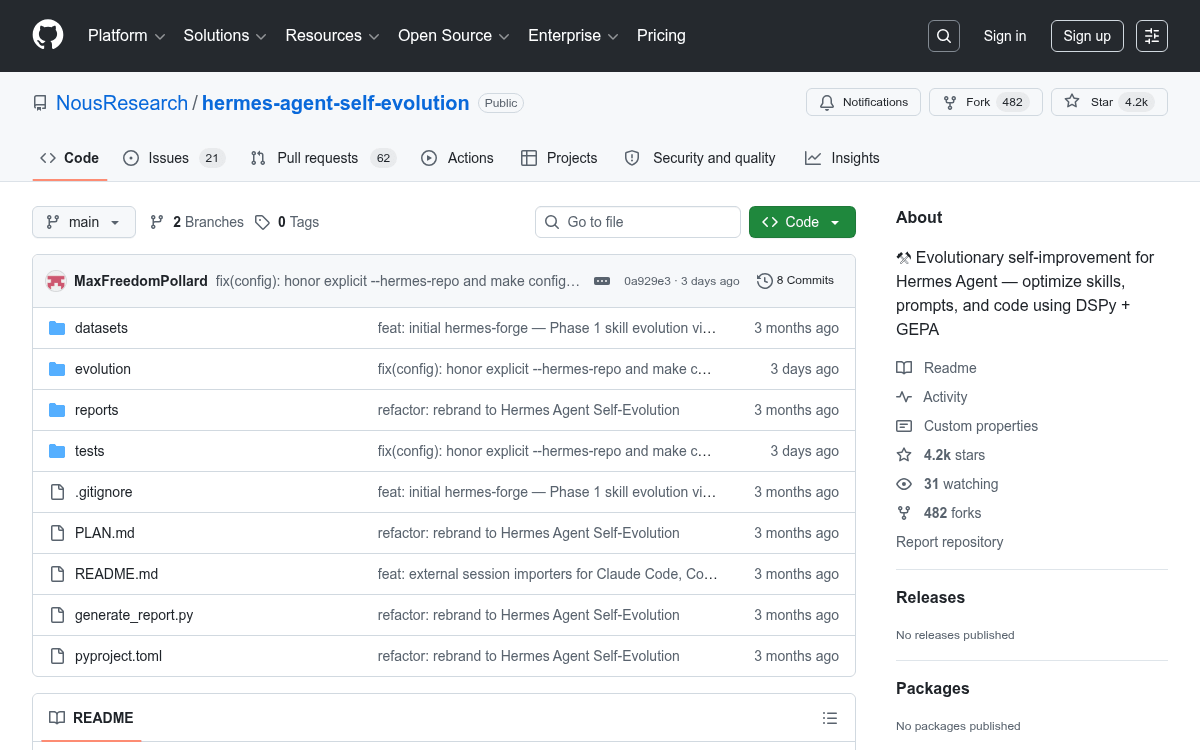
Hermes Agent Self-Evolution is a new open-source pipeline from NousResearch that lets an AI agent improve itself over time , not by retraining weights, but by evolving the text that drives its behavior: skill files, tool descriptions, system prompt sections, and eventually tool implementation code. The engine behind it is GEPA (Genetic-Pareto Prompt Evolution), a prompt optimizer that just received an Oral presentation at ICLR 2026. The repo has already crossed 3,300 stars with 355 forks and is actively receiving community PRs.
The problem it actually solves
Every agent framework eventually hits the same wall: your agent's behavior is only as good as the prompts and skill instructions you wrote on day one. Improving them means manually reading failure logs, guessing what went wrong, editing text, and re-running evals. It's tedious, opaque, and doesn't scale. GEPA reads execution traces to understand why things fail , not just that they fail , and works with as few as 3 examples. That's the shift this project is betting on.
Nous Research built its credibility on the Hermes model series , fine-tuned LLMs with strong instruction-following that became workhorses for the open-source community. Hermes-agent is a different kind of bet: not a model, but an agent framework that claims to get smarter the more you use it.
What GEPA actually does
GEPA is a reflective prompt optimizer for compound AI systems that merges textual reflection with multi-objective evolutionary search. It iteratively mutates prompts using natural language feedback drawn from new rollouts. The key word is reflective , instead of treating a failed run as just a negative scalar reward (like RL does), GEPA reads the full execution trace and writes a natural-language diagnosis of what went wrong before proposing a fix.
Given any AI system containing one or more LLM prompts, GEPA samples system-level trajectories , reasoning, tool calls, and tool outputs , and reflects on them in natural language to diagnose problems, propose and test prompt updates, and combine complementary lessons from the Pareto frontier of its own attempts.