
NVIDIA, Google DeepMind, and Disney's Newton Simulates Robots 475x Faster
Newton, a free GPU-accelerated physics engine from NVIDIA, Google DeepMind, and Disney Research, is closing the sim-to-real gap in robotics with 475x speedups and production deployments at Samsung and Skild AI.
Takeaways
- Newton 1.0 is a free, open-source GPU-accelerated physics engine co-built by NVIDIA, Google DeepMind, and Disney Research, now managed by the Linux Foundation.
- Benchmarks show up to 475x speedup over MJX for manipulation tasks and 313x on RTX 4090, enabling overnight training runs that previously took a week.
- Ships with multiple solvers: MuJoCo-Warp (rigid bodies), VBD (cloth/cables), MPM (granular materials), and Disney's Kamino (closed-loop mechanisms).
- Already in production: Samsung uses it for cable manipulation in assembly lines; Skild AI uses it for GPU rack assembly with tight tolerances.
- Supports differentiable physics, OpenUSD, and integrates with Isaac Lab and MuJoCo Playground; free via
pip install newton. - GPU-first design means full performance requires an NVIDIA GPU; macOS is CPU-only and 189 open issues signal the project is still maturing.
Training a robot arm for thousands of hours in simulation only to watch it fail the moment it touches a real cable or connector has been robotics' quiet bottleneck for a decade. The sim-to-real gap, the mismatch between virtual physics and the real world, has been the reason most simulation-trained policies need extensive real-world fine-tuning before they're actually useful. Newton is a direct attempt to close it.
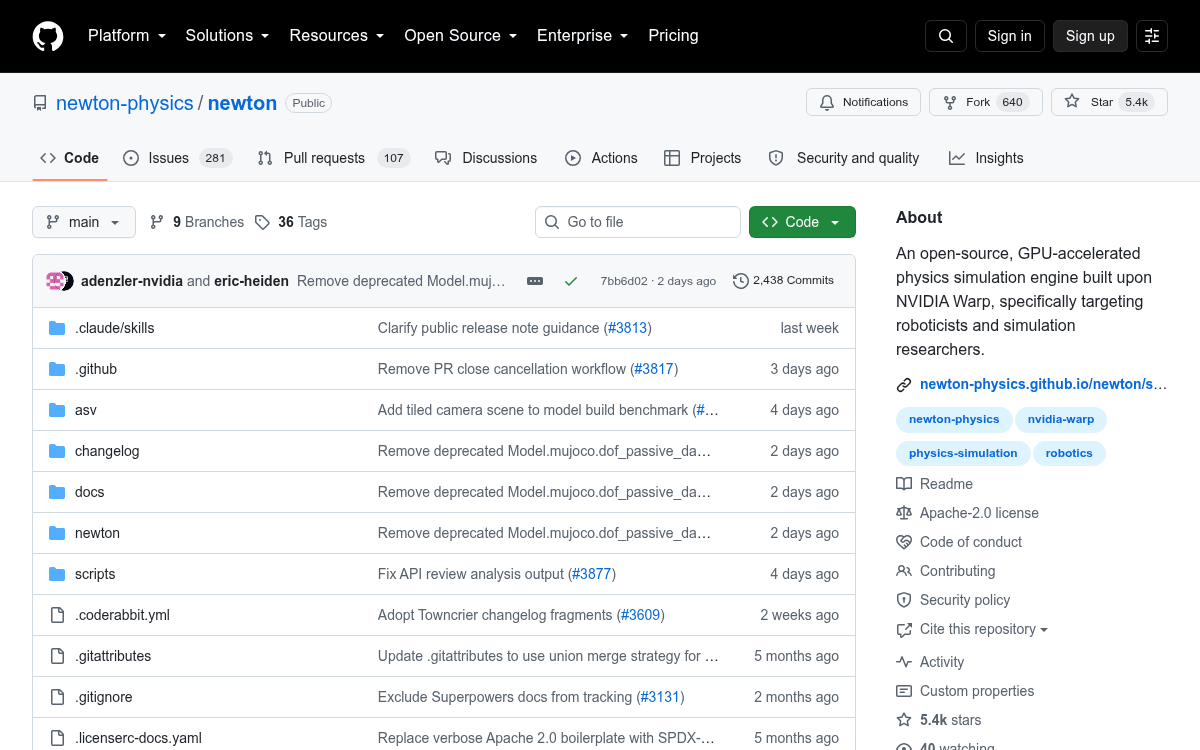
The Linux Foundation welcomed Newton, an open source, GPU-accelerated, extensible physics engine that enables faster, more scalable simulations to lower the barrier to robotics research. Co-developed by Disney Research, Google DeepMind, and NVIDIA, Newton was designed and built by and for robotics developers to tackle the modern-day challenges of building generalist robots. It is built on NVIDIA Warp and OpenUSD, and it is free to use, modify, and extend.
Three Giants, One Engine
The collaboration behind Newton is unusual. Each contributor brings something the others don't have:
- NVIDIA contributes Warp, which lets researchers write simulation code in Python while achieving performance competitive with hand-written CUDA. This matters because the robotics community largely works in Python, and the friction of context-switching to C++/CUDA has historically slowed iteration cycles.
- Google DeepMind contributes MuJoCo-Warp, a GPU-optimized reimplementation of the venerable MuJoCo physics engine. MuJoCo-Warp provides a 70x acceleration for humanoid simulations and a 100x speedup for in-hand manipulation tasks.
- Disney Research brings Kamino, a Newton-based simulator developed at Disney Research, designed to manage the kinds of intricate, closed-loop robotic systems found in Disney's parks, serving as a bridge between the company's animation heritage and the demands of physical robotics.