
NVIDIA Rebuilds NeMo Retriever to Ingest PDFs, Audio, and Video for RAG
NVIDIA rebrands its nv-ingest document extraction tool as NeMo Retriever Library, expanding scope to audio, video, and a cleaner Python API for multimodal RAG pipelines.
Takeaways
- Renamed: NVIDIA's
nv-ingestdocument extraction tool is now officially called NeMo Retriever Library, with a new Python API. - Expanded scope: Now handles PDFs, DOCX, PPTX, HTML, audio, video, images, and more — not just PDFs.
- New extraction method: Nemotron Parse offers VLM-powered PDF parsing for complex layouts via
extract_method="nemotron_parse". - Chainable Python API: New lazy-execution
nemo_retrieverlibrary replaces oldnv-ingestAPIs with a cleaner.files().extract().embed().vdb_upload().ingest()pattern. - Modular NIM stack: Core NIMs ship by default; Nemotron Parse, Omni 30B captioner, and Parakeet ASR are opt-in to avoid pulling ~62 GiB of weights unintentionally.
- Open source, Apache 2.0: Latest stable release is 26.3.0; requires Python 3.12+ and NVIDIA GPUs for full pipeline mode.
NVIDIA has consolidated and rebranded its document ingestion infrastructure under a new name: NeMo Retriever Library. What started as nv-ingest , a microservice for cracking open PDFs and pulling out structured content , has grown into a full multimodal extraction framework that handles everything from Word docs and PowerPoints to audio files and video. The rename reflects a meaningful expansion in both scope and API design.
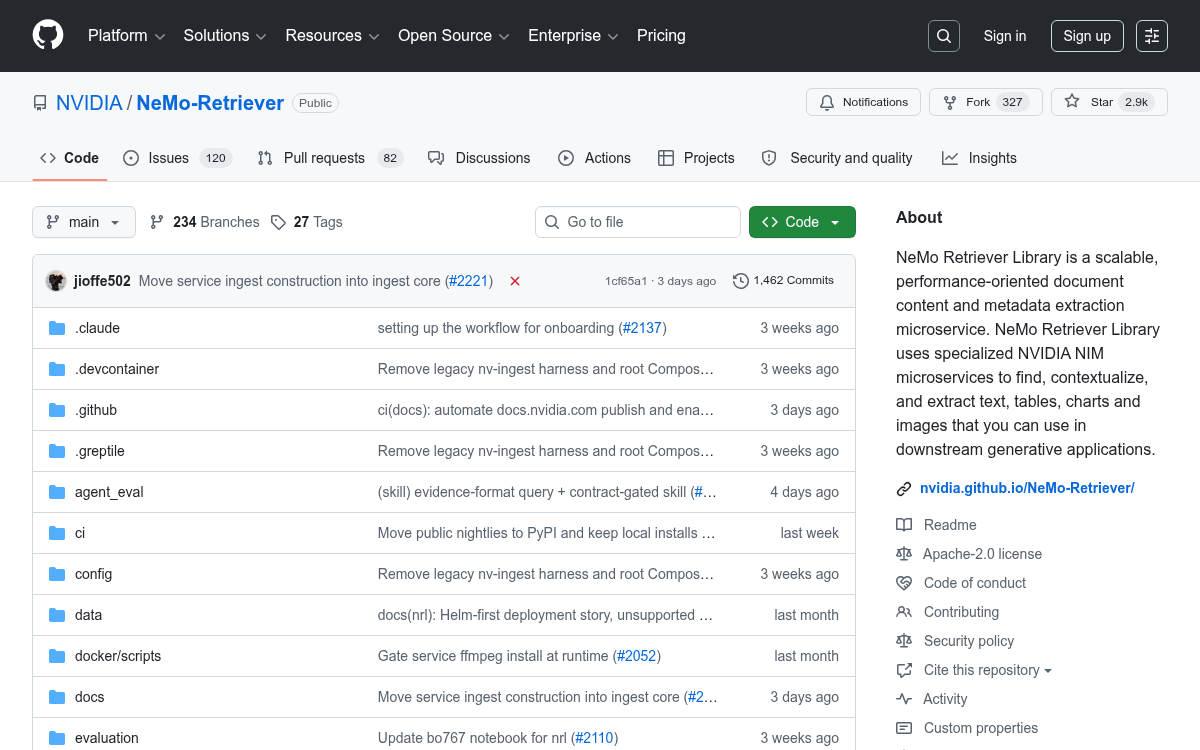
NVIDIA Ingest (nv-ingest) has been renamed NeMo Retriever Library.
The old nv-ingest APIs are being phased out in favor of a cleaner nemo_retriever Python library, and the repo's README now points developers toward the new interface as the forward-looking path.
What it actually does
NVIDIA NeMo Retriever Library (NRL) is a high retrieval accuracy, performant, and scalable framework for content and metadata extraction from various media types , PDFs, HTML, Word docs, PowerPoint, audio, video, and image files. It supports both NVIDIA NIM microservices and a range of models to find, contextualize, and extract text, tables, charts, infographics, and transcripts for use in downstream generative and retrieval-augmented applications.
NeMo Retriever Library enables parallelization of splitting documents into pages where artifacts are classified , such as text, tables, charts, and infographics , extracted, and further contextualized through optical character recognition (OCR) into a well-defined JSON schema. From there, NeMo Retriever Library manages computation of embeddings for the extracted content and stores them in LanceDB.