
NVIDIA's Accelerated Computing Hub Makes GPU Programming Free and Accessible
NVIDIA's free, open-source GPU learning hub now covers CUDA Tile, nvmath-python, and Warp — all runnable in the cloud with one click
Takeaways
- Free & open-source: NVIDIA's Accelerated Computing Hub offers interactive GPU tutorials runnable on Google Colab or NVIDIA Brev.
- CUDA Tile tutorial added: Covers the new tile-based kernel model (cuTile Python, C++, Tile IR) — requires a Blackwell GPU (B200/B300/RTX Pro 6000).
- Massive Python coverage: Tracks for CuPy, cuDF, CCCL, Numba, nvmath-python, and cuda.cooperative; syllabi range from 2 to 8 hours.
- nvmath-python 1.0 now GA: Pythonic access to cuFFT, cuBLASLt, cuTENSOR and more, with multi-GPU/multi-node support and fused kernel execution.
- NVIDIA Warp tutorial included: Covers differentiable GPU simulation in Python, integrating with PyTorch and JAX pipelines.
- All free, Apache 2.0 code: 1,800+ stars, 300+ forks; NVIDIA's official CUDA pages now direct users here as the primary learning resource.
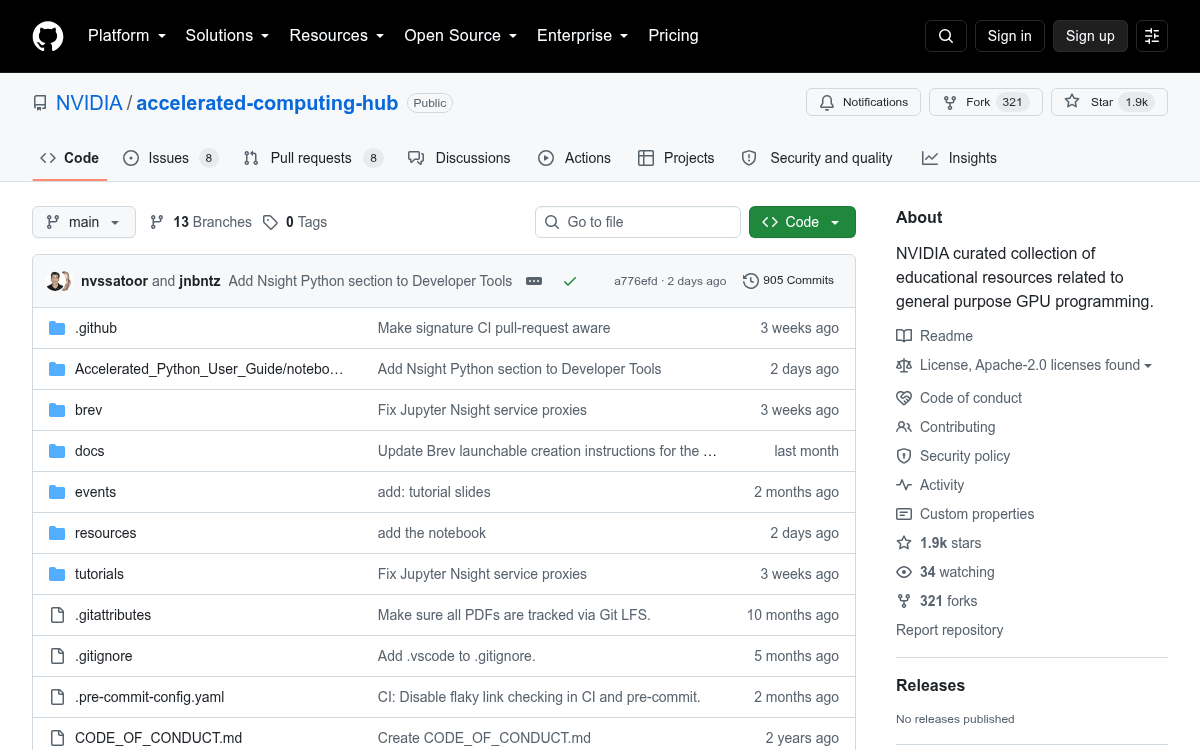
GPU programming has always had a steep on-ramp. CUDA's thread-block-grid model, manual memory management, and the sheer breadth of NVIDIA's library ecosystem make it genuinely hard to know where to start. NVIDIA's answer is the Accelerated Computing Hub , a free, open-source repository of interactive tutorials, user guides, and runnable notebooks that has quietly grown into one of the most practical GPU learning resources available.
One repo, the whole stack
The hub is a home for open learning materials related to GPU computing, with the intention of creating a living project where documents, examples, best practices, optimizations, and new features can become both visible and accessible to users quickly and easily. Everything is free, and the interactive tutorials can be run on NVIDIA Brev or Google Colab , meaning you don't need a local GPU to get started.
The repo currently covers these major tracks:
- CUDA C++ Tutorial , classic kernel writing, thread hierarchies, memory coalescing
- CUDA Tile Tutorial , the new tile-based programming model (Blackwell GPUs required)
- Accelerated Python Tutorial , CuPy, cuDF, CCCL, and custom kernels; available in 2-hour and 8-hour syllabi
- nvmath-python Tutorial , high-performance math ops from Python
- NVIDIA Warp Tutorial , GPU simulation and differentiable physics in Python
- Standard Parallelism (stdpar) Tutorial , GPU acceleration via standard C++ parallel algorithms
- GPU Deployment Tutorial , setting up GPU infrastructure from scratch
The headline addition: CUDA Tile
The most significant new tutorial covers CUDA Tile , arguably the biggest shift in GPU kernel programming in years. Traditionally, GPU kernels have been written using the Single-Instruction, Multiple-Thread (SIMT) model, where developers explicitly assign work to thousands of individual threads and manually manage scheduling, memory access, and synchronization. The new CUDA Tile model abstracts much of that complexity: developers work with arrays and tiles (subregions of arrays) instead of individual threads, and the GPU compiler and runtime are responsible for mapping tiles to actual hardware.