
NVIDIA's CCCL 3.x Unifies GPU Computing Into One Open-Source Library
NVIDIA's CUDA Core Compute Libraries unify Thrust, CUB, and libcudacxx into a single standard library for GPU programming, now with Python APIs and deterministic reductions
Takeaways
- Unified GPU standard library: CCCL merges Thrust, CUB, and libcudacxx into one repo, providing high-level and low-level GPU primitives under a single versioned API.
- CCCL 3.x requires C++17+ and CUDA 12+: The major version bump dropped legacy C++ dialect support and reorganized headers under
${CTK_ROOT}/include/cccl/. - Deterministic reductions now available: CCCL 3.1 adds three explicit determinism modes to
cub::DeviceReduce, including a gpu-to-gpu bitwise-identical option critical for reproducible ML training. - Simpler CUB APIs: New single-phase overloads accept a memory resource, eliminating the cumbersome two-step temp-storage query-allocate pattern.
- Python support added in CCCL 3.3: Python developers can now access parallel sort, reduction, and cooperative primitives without writing CUDA C++.
- Massive downstream adoption: PyTorch, TensorFlow, vLLM, TensorRT-LLM, cuDF, XGBoost, and dozens more frameworks build directly on CCCL.
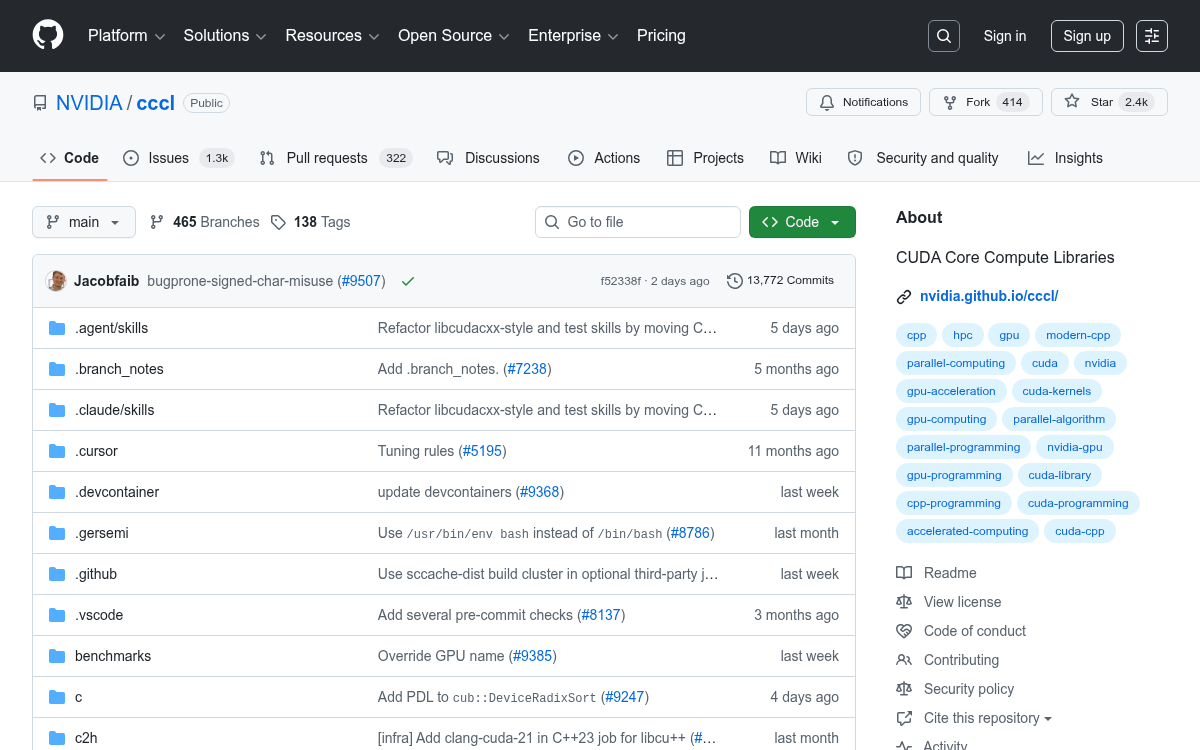
CUDA Core Compute Libraries (CCCL) is NVIDIA's answer to a question GPU programmers have been asking for years: why do I have to juggle three separate libraries just to write a parallel reduction? CCCL consolidates Thrust, CUB, and libcudacxx into one unified repo, and it has quietly become the backbone of nearly every serious GPU compute stack out there, from PyTorch and TensorFlow to vLLM and TensorRT-LLM.
Three libraries, one mission
The concept for CCCL grew organically out of Thrust, CUB, and libcudacxx, three projects developed independently over the years with a similar goal: to provide high-quality, high-performance, and easy-to-use C++ abstractions for CUDA developers. The overlap was obvious, and so was the fix.
- Thrust: A powerful data-parallel library based on the C++ STL that lets developers implement complex GPU-accelerated algorithms in a high-level API without sacrificing performance.
- CUB: Cooperative primitives for CUDA kernel authoring, providing warp-wide, block-wide, and device-wide collective primitives across the CUDA programming model.
- libcudacxx: The CUDA C++ Standard Library, giving you
cuda::std::atomic,cuda::std::span, synchronization primitives, and more, all usable in both host and device code.
The main goal of CCCL is to fill a similar role that the Standard C++ Library fills for Standard C++: provide general-purpose, speed-of-light tools to CUDA C++ developers, allowing them to focus on solving the problems that matter.
What CCCL 3.x actually changes
The 3.0 release marks CCCL's first major version since unifying the three libraries under a single repository, reflecting over a year of work focused on cleanup, consolidation, and modernizing the codebase to support future growth. The most visible breaking change: C++17 or newer is now required (support for C++11 and C++14 has been dropped), and CUDA Toolkit 12.0+ is now required.
CCCL version 3.0 is included with CUDA Toolkit 13.0, unifying Thrust, CUB, and libcudacxx libraries, with headers relocated to