
NVIDIA's Earth2Studio Unifies Every Major AI Weather Model in Four Lines of Code
NVIDIA's open-source Earth2Studio gives Python developers a unified API to run, chain, and benchmark state-of-the-art AI weather models in minutes
Takeaways
- What it is: Earth2Studio is NVIDIA's open-source Python toolkit for running AI weather/climate inference pipelines with a unified API.
- Largest model zoo: Supports 20+ pre-trained models including FourCastNet3, GraphCast, AIFS, Aurora, Pangu, StormCast, and GenCast Mini.
- v0.15.0 adds observational data: New satellite (Himawari AHI), station (GHCN-Daily), and real-time conventional obs sources, plus Orbit-2 precipitation downscaling.
- v0.16.0 alpha in progress: Adds ECMWF AIFS 2.0 with wave variables, stochastic ensemble variant, and NCEP CFSv2 seasonal forecast data.
- Agent-ready: New AI agent skills let Claude/Codex scaffold full forecast workflows via the NVIDIA Skills catalog.
- Free and open-source: Apache 2.0 license; inference only — training is handled by the separate PhysicsNeMo repo.
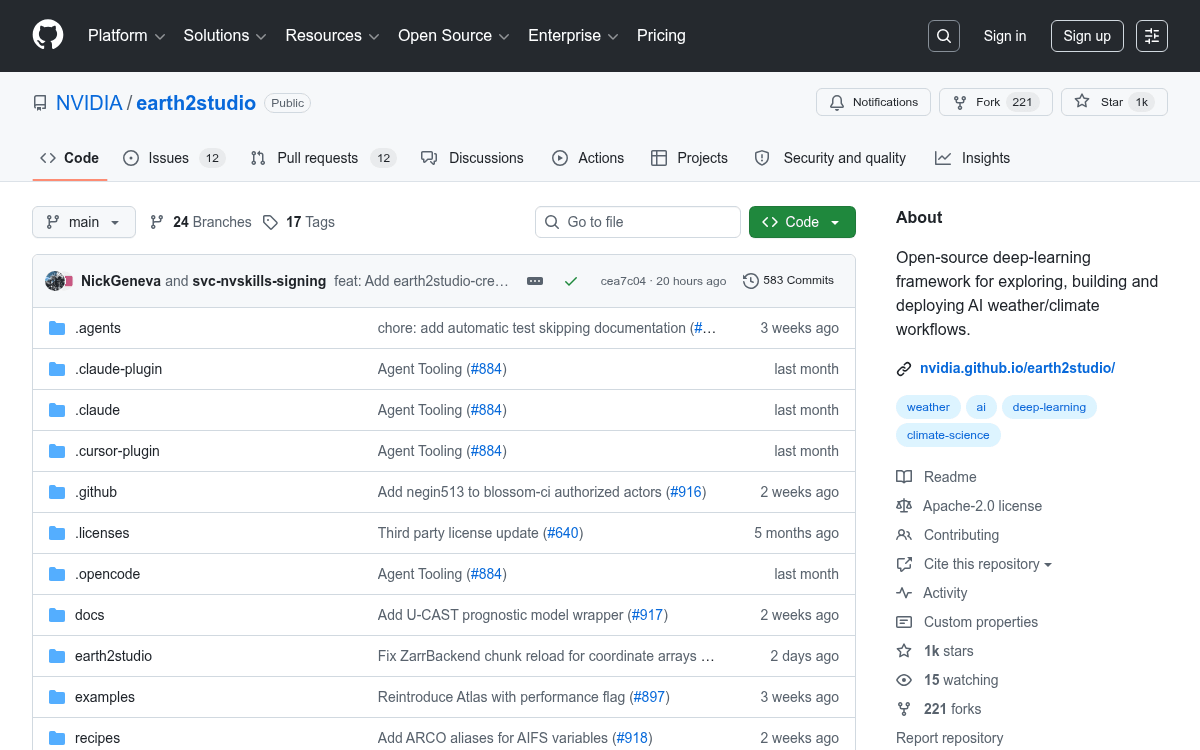
Earth2Studio is NVIDIA's open-source Python framework for building AI-driven weather and climate inference pipelines. It sits above the raw model weights and data formats, giving you a composable toolkit to fetch atmospheric data, run forecasts with pre-trained models, apply diagnostics, and write outputs , all through a single unified API. The repo has crossed 1,000 GitHub stars and is actively maintained, with version 0.15.0 shipping recently and a 0.16.0 alpha already in progress.
The problem it solves
AI weather forecasting has exploded in the last two years. GraphCast, Pangu-Weather, FourCastNet, AIFS, Aurora , each comes with its own checkpoint format, coordinate system, data preprocessing logic, and inference loop. Stitching them together for a real workflow means writing a lot of glue code. Earth2Studio replaces that glue with a shared vocabulary and protocol, so swapping one model for another is a one-line change.
The framework is built around five composable component types:
- Prognostic models , time-stepping models that auto-regressively roll out atmospheric fields into the future (typically 6 hours per step)
- Diagnostic models , time-independent transforms that derive new quantities from a forecast (precipitation, wind gusts, tropical cyclone tracks, solar radiation)
- Data sources , standardized connectors to operational feeds (GFS, IFS, HRRR), reanalysis archives (ERA5, ARCO), and satellite observations
- IO backends