
NVIDIA's NeMo Agent Toolkit Turns Experimental AI Agents Into Production-Ready Systems
NVIDIA's open-source NeMo Agent Toolkit adds inference-aware scheduling, framework-agnostic performance primitives, and a full build-evaluate-optimize loop for multi-agent systems
Takeaways
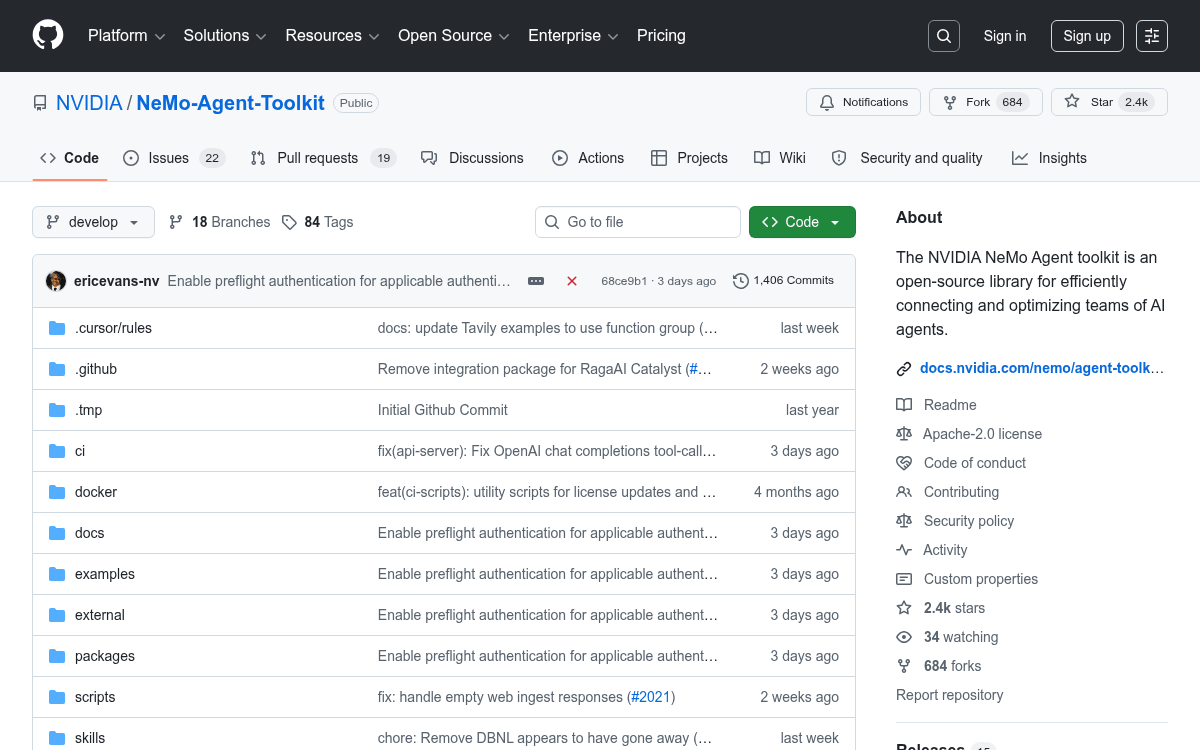
- Open-source multi-agent toolkit: NVIDIA NeMo Agent Toolkit (NAT) is a framework-agnostic library for building, profiling, evaluating, and optimizing multi-agent AI systems, available on GitHub.
- Dynamo Runtime Intelligence: New feature automatically infers per-request latency sensitivity from agent profiles and passes hints to NVIDIA Dynamo for cache control, load-aware routing, and priority serving.
- Agent Performance Primitives (APP): Framework-agnostic primitives accelerate LangChain, CrewAI, and Agno with parallel execution, speculative branching, and node-level priority routing.
- Full lifecycle tooling: Covers build (YAML config), observe (token-level profiling, LangSmith/Phoenix/Weave integrations), and optimize (genetic algorithm prompt tuning, RL fine-tuning from agent trajectories).
- Protocol-native: First-class support for both MCP (as client and server) and Agent-to-Agent (A2A) protocol, enabling interoperability with any compatible orchestrator or tool server.
- Free, Apache 2.0: Install with
pip install nvidia-nat; supports Python 3.11–3.13; peak performance features require self-hosted NVIDIA Dynamo infrastructure.
NVIDIA NeMo Agent Toolkit (NAT) is an open-source Python library built around one idea: you should be able to add enterprise-grade instrumentation, profiling, and optimization to your existing agent stack without ripping it out and starting over. With over 2,300 GitHub stars and 14 releases since its launch, the toolkit has grown into a full lifecycle platform for multi-agent systems, covering everything from building and evaluating to fine-tuning and serving at scale.
The problem it's solving
Most agent frameworks today are good at one thing: building agents. What they lack is the operational layer that makes those agents production-ready. How do you know which step in a 10-agent pipeline is causing latency? How do you systematically improve prompt quality without manual trial-and-error? How do you fine-tune a model specifically for your agent's tool-calling patterns? NAT is NVIDIA's answer to that gap.
It serves as a unifying library that connects existing enterprise agents to data sources and tools across multiple frameworks, including LangChain, LlamaIndex, CrewAI, Agno, and Microsoft Semantic Kernel, and provides enterprise-grade instrumentation, profiling capabilities, and facilities for continuous improvement through automated evaluation and hyperparameter optimization.
What's new in recent releases
The toolkit has been shipping features rapidly. The headline additions across recent releases include:
- Dynamo Runtime Intelligence: Automatically infers per-request latency sensitivity from agent profiles and applies runtime hints for cache control, load-aware routing, and priority-aware serving.
- Agent Performance Primitives (APP): Framework-agnostic performance primitives that accelerate graph-based agent frameworks such as LangChain, CrewAI, and Agno with parallel execution, speculative branching, and node-level priority routing.
- FastMCP Workflow Publishing: Publish NeMo Agent Toolkit workflows as MCP servers using the FastMCP runtime to simplify MCP-native deployment and integration.