
OmniRoute Unifies 160+ AI Providers Behind One Free Open-Source Gateway
OmniRoute is a free, open-source AI gateway that unifies 160+ providers behind one endpoint with smart fallback, prompt compression, and full MCP/A2A support
Takeaways
- One endpoint, 160+ providers: OmniRoute is a free, open-source AI gateway that routes any OpenAI-compatible tool across 160+ LLM providers with smart auto-fallback.
- 4-tier fallback chain: Requests cascade automatically from paid subscriptions → API keys → cheap providers → free providers, with zero downtime.
- Up to 95% token savings: A built-in 7-mode compression pipeline (including RTK + Caveman stacked mode) reduces token usage transparently before requests reach any provider.
- 11+ genuinely free providers: Kiro, Qoder, Pollinations, LongCat (50M tokens/day), Cloudflare AI, NVIDIA NIM, and more — combined ~32B tokens/month at $0.
- MCP + A2A native: Exposes 87 MCP tools across 30 scopes and a full A2A JSON-RPC 2.0 server, making it operable by agents, not just humans.
- Install in one command:
npm install -g omniroute— also available via Docker, Electron desktop app, and Android (Termux).
OmniRoute is a self-hosted AI gateway that puts every major LLM provider behind a single OpenAI-compatible endpoint. Instead of juggling separate API keys, rate limits, and quota resets across Claude, GPT, Gemini, DeepSeek, and dozens more, you point your coding tools at http://localhost:20128/v1 and let OmniRoute handle the rest. It is fully open-source under the MIT license, written in 100% TypeScript, and costs nothing to run.
The problem it actually solves
If you use AI coding tools heavily, you have hit this wall: Claude Pro quota runs out mid-session, you switch to GPT, that rate-limits, you manually copy your context to another tab. OmniRoute eliminates development interruptions caused by quota limits or provider downtime by implementing automated, multi-tier fallback routing and format translation for coding agents and CLI tools. The key insight is that most developers already have access to multiple providers, they just have no infrastructure to stitch them together automatically.
The 4-tier fallback chain
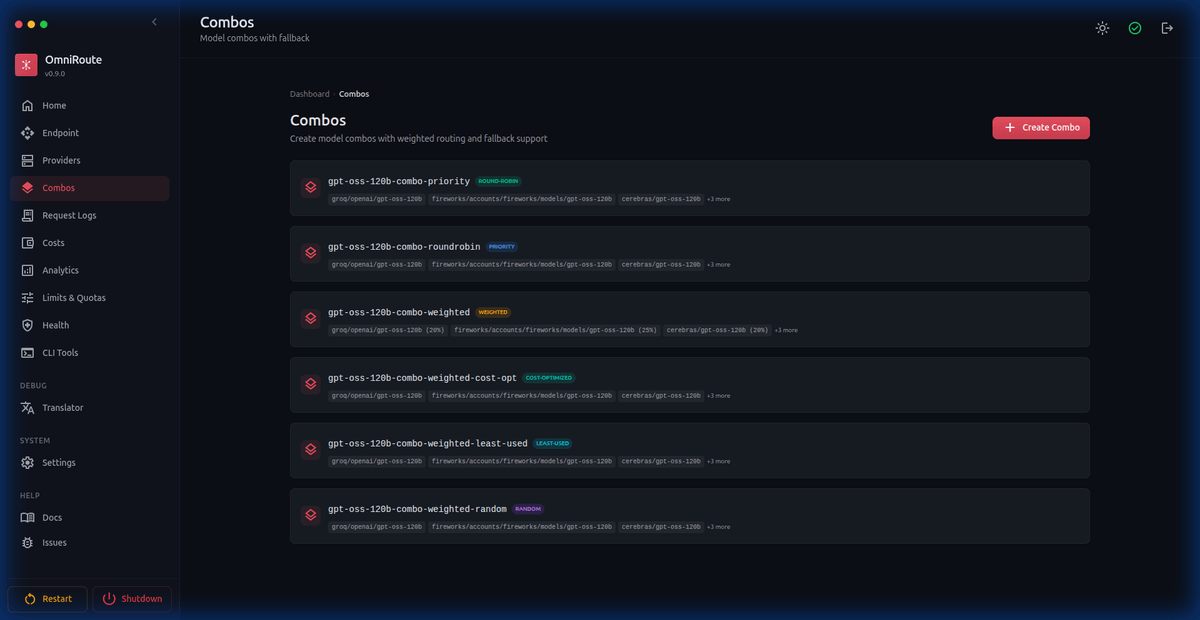
OmniRoute routes requests sequentially through four priority levels: Subscriptions, API Keys, Low-cost providers ($0.2/1M tokens), and Free providers. When your Claude Pro quota is exhausted, it silently falls over to a cheap API provider. When that hits a budget cap, it falls to genuinely free tiers. With 15 routing strategies and tier-1/2/3 fallback, quota out on one provider means you are switched to the next in milliseconds. The whole cascade is configurable from a dashboard with no YAML editing required.
The fallback chain is just one of 15 routing strategies. Others include:
- Round-robin / P2C , balance traffic across keys and accounts to dodge rate limits
- Cost-optimized , always route to the lowest cost-per-token that can serve the request
- Context-relay , keep long contexts on models that fit, relay when they overflow
- Task-aware routing , analyzes incoming request content to identify one of seven task types (coding, vision, summarization, etc.) and selects the model variant optimized for that domain