
Open-Source Anthropic-Cybersecurity-Skills Gives AI Agents 817 Expert Hacking Workflows
Mahipal Jangra's community-built repo gives AI agents 817 structured, MITRE-mapped cybersecurity playbooks installable in one command across 26+ platforms.
Takeaways
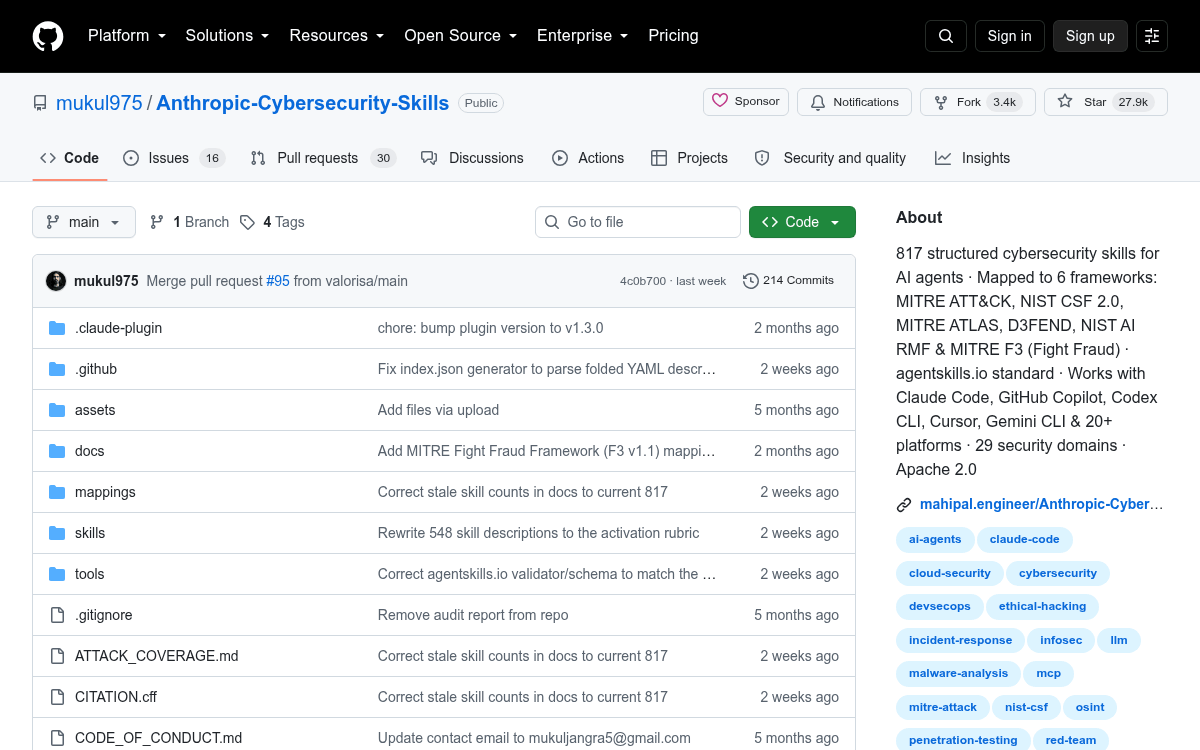
- Mahipal Jangra released Anthropic-Cybersecurity-Skills, a community-built open-source library (not affiliated with Anthropic PBC) of 817 structured cybersecurity skills for AI agents.
- Skills are structured Markdown + YAML files encoding full practitioner workflows: trigger conditions, prerequisites, step-by-step commands, and verification checks.
- The library maps across 6 frameworks: MITRE ATT&CK v19.1, NIST CSF 2.0, MITRE ATLAS, MITRE D3FEND, NIST AI RMF, and the new MITRE Fight Fraud Framework (F3 v1.1).
- Covers 29 security domains including cloud security, threat hunting, red teaming, DFIR, AI security, and OT/ICS; installable in one command via
npx skills add mukul975/Anthropic-Cybersecurity-Skills. - Works with 26+ platforms out of the box: Claude Code, GitHub Copilot, Cursor, Gemini CLI, OpenAI Codex CLI, LangChain, AutoGen, and any agentskills.io-compatible agent.
- Free under Apache 2.0; the repo has 3,000+ stars and 312 forks, with a live playground available at Casky.ai.
There are roughly 4.8 million unfilled cybersecurity roles globally, and AI agents are increasingly being asked to help close that gap. The problem is that a generic LLM can write code and search the web, but it has no idea when to run a Volatility3 plugin on a memory dump, which Sigma rules catch Kerberoasting, or how to scope a cloud breach across three providers. Mahipal Jangra, a security practitioner and independent developer, built Anthropic-Cybersecurity-Skills to fix exactly that , a community-maintained, open-source library of 817 structured cybersecurity skills designed to be loaded directly into AI agents.
The repo is not affiliated with Anthropic PBC in any way. The name comes from its original focus on Claude Code as a target platform. It now works with over 26 AI coding assistants and agent frameworks, from GitHub Copilot and Cursor to LangChain and AutoGen.
Skills, not scripts
The key distinction here is what a "skill" actually is. This is not a collection of exploit scripts, wordlists, or checklists. Each skill is a structured Markdown file with YAML frontmatter that encodes a real practitioner workflow: when to use the technique, what prerequisites to check, the exact step-by-step execution with CLI commands, and how to verify results. Think of it as the decision-making playbook of a senior analyst, packaged in a format an AI agent can read and act on.
The architecture uses a progressive disclosure pattern, which is the key design insight. An agent scans only the YAML frontmatter of each skill , roughly 30 tokens per skill , to decide relevance, then loads the full workflow body (500–2,000 tokens) only when needed. This means an agent can search all 817 skills in a single pass without blowing its context window.