
Open-Source Tool reverse-SynthID Strips Google DeepMind's Invisible Watermark From Gemini Images
An independent researcher cracked Google's SynthID image watermark using only FFT and a Stable Diffusion VAE, bypassing the detector with visually lossless output
Takeaways
- Cracked in 6 rounds: Independent researcher Alosh Denny built reverse-SynthID, an open-source tool that bypasses Google's SynthID watermark detector with visually lossless output.
- Root cause: SynthID uses a fixed phase template identical across all images from the same Gemini model, making the watermark extractable by averaging noise from reference images.
- 7-stage pipeline: The final Round 06 attack chains a Stable Diffusion VAE round-trip, elastic deformation, geometric warps, resize-squeeze, color nudge, FFT subtraction, and JPEG compression.
- Confirmed bypass: The tool achieves 91% phase coherence drop and has been manually verified to defeat the live Gemini app detector on both
gemini-3.1-flash-image-previewandnano-banana-pro-preview. - High stakes timing: The EU AI Act's mandatory AI content watermarking requirement takes effect August 2026, directly overlapping with public proof that the leading watermark can be stripped.
- Broader implications: OpenAI recently adopted SynthID for ChatGPT image outputs; the bypass raises questions about whether pixel-embedded watermarks can serve as reliable provenance infrastructure.
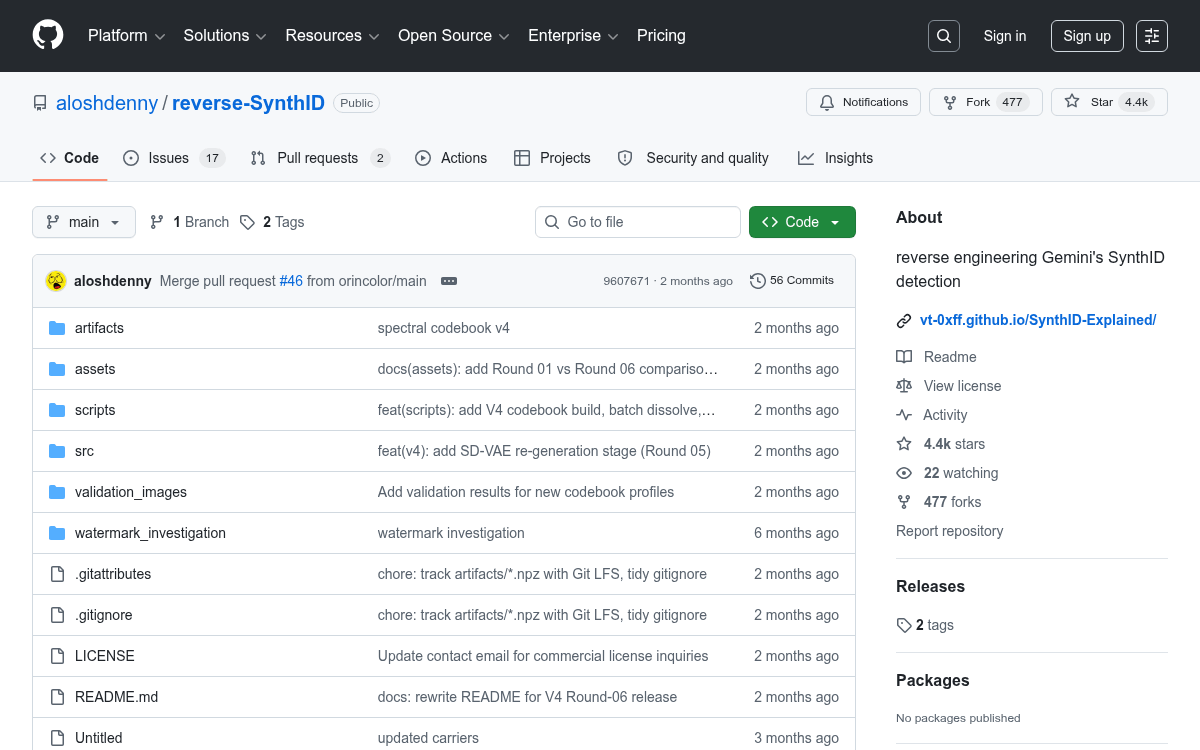
reverse-SynthID is an open-source project that does exactly what its name suggests: it reverse-engineers, detects, and surgically removes the invisible watermark that Google DeepMind bakes into every image generated by Gemini. Built by independent researcher Alosh Denny using nothing but signal processing and a borrowed Stable Diffusion VAE, the project has accumulated over 4,400 GitHub stars and sparked a serious conversation about whether invisible watermarks can ever be a reliable foundation for AI content provenance.
What SynthID actually does
SynthID is Google DeepMind's AI authentication technology that embeds invisible signals into content during generation, working across images, video, audio, and text. Unlike metadata-based watermarks that strip on re-encode, SynthID embeds the mark directly into the content itself , modulating pixel patterns in images, waveforms in audio, and token probabilities in text , producing a signal that survives most ordinary editing, transcoding, and compression.
Google created SynthID to watermark AI-generated media, and by Google I/O the company reported over 10 billion pieces of content had been watermarked with the technology. The stakes got higher when OpenAI announced it would incorporate SynthID into images generated through ChatGPT and the OpenAI API, with SynthID providing an invisible watermarking layer that complements C2PA metadata-based approaches. In short: SynthID was becoming the industry's default provenance layer.
The structural flaw that made this possible
The attack works because of one critical design choice: SynthID embeds carrier frequencies at different absolute positions depending on image resolution, and the watermark's phase template is identical across all images from the same Gemini model. That last part is the vulnerability. If the watermark phase is the same in every single image, you can average it out.
Researchers reverse-engineered SynthID by collecting images from Gemini, averaging their noise patterns, isolating the consistent frequency-domain signature, and inverting it , achieving a 91% phase coherence drop and 75% carrier energy reduction. The green channel carries the strongest watermark signal, and at 1024x1024 resolution, the top carrier bins show 100% phase coherence across all reference images. Once you know exactly where the watermark lives in frequency space, you can subtract it.