
OpenAI Open-Sources Privacy Filter to Strip Sensitive Data Before It Reaches Any AI
OpenAI open-sources a 1.5B-parameter PII detection model that runs locally, strips sensitive data in one pass, and hits 96% F1 out of the box
Takeaways
- OpenAI released Privacy Filter, an open-weight PII detection model that runs fully on-device under Apache 2.0.
- 1.5B total parameters, only 50M active at inference via sparse Mixture-of-Experts routing -- runs on a laptop or in a browser.
- Detects 8 PII categories including names, addresses, emails, phone numbers, dates, account numbers, and secrets like API keys.
- Hits 96% F1 on the PII-Masking-300k benchmark; fine-tuning on just 10% of domain data jumps F1 from 54% to 96%.
- 128K token context window enables single-pass processing of long documents with no chunking required.
- Weights and code available on GitHub and Hugging Face; multilingual and adversarial performance are known weak spots.
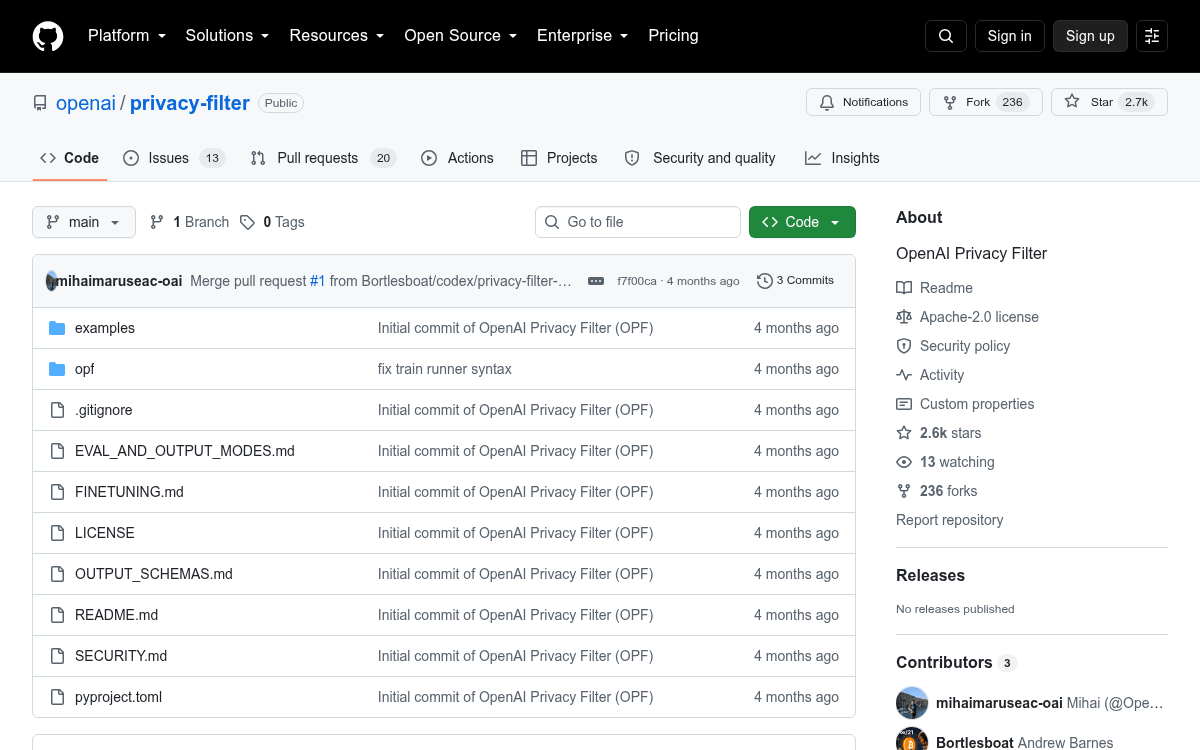
OpenAI just open-sourced Privacy Filter, a purpose-built model for detecting and redacting personally identifiable information (PII) in text. It runs entirely on your machine, processes up to 128,000 tokens in a single forward pass, and is free to use commercially under the Apache 2.0 license. The repo and weights are live on GitHub and Hugging Face right now.
The headline stat: Privacy Filter achieves state-of-the-art results on the PII-Masking-300k benchmark with an F1 score of 96%, rising to a corrected 97.43% after accounting for label noise in the dataset. That puts it well ahead of regex-based tools and older NER models on real-world text.
The problem it actually solves
Every team building on top of LLMs eventually runs into the same wall: you want to send user data to a model, but that data contains names, emails, phone numbers, or API keys. The classic options are either regex patterns (brittle, easy to fool) or sending the text to a managed cloud service for de-identification (which defeats the purpose if data residency is the concern).
Privacy Filter is designed for high-throughput privacy workflows, and is able to perform context-aware detection of PII in unstructured text. It can run locally, which means that PII can be masked or redacted without leaving your machine. That last part is the whole point for regulated industries.
OpenAI also notes they use a fine-tuned version of Privacy Filter in their own internal privacy-preserving workflows, which is a meaningful signal about production readiness.
What it detects
It detects eight categories of sensitive spans:
private_person- individual namesprivate_address- home and physical addressesprivate_email- email addressesprivate_phone- phone numbersprivate_url- URLs tied to individualsprivate_date- dates (e.g. birthdates)account_number- credit card numbers, bank accounts, and similarsecret- API keys, passwords, credentials