
Parlor Runs a Full Voice-and-Vision AI Assistant Locally on a Laptop
Parlor runs voice and vision conversations entirely on a laptop, using Gemma 4 E2B and Kokoro to hit sub-3-second replies with 3 GB of RAM.
Takeaways
- Parlor is an open-source app for local voice and vision chat, powered by Gemma 4 E2B and Kokoro
- Runs entirely on-device with roughly 3 GB RAM, no cloud API dependencies
- End-to-end latency of 2.5 to 3 seconds on Apple M3 Pro, 83 tokens per second decode
- Features browser-side Silero VAD, barge-in interrupts, sentence-level TTS streaming
- FastAPI server with WebSocket audio and JPEG frame transport, MLX on Mac, ONNX on Linux
- Apache 2.0 licensed research preview aimed at language learning and offline assistants
A new open-source project called Parlor shows just how far on-device multimodal AI has come in a year. It runs a full voice-and-vision conversational assistant on an Apple Silicon laptop, with no API calls to the cloud, no server hosting, and no push-to-talk. You speak, point your camera at something, and it answers back in a synthesized voice, all locally.
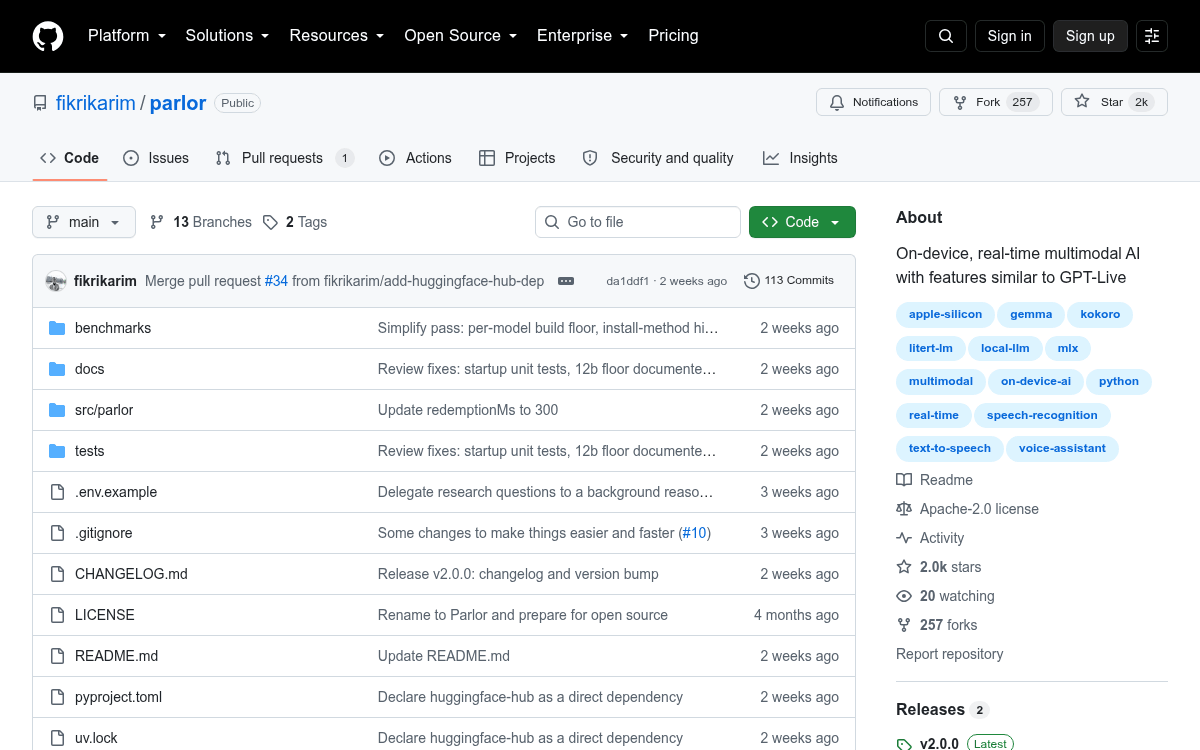
The repo has climbed to nearly 2,000 stars and stitches together three recent pieces of on-device tech: Google's Gemma 4 E2B for understanding speech and images, Kokoro for text-to-speech, and Silero VAD in the browser for voice activity detection. Parlor uses Gemma 4 E2B for understanding speech and vision, and Kokoro for text-to-speech.
The RTX 5090 problem, solved by a small model
The author frames the motivation clearly. They run a free voice AI service that helps people learn English, and hosting costs are the enemy of "free." Six months ago running the voice models in real-time required an RTX 5090. A capable small multimodal model changes that math: push inference to the user's device and the server bill collapses to zero.