
Pollen Robotics Opens Reachy Mini SDK so AI Agents Can Code Your Robot
Pollen Robotics open-sourced the Python SDK powering Reachy Mini, an $299 Hugging Face desktop robot with WebRTC control and a Spaces-powered app store.
Takeaways
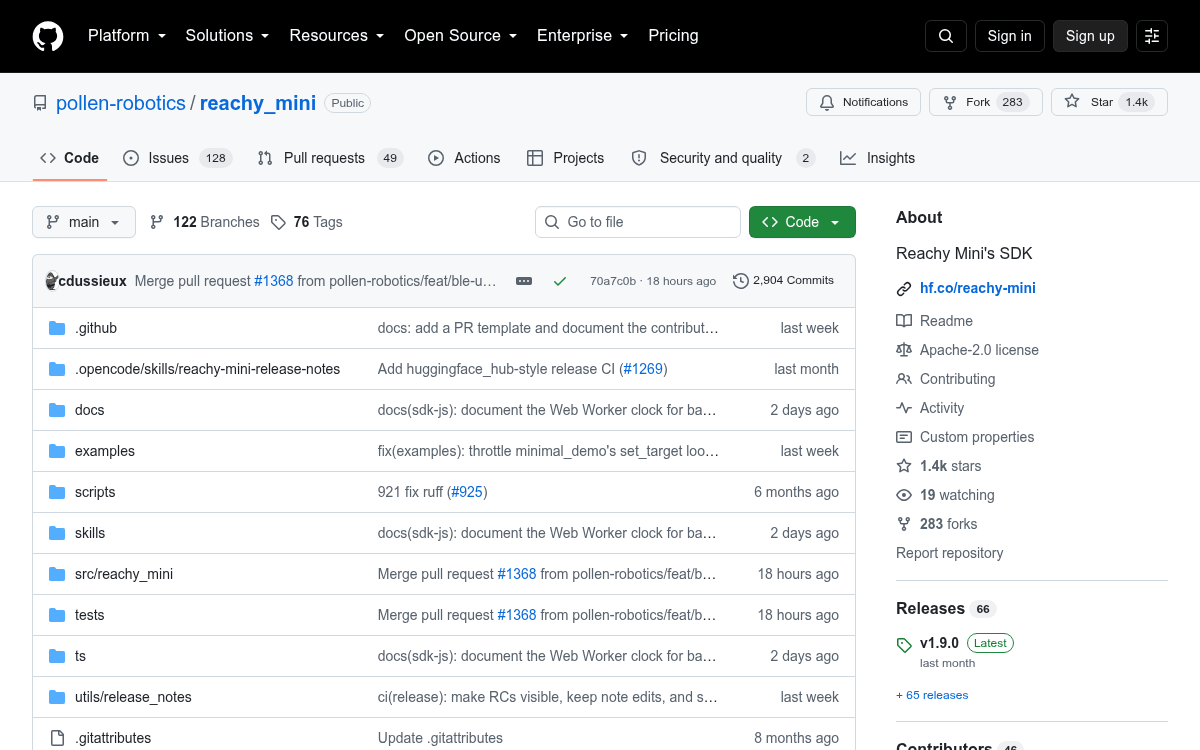
- Pollen Robotics open-sourced the Reachy Mini SDK under Apache 2.0 on GitHub.
- Python and JavaScript SDKs drive the robot via scripts or WebRTC from any browser.
- Supports three platforms: Wireless (RPi CM4), Lite (USB tethered), and MuJoCo simulation with no hardware.
- App ecosystem powered by Hugging Face Spaces with one-click install from the robot dashboard.
- Reachy Mini hardware starts at $299 Lite, $449 Wireless, with 6-DOF head and antennas.
- Ships an AGENTS.md file so Claude Code, Codex, or Copilot can scaffold new apps.
Pollen Robotics has published the official SDK for Reachy Mini, the expressive desktop robot it builds with Hugging Face. The repository is Apache 2.0 licensed, written in Python, and gives you everything needed to drive the hardware from scripts, browsers, or an AI coding agent, plus a MuJoCo simulator so you can start hacking before any parts arrive.
Hugging Face sells the robot starting at $299 for the lite version and $449 for the wireless model with onboard computer and battery. It stands 11 inches tall, with a 6-DOF moving head, 360 degree body rotation, a camera, microphones, speakers, and two expressive antennas. The SDK is the software layer that makes all of that programmable.
Inside the repo
The SDK ships as a Python package with a small, opinionated surface, covering scripts, control loops, and on-robot code. A minimal hello-world looks like this:
from reachy_mini import ReachyMini
from reachy_mini.utils import create_head_pose
with ReachyMini() as mini:
    mini.goto_target(
        head=create_head_pose(z=10, roll=15, degrees=True, mm=True),
        duration=1.0,
    )